Walking Liberty Half Dollar Value Chart by Year (1916–1947)
Catalog values, history, and authentication — walking liberty half dollar value.
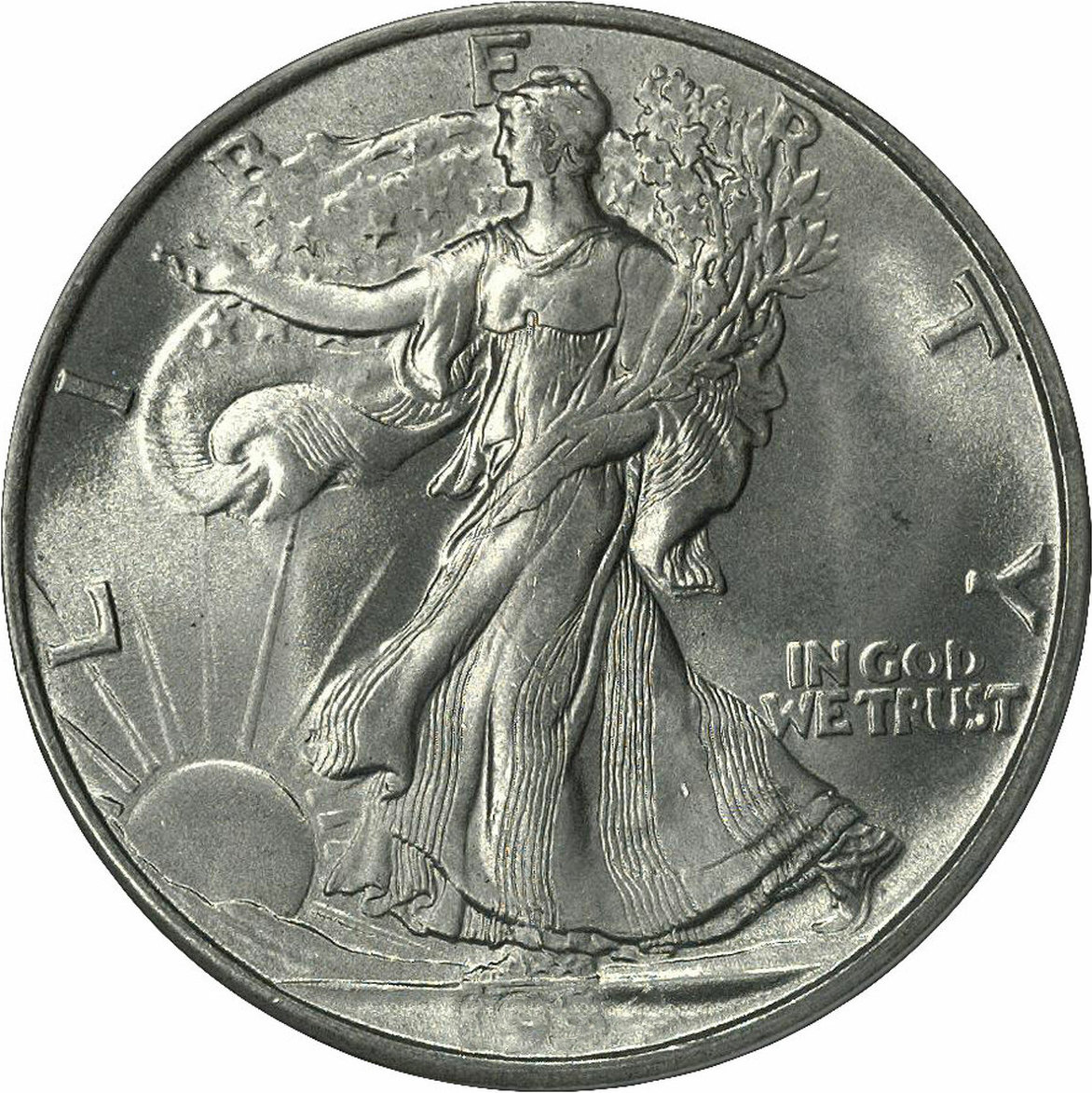
The Walking Liberty Half Dollar ran from 1916 through 1947 — 32 years and dozens of date-and-mintmark combinations, every one struck in 90% silver. That silver content (0.3617 troy oz per coin) puts a hard melt-value floor under even the most heavily worn common dates, while the series' genuine key dates command collector premiums that can reach six figures in high grade. This chart covers what every date is actually worth, which years to watch for, and how to grade a Walker in hand.
Full grade-by-grade pricing for the entire series lives on the Walking Liberty price guide. The history of the design — Adolph Weinman's Liberty striding toward the sunrise — is covered in the Walking Liberty Half Dollar history guide.
Three eras of the series
Collectors usually divide the Walking Liberty series into three production periods, each with its own mintage patterns and relative scarcity.
1916–1929: First issues and the key-date cluster
The series launched mid-year 1916 at all three operating mints — Philadelphia (no mintmark), Denver (D), and San Francisco (S). Because production started partway through the year, all three 1916 issues have relatively low mintages, and the 1916-S (508,000 struck) and 1916 Philadelphia (608,000) rank among the hardest coins to find in collectable condition. The 1921 trio — struck after a two-year production gap — are the most valuable dates in the entire series. Philadelphia produced only 246,000 in 1921; Denver only 208,000. Both are genuine rarities at any grade above AG.
Mintmarks on coins dated 1916 through 1917 appear on the obverse, below "IN GOD WE TRUST" near the bottom-left of Liberty's skirt. Starting in mid-1917 the mintmark moved to the reverse, below the eagle — where it stayed for the rest of the series. See our guide to reading mint marks if you're unsure where to look.
1934–1940: Post-Depression production resumes
No Walking Liberty halves were struck from 1922 through 1933. When production resumed in 1934, mintages rose substantially and most dates from this era are available as common-date silver at modest premiums over melt. The 1938-D is the notable exception: with only 491,600 struck, it is the lowest-mintage date of the post-resumption period and the one "semi-key" collectors specifically watch for in this stretch.
1941–1947: Wartime through the final year
Production surged during World War II as the half dollar saw heavy commercial use. Mintages for many 1941–1947 dates run into the tens of millions, making them the easiest and cheapest Walkers to acquire. Even well-worn examples carry intrinsic silver value, and lightly circulated specimens trade near melt with a small collector premium. The series ended in 1947; the Franklin Half Dollar replaced it the following year.
Key dates: value tables by grade
The seven dates below — the three 1916 issues, the 1921 trio, and the 1938-D — are the dates that move the needle most for Walking Liberty collectors. Values are pulled from the LuckyCoin catalog. For the full Sheldon-scale chart on each coin, visit the Walking Liberty price guide.
1916 Philadelphia (mintage: 608,000)
| Grade | Value | What this grade looks like |
|---|---|---|
| AG-3 | $40 | Date readable; design outline only |
| G-4 | $55 | Liberty's outline clear; major details flat |
| VG-8 | $75 | Some skirt and hand detail visible |
| F-12 | $110 | Skirt folds visible; hand details worn |
| VF-20 | $210 | Most details sharp; wear on high points |
| XF-40 | $260 | All details sharp; trace wear |
| AU-58 | $800 | Faintest wear; most luster intact |
| MS-63 | $1,300 | No wear; minor contact marks |
| MS-65 | $3,200 | Sharp strike; nearly mark-free |
| MS-66 | $7,000 | Exceptional preservation |
1916-D (mintage: 1,014,400)
| Grade | Value | What this grade looks like |
|---|---|---|
| AG-3 | $30 | Date readable; design outline only |
| G-4 | $55 | Liberty's outline clear; major details flat |
| VG-8 | $75 | Some skirt and hand detail visible |
| F-12 | $110 | Skirt folds visible; hand details worn |
| VF-20 | $160 | Most details sharp; wear on high points |
| XF-40 | $240 | All details sharp; trace wear |
| AU-58 | $700 | Faintest wear; most luster intact |
| MS-63 | $1,100 | No wear; minor contact marks |
| MS-65 | $2,600 | Sharp strike; nearly mark-free |
| MS-66 | $7,000 | Exceptional preservation |
1916-S (mintage: 508,000)
The 1916-S is the most challenging of the three first-year issues. Its mintage was the lowest of the trio and a higher proportion entered heavy circulation in the Western states. Survivors above VF-20 are scarce, and the jump to MS grades is dramatic.
| Grade | Value | What this grade looks like |
|---|---|---|
| AG-3 | $75 | Date readable; design outline only |
| G-4 | $100 | Liberty's outline clear; major details flat |
| VG-8 | $160 | Some skirt and hand detail visible |
| F-12 | $290 | Skirt folds visible; hand details worn |
| VF-20 | $600 | Most details sharp; wear on high points |
| XF-40 | $800 | All details sharp; trace wear |
| AU-58 | $2,400 | Faintest wear; most luster intact |
| MS-63 | $4,000 | No wear; minor contact marks |
| MS-65 | $9,000 | Sharp strike; nearly mark-free |
| MS-66 | $40,000 | Exceptional preservation |
1921 Philadelphia (mintage: 246,000)
The lowest-mintage Philadelphia Walker. Many were heavily worn before collectors recognized the date as scarce, so high-grade survivors are genuinely rare.
| Grade | Value | What this grade looks like |
|---|---|---|
| AG-3 | $110 | Date readable; design outline only |
| G-4 | $130 | Liberty's outline clear; major details flat |
| VG-8 | $240 | Some skirt and hand detail visible |
| F-12 | $400 | Skirt folds visible; hand details worn |
| VF-20 | $900 | Most details sharp; wear on high points |
| XF-40 | $2,100 | All details sharp; trace wear |
| AU-58 | $8,000 | Faintest wear; most luster intact |
| MS-63 | $11,000 | No wear; minor contact marks |
| MS-65 | $29,000 | Sharp strike; nearly mark-free |
| MS-66 | $60,000 | Exceptional preservation |
1921-D (mintage: 208,000)
The lowest absolute mintage of any Walking Liberty date. Demand from both type collectors and date-set builders keeps prices firm at every grade level. The spread from XF to AU is steep — fully original luster is exceptionally hard to find.
| Grade | Value | What this grade looks like |
|---|---|---|
| AG-3 | $160 | Date readable; design outline only |
| G-4 | $240 | Liberty's outline clear; major details flat |
| VG-8 | $390 | Some skirt and hand detail visible |
| F-12 | $700 | Skirt folds visible; hand details worn |
| VF-20 | $1,300 | Most details sharp; wear on high points |
| XF-40 | $3,900 | All details sharp; trace wear |
| AU-58 | $9,000 | Faintest wear; most luster intact |
| MS-63 | $13,000 | No wear; minor contact marks |
| MS-65 | $50,000 | Sharp strike; nearly mark-free |
| MS-66 | $120,000 | Exceptional preservation |
1921-S (mintage: 548,000)
Higher mintage than either 1921 Philadelphia or 1921-D, but the 1921-S is paradoxically the most expensive of the trio in grades above XF. Branch-mint Walker strikes of this era were often poorly centered and weakly struck through the centers, meaning sharp, well-struck MS examples are extraordinarily rare. The catalog values above VF reflect that survival challenge acutely.
| Grade | Value | What this grade looks like |
|---|---|---|
| AG-3 | $45 | Date readable; design outline only |
| G-4 | $55 | Liberty's outline clear; major details flat |
| VG-8 | $110 | Some skirt and hand detail visible |
| F-12 | $320 | Skirt folds visible; hand details worn |
| VF-20 | $900 | Most details sharp; wear on high points |
| XF-40 | $3,400 | All details sharp; trace wear |
| AU-58 | $21,000 | Faintest wear; most luster intact |
| MS-63 | $40,000 | No wear; minor contact marks |
| MS-65 | $130,000 | Sharp strike; nearly mark-free |
| MS-66 | $210,000 | Exceptional preservation |
1938-D (mintage: 491,600)
The only post-1933 semi-key in the series. Its mintage is low enough to generate meaningful collector premiums above circulated grades, but enough circulated examples exist that most collectors can acquire one without difficulty. It's frequently the last date needed to complete a circulated set of post-resumption Walkers.
| Grade | Value | What this grade looks like |
|---|---|---|
| AG-3 | $45 | Date readable; design outline only |
| G-4 | $55 | Liberty's outline clear; major details flat |
| VG-8 | $65 | Some skirt and hand detail visible |
| F-12 | $75 | Skirt folds visible; hand details worn |
| VF-20 | $100 | Most details sharp; wear on high points |
| XF-40 | $190 | All details sharp; trace wear |
| AU-58 | $400 | Faintest wear; most luster intact |
| MS-63 | $900 | No wear; minor contact marks |
| MS-65 | $1,700 | Sharp strike; nearly mark-free |
| MS-66 | $2,400 | Exceptional preservation |
Catalog snapshot. Coin markets move — for any transaction, check current dealer pricing and the live grade-by-grade chart.
Common dates: silver melt plus a small premium
Every Walking Liberty Half Dollar contains 0.3617 troy oz of silver. At any given spot price, that sets the absolute floor for a common-date Walker in any condition. Most 1941–1947 dates — and many 1934–1940 dates — trade at melt plus a small collector premium in circulated grades, typically ranging from melt up to two or three times melt for well-struck XF examples. See our pre-1965 silver coins guide for the full melt-value calculation and how junk-silver bags are typically priced relative to spot, or use the silver melt calculator to compute live values for a roll of Walkers in seconds.
Common-date uncirculated examples — MS-63 and above — do carry meaningful collector premiums beyond melt, particularly for well-struck, original-luster coins. But the day-to-day market for circulated common-date Walkers is driven primarily by the silver price.
How to grade a Walking Liberty Half Dollar
The highest points on the obverse are Liberty's left hand (raised toward the sunrise) and the folds of her skirt across her legs. These are the first areas to show wear. On the reverse, the eagle's breast and the tops of the wing feathers wear first.
A practical grading sequence for Walkers in hand:
- AG-3 / G-4:Date and design outline visible; Liberty's hand area is completely flat; major skirt folds merged.
- VG-8 / F-12:Skirt fold lines visible but merged at the high points; some separation returning to Liberty's fingers; eagle breast shows wear but primary feather groups distinct.
- VF-20 / XF-40:Most skirt folds sharp and separated; Liberty's fingers individuated; eagle breast feathers mostly sharp with only the highest tips showing contact.
- AU-50 / AU-58:Only the very tips of Liberty's hand and skirt show the faintest rub; mint luster present in protected areas and mostly intact across the fields.
- MS-63 and above: No wear anywhere; graded by the quantity and severity of contact marks, quality of strike, and originality of luster.
Weak strikes vs. actual wear — the branch-mint problem
This is the most common grading pitfall with Walking Liberty halves. Many branch-mint examples — particularly San Francisco issues from the 1920s and early 1930s — were struck from worn or improperly hubbed dies that left Liberty's hand and skirt center weakly defined straight out of the mint. A genuinely uncirculated coin with a weak center can look, at first glance, like a VF example with wear.
The diagnostic: check the fields and the rim. A weak strike still has sharp, flowing mint luster across the flat fields and crisp, unbroken rims. True wear produces a dull, gray, granular surface on the high points with luster break and flow lines interrupted. If the fields look original but the center detail is soft, you're almost certainly looking at strike weakness, not wear — and professional graders at PCGS and NGC consider strike quality alongside surface preservation when assigning a grade.
The 1921-S is the extreme example of this phenomenon, which is a large part of why its MS-65 and MS-66 values are so dramatically higher than its relatively higher mintage would suggest.
Where to find Walking Liberty Half Dollars
Common-date Walkers appear reliably in three places: estate-sale coin lots, junk-silver bags sold by weight at coin shows, and pre-1965 silver collections assembled by earlier generations. The key dates — the 1916 trio, the 1921 trio, and the 1938-D — almost never appear in junk-silver lots at melt prices; sellers who handle volume know what they have.
Two scenarios still produce occasional surprises:
- Inherited coin folders and albums.Whitman albums for Walking Liberty halves were popular through the 1960s, and many older collections sitting in attics were assembled when key dates were more accessible. Always check the 1916, 1921, and 1938 slots of any inherited Walker album before assuming it's all common dates.
- Mixed-lot estate purchases. Sellers unfamiliar with numismatics occasionally include a key-date Walker in a bag of assorted 90% silver priced by weight. Worth examining every coin in any junk-silver purchase rather than assuming uniform composition.
The US half dollar series overview covers where the Walking Liberty fits in the broader half-dollar collecting landscape, including its successors the Franklin Half Dollar and Kennedy Half Dollar.
Where the Walking Liberty fits in a half-dollar collection
The Walking Liberty is the first of three major 20th-century US half dollar designs. After 1947 the Franklin Half Dollar took over (1948–1963), followed by the Kennedy Half Dollar from 1964 to the present. All three series are tracked together on the US half dollars page.
For collectors building a complete Walking Liberty set, the conventional approach is to fill the common-date slots first — using junk-silver lots to knock out the 1941–1947 dates cheaply — and then budget separately for the key dates. The 1921-D and 1921-S are typically the last two acquired; both require four-figure budgets even in low circulated grades.
- How much silver is in a Walking Liberty Half Dollar?
- Every Walking Liberty Half Dollar struck from 1916 through 1947 contains 0.3617 troy oz of silver (the coin is 90% silver, 10% copper, weighing 12.5 grams total). Multiply the current silver spot price by 0.3617 to get the melt value of any Walker regardless of date.
- What is the rarest Walking Liberty Half Dollar?
- By mintage, the 1921-D at 208,000 struck is the rarest date. By catalog value in high grades, the 1921-S reaches the highest prices — MS-65 is listed at $130,000 and MS-66 at $210,000 in the LuckyCoin catalog — largely because a disproportionate share of 1921-S coins were weakly struck and fail to reach gem grade even when genuinely uncirculated.
- Where is the mintmark on a Walking Liberty Half Dollar?
- It depends on the year. On coins dated 1916 and early 1917, the mintmark is on the obverse, at the lower left near Liberty's skirt hem below "IN GOD WE TRUST." From mid-1917 onward, the mintmark moved to the reverse, at the lower left below the eagle and the "HALF DOLLAR" legend. Our mint mark guide has photos of both positions.
- Are common-date Walking Liberty halves worth collecting?
- Yes, for two reasons. First, every Walker carries intrinsic silver value (0.3617 oz) that gives it a hard floor regardless of condition. Second, higher-grade common-date examples — particularly well-struck MS-64 and MS-65 coins — carry meaningful collector premiums over melt and can appreciate with the broader silver-coin market. Many collectors build complete date-and-mintmark sets that require dozens of common-date coins alongside the key dates.
- How do I tell wear from a weak strike on a Walker?
- Look at the fields and the rim rather than the design's high points. Genuine wear breaks the mint luster on the highest surfaces and leaves a dull, slightly granular texture. A weak strike still shows flowing, original luster across the flat fields and a sharp, unbroken rim — the soft center detail is from the die, not from handling. When in doubt, have any key-date Walker authenticated and graded by PCGS or NGC before buying or selling.
- What replaced the Walking Liberty Half Dollar?
- The Franklin Half Dollar replaced the Walking Liberty design in 1948 and ran through 1963. It was followed by the Kennedy Half Dollar beginning in 1964. You can compare all three series on the US half dollars page.
- Should I clean a Walking Liberty Half Dollar before selling it?
- No. Cleaning silver coins — even gently with a soft cloth — leaves microscopic hairlines that grading services classify as "cleaned" or "details" grades, which sell at significant discounts to problem-free examples. Store Walkers as found, and submit any coin you believe is a key date to PCGS or NGC for authentication and grading before any transaction.