Walking Liberty Half Dollar: A Complete History (1916–1947)
Catalog values, history, and authentication — walking liberty half dollar.
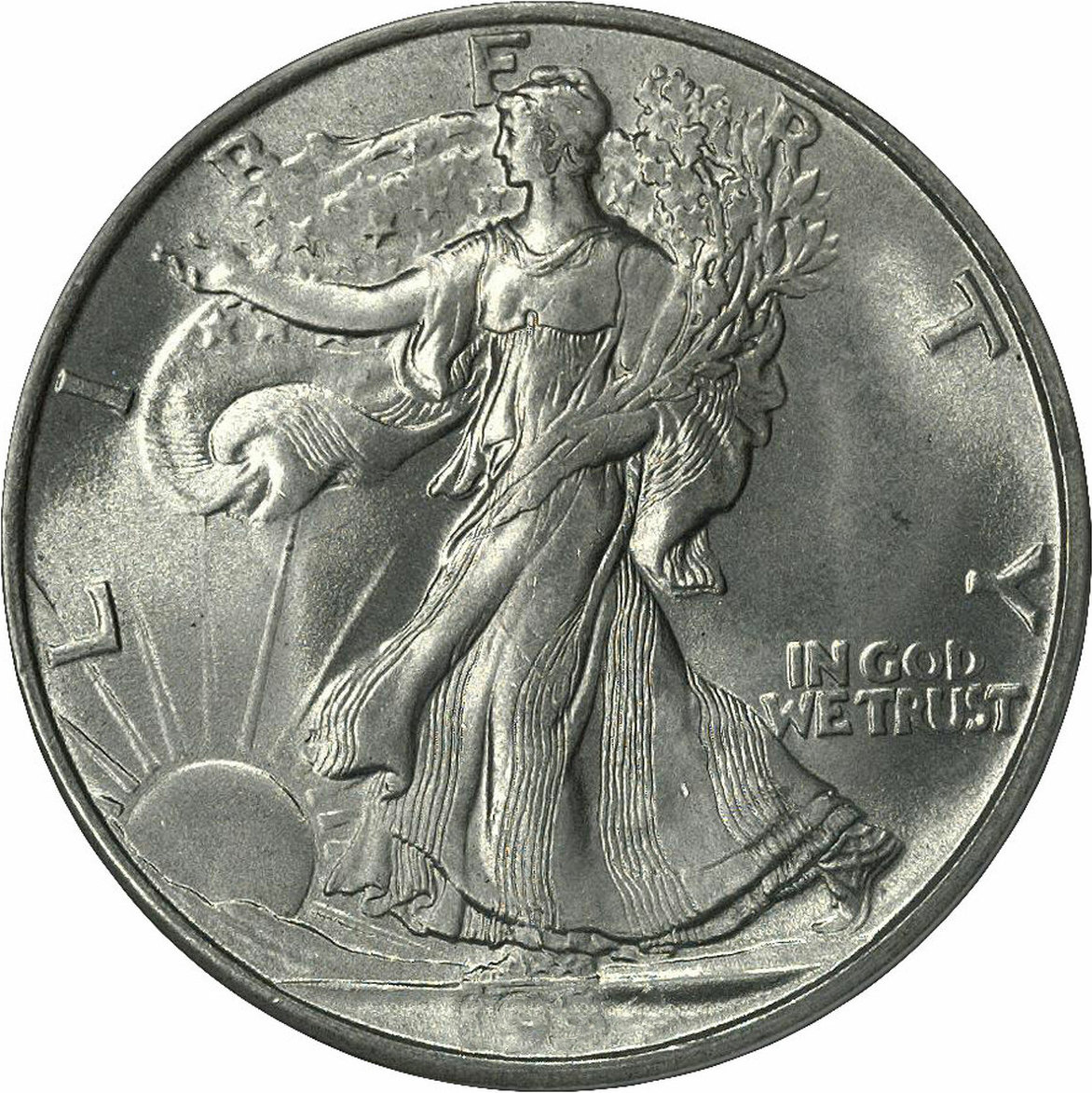
The Walking Liberty half dollar ran from 1916 through 1947 — thirty-one years of circulating coinage on which Adolph A. Weinman's Liberty strode confidently toward a rising sun, draped in the American flag. Collectors, curators, and casual observers have called it the most beautiful design ever placed on a US circulating coin, and the design's second life on the American Silver Eagle — still in production today — is the clearest evidence that the verdict has stuck.
This guide covers the full arc of the series: Weinman's background, what every element of the design means, how the series launched in 1916, the quirky mintmark migration of 1916–1917, the brutal low-mintage years of 1921, production through World War II, and the 1947 handoff to the Franklin half dollar. Value tables for the three key-date years — drawn from the LuckyCoin catalog — are included below.
Designer: Adolph A. Weinman
Adolph Alexander Weinman was born near Karlsruhe, Germany in 1870 and emigrated to the United States with his mother as a child. He attended evening classes at Cooper Union and later studied at the Art Students League of New York under Augustus Saint-Gaudens and Philip Martiny. Saint-Gaudens's influence on American coinage — the 1907 Saint-Gaudens double eagle is the most famous result — shaped an entire generation of coin designers. Weinman absorbed Saint-Gaudens's commitment to high-relief, classically inspired imagery and applied it directly to his two 1916 coin commissions: the Walking Liberty half dollar and the Mercury (Winged Liberty) dime.
Both coins emerged from the same design competition held in 1915–1916, when the Treasury sought to replace the Barber-era designs that had occupied the dime, quarter, and half dollar since 1892. Charles Barber's designs were competent but uninspired by the standards of the Progressive Era aesthetic reform movement. Weinman won both the dime and half dollar competitions; Hermon MacNeil won the quarter with his Standing Liberty design. Together the three new coins represented the second great wave of US coinage beautification after the Saint-Gaudens gold coins of 1907–1908.
Design symbolism
The obverse shows Liberty in full stride, moving left toward a rising sun on the horizon. Her right hand reaches forward; her left arm holds branches of laurel and oak — traditional symbols of civil and military glory. The American flag is draped over her left shoulder and billows behind her. "IN GOD WE TRUST" appears above; "LIBERTY" arcs at the top; the date sits below. The overall composition conveys forward motion, optimism, and national confidence — qualities the country was projecting as it watched World War I unfold in Europe.
The reverse depicts a American bald eagle perched on a rocky mountain crag, wings spread. A small pine sapling grows from a crack in the rock at the eagle's feet — often read as a symbol of the young nation's growth from rugged beginnings. The eagle's posture is more alert and naturalistic than the heraldic eagles typical of earlier US coinage, reflecting Weinman's classical training. "E PLURIBUS UNUM" and "UNITED STATES OF AMERICA" complete the reverse legend.
1916 launch: replacing the Barber half dollar
The first Walking Liberty halves were struck at Philadelphia in 1916 with a mintage of just 608,000 — a small initial run as the Mint transitioned dies and production equipment. San Francisco and Denver also struck the design in 1916, with the mintmark appearing on the obverse below "IN GOD WE TRUST." The Barber half dollar it replaced had run since 1892; the contrast between the two designs was immediately noticed by the press and the collecting public.
The 1916 Philadelphia issue is a collector key date. With only 608,000 struck and the usual attrition from circulation, survivors in any condition carry meaningful premiums. Values from the LuckyCoin catalog:
| Grade | Approximate Value | What this grade looks like |
|---|---|---|
| AG-3 | $40 | Heavily worn; design outline visible, date legible |
| G-4 | $55 | Liberty's outline clear; major details flat |
| VG-8 | $75 | Some gown and eagle detail visible; full rim |
| F-12 | $110 | Most design detail present; high points worn smooth |
| VF-20 | $210 | Most details sharp; light wear on Liberty's hand and eagle's breast |
| XF-40 | $260 | All details sharp; trace wear on highest points only |
| AU-55 | $400 | Slight wear on high points; most luster intact |
| AU-58 | $800 | Faintest wear; original mint luster nearly complete |
| MS-63 | $1,300 | No wear; minor contact marks; good luster |
| MS-64 | $1,900 | Sharp strike; few distracting marks |
| MS-65 | $3,200 | Gem: strong luster, minimal marks |
| MS-66 | $7,000 | Exceptional preservation; near-perfect surfaces |
Catalog snapshot. For the full grade-by-grade chart and current sold listings, see the Walking Liberty half dollar coin page.
Series quirk: the traveling mintmark
In 1916 and for part of 1917, the mintmark for Denver and San Francisco issues appeared on the obverse, just below "IN GOD WE TRUST" at the left. Partway through 1917, the Mint moved the mintmark to thereverse, at the lower left of the design near the eagle's tail feathers — where it stayed for the rest of the series through 1947.
This creates a genuine variety distinction: 1916-D, 1916-S, 1917-D obverse, and 1917-S obverse coins all carry the mintmark on the front, while 1917-D reverse, 1917-S reverse, and all subsequent issues carry it on the back. If you're hunting mintmarks on Walking Liberties, our guide to reading mint marks explains exactly where to look by year.
The 1921 famine: the series' lowest-mintage years
After strong wartime production (more on that below), the postwar economic slowdown caused a dramatic reduction in half dollar demand. The Mint struck Walking Liberty halves at only two facilities in 1921 — Philadelphia and Denver — with San Francisco sitting out entirely. The results were the two lowest-mintage dates in the entire series: 246,000 at Philadelphia and 208,000 at Denver. Both are genuine key dates commanding prices well above most other Walking Liberty issues.
1921 Philadelphia values
| Grade | Approximate Value | What this grade looks like |
|---|---|---|
| AG-3 | $110 | Heavily worn; Liberty's outline and date readable |
| G-4 | $130 | Major design elements present; fine detail gone |
| VG-8 | $240 | Some gown and flag detail; full rim |
| F-12 | $400 | Most detail visible; high points worn flat |
| VF-20 | $900 | Crisp details; light wear on Liberty's hand and eagle |
| XF-40 | $2,100 | Nearly full detail; trace wear on highest relief |
| AU-50 | $3,200 | Slight wear; significant luster remaining |
| AU-55 | $5,000 | Minimal wear; luster mostly intact |
| AU-58 | $8,000 | Faintest friction; nearly full original luster |
| MS-63 | $11,000 | No wear; some contact marks; full luster |
| MS-64 | $13,000 | Sharp strike; few distracting marks |
| MS-65 | $29,000 | Gem surfaces; exceptional luster and strike |
| MS-66 | $60,000 | Finest known tier; virtually perfect |
1921-D Denver values
| Grade | Approximate Value | What this grade looks like |
|---|---|---|
| AG-3 | $160 | Heavily worn; outline and date legible |
| G-4 | $240 | Design visible but flat; mintmark present |
| VG-8 | $390 | Some gown folds; full rim |
| F-12 | $700 | Most detail present; significant high-point wear |
| VF-20 | $1,300 | Sharp details; light wear on highest points |
| XF-40 | $3,900 | Nearly full detail; trace wear only |
| AU-50 | $6,000 | Slight wear; strong luster in protected areas |
| AU-55 | $8,000 | Minimal wear; luster nearly complete |
| AU-58 | $9,000 | Faintest friction; nearly full original luster |
| MS-63 | $13,000 | No wear; moderate contact marks; full luster |
| MS-64 | $21,000 | Few distracting marks; sharp strike |
| MS-65 | $50,000 | Gem: exceptional surfaces and luster |
| MS-66 | $120,000 | Finest known tier; near-flawless |
Catalog snapshot. Coin markets move — for current pricing and live sold data, check the Walking Liberty coin page.
The 1921-D is notably scarcer than the 1921-P in high grades. The Denver Mint's striking quality in 1921 was inconsistent, and weakly struck examples — particularly on Liberty's hand and the eagle's breast feathers — are common even on technically uncirculated coins. A sharply struck 1921-D in MS-64 or better is genuinely rare and commands significant premiums over catalog levels at auction.
Wartime production: Walking Libertys through World War II
Unlike some US coin series interrupted by wartime metal demands, the Walking Liberty half dollar ran continuously through both world wars. Mintages fluctuated with economic conditions but the design never paused. During World War II, the Mint struck hundreds of millions of half dollars across all three active facilities — Philadelphia, Denver, and San Francisco — to meet the demand created by wartime wage growth and retail activity. Dates from 1941 through 1945 are common in circulated grades and affordable for type collectors, though well-struck gem examples can still be elusive.
The wartime halves used the standard 90% silver composition throughout — unlike the wartime nickels, which received a silver-manganese alloy change in 1942. Every Walking Liberty half dollar ever struck is 90% silver and 10% copper, giving even a heavily circulated example meaningful bullion content. See our guide to pre-1965 silver coins for how to calculate the silver value of any Walking Liberty in your collection.
1947: end of the run, and the coin's second life
The Walking Liberty half dollar was struck for the last time in 1947. Congress authorized a redesign to honor Benjamin Franklin, and the Franklin half dollar debuted in 1948. The transition was straightforward — no controversy, no public outcry, just a scheduled changeover. Weinman's design was retired to the archive.
It did not stay there permanently. When the United States Mint launched the American Silver Eagle bullion program in 1986, it selected Weinman's Walking Liberty obverse as the face of the new coin — the greatest posthumous compliment an American coin design can receive. The reverse was updated (John Mercanti, then a Mint engraver and later the 12th Chief Engraver, designed the heraldic eagle reverse used on the Silver Eagle from 1986 through 2021), but Liberty striding toward the sunrise has appeared on every American Silver Eagle struck since 1986. The design is, in that sense, still in active production nearly eight decades after Weinman first drew it.
Why collectors love this series
The Walking Liberty series attracts three distinct types of collectors. Type collectors want a single example of the design — typically a common date like a 1941 or 1942 Philadelphia issue in VF or XF, which can be acquired for modest premiums over silver melt. Date-and-mintmark collectors building a complete Walking Liberty set face 65 collectible issues across three mints, with the 1921 and 1921-D as the undisputed keys and several semi-keys (1916, 1917-S obverse, 1938-D) requiring meaningful budgets. Strike quality collectors chase the series for a different reason: because so many Walking Libertys were weakly struck — particularly on Liberty's left hand and thumb, which are the traditional grading focal points — a sharply struck example of even a common date stands out dramatically.
The series also offers an unbroken window into American life from 1916 through 1947: the coins were in pockets during both world wars, the Roaring Twenties, the Great Depression, and the postwar boom. That historical continuity, combined with what many consider the finest artistic design in US coinage history, keeps demand steady across generations of collectors.
Where to go next
If you're building a type set of US half dollars, the Walking Liberty sits between the Barber half dollar (1892–1915) and the Franklin half dollar (1948–1963) in the sequence. All three are 90% silver. All three are documented in detail on LuckyCoin with grade-by-grade values, mintage figures, and variety notes. The American Silver Eagle, which carries the Walking Liberty obverse forward into the modern era, rounds out the story.
- What years were Walking Liberty half dollars made?
- The Walking Liberty half dollar was struck from 1916 through 1947, a run of 32 years across three mints: Philadelphia (no mintmark), Denver (D), and San Francisco (S). The design was then revived for the American Silver Eagle bullion coin starting in 1986.
- What is a Walking Liberty half dollar worth?
- Value depends heavily on date, mintmark, and grade. Common dates from the 1940s in circulated condition trade close to their 90% silver melt value. Key dates are far more valuable: a 1916 Philadelphia in Good (G-4) catalogs at $55; a 1921 in Good catalogs at $130; a 1921-D in Good catalogs at $240. In gem uncirculated grades, the 1921 reaches $29,000 and the 1921-D reaches $50,000 at MS-65.
- What are the key dates in the Walking Liberty series?
- The two primary key dates are the 1921 (Philadelphia, 246,000 minted) and 1921-D (Denver, 208,000 minted). Important semi-keys include the 1916 Philadelphia (608,000 minted), the 1917-S obverse mintmark, and the 1938-D. All command premiums well above common Walking Liberty dates.
- Are Walking Liberty half dollars silver?
- Yes. Every Walking Liberty half dollar struck from 1916 through 1947 is composed of 90% silver and 10% copper. Each coin contains 0.3617 troy ounces of pure silver. See our guide to pre-1965 silver coins for the full silver content breakdown and how to calculate melt value at any spot price.
- Where is the mintmark on a Walking Liberty half dollar?
- It depends on the year. In 1916 and part of 1917, the D and S mintmarks appeared on the obverse below "IN GOD WE TRUST." From mid-1917 onward, the mintmark moved to the reverse at the lower left near the eagle's tail feathers. Philadelphia issues (no mintmark) were never marked. Our guide on how to read mint marks covers the exact locations by year.
- Who designed the Walking Liberty half dollar?
- Adolph A. Weinman, a German-born American sculptor who trained under Augustus Saint-Gaudens. Weinman won the 1915–1916 design competition for both the half dollar and the Mercury dime. His Walking Liberty obverse was later selected for the American Silver Eagle bullion coin in 1986, where it remains in use today.
- Should I clean my Walking Liberty half dollar?
- No. Cleaning silver coins — even gently — leaves microscopic hairlines that professional graders identify immediately, and cleaned coins are labeled "details" grades by PCGS and NGC, cutting their market value significantly. Store as found. For any coin you suspect is a key date or high-grade example, submit to PCGS or NGC for authentication before attempting any conservation.