Standing Liberty Quarter: A Short, Beautiful Run (1916–1930)
Catalog values, history, and authentication — standing liberty quarter.
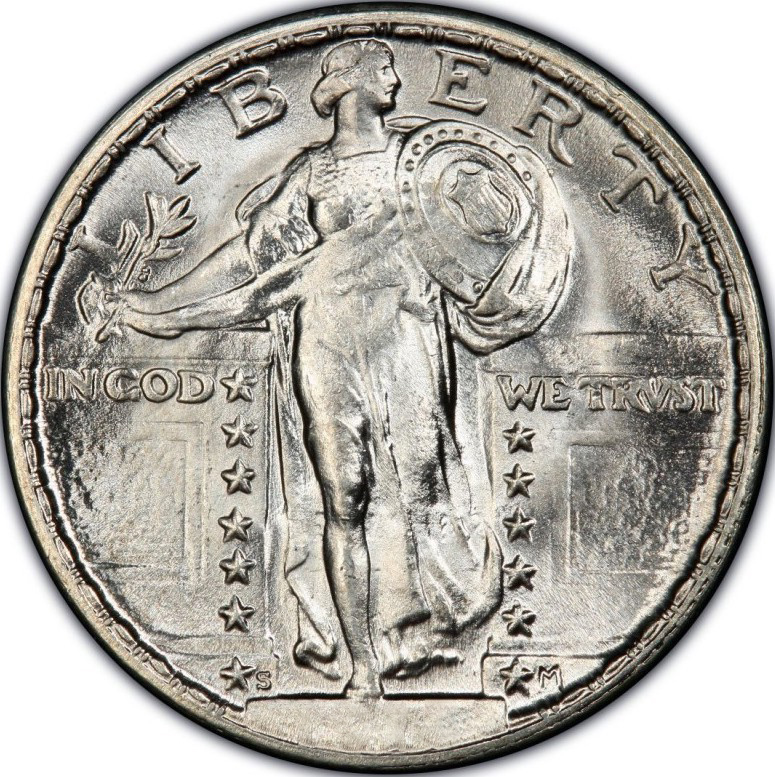
The Standing Liberty Quarter had only fifteen years on circulating American coinage — 1916 through 1930 — yet it produced two of the most striking quarter designs in US Mint history and at least two of the most studied rarities in the series. The design replaced the Barber Quarter and was itself replaced by the Washington Quarter. In between, sculptor Hermon MacNeil created something that collectors still argue is the most artistically ambitious American quarter ever struck.
This guide covers the history of the design, the two major types and why Type 1 was pulled after barely a year, the 1916 key date and what it is actually worth at every grade, the famous 1918/7-S overdate, the date-wear problem that led to a mid-series redesign, and what to watch for if you are building a set.
Designer Hermon MacNeil and the ‘Renaissance of American Coinage’
By the early 1910s the US Mint had already seen what an outside sculptor could do: Augustus Saint-Gaudens had transformed the double eagle and eagle in 1907, and James Earle Fraser's Buffalo Nickel had debuted in 1913. Treasury Secretary William McAdoo pushed for the same treatment on the quarter and half dollar. Hermon Atkins MacNeil, a respected American sculptor known for his monumental works, won the quarter commission in 1915.
MacNeil's design showed Liberty in full stride, stepping through a gateway between two walls, her right hand holding an olive branch and her left arm raised supporting a shield. The imagery is often read as America emerging to face the world on the eve of potential involvement in World War I — a guardian prepared for both peace and defense. The reverse depicted a flying eagle in high relief, a deliberate echo of Saint-Gaudens's work.
Type 1 (1916–1917): the exposed-bust design
MacNeil's original design left Liberty's right breast exposed — consistent with classical sculptural tradition and with how Liberty had been depicted on earlier American coins. The first coins struck under this design were the tiny 1916 Philadelphia issue and the more common 1917 coins from Philadelphia, Denver, and San Francisco.
Public reaction was sharp. A segment of the press and some members of Congress objected to the exposed figure on a circulating coin. By mid-1917 the Mint had recalled MacNeil and instructed him to modify the design. The resulting change covered Liberty with a coat of chain mail, transforming the classical figure into something more martial. MacNeil also used the opportunity to make other adjustments: the stars on the reverse were rearranged and three stars were added below the eagle. The revised design is known as Type 2.
Type 2 (1917–1930): chain mail and a recessed date
Type 2 ran from late 1917 through the end of the series in 1930 and accounts for the large majority of Standing Liberty Quarters by mintage. Within Type 2, collectors recognize a further distinction: coins struck from 1917 through 1924 have a flat, raised date in the same high-relief field as the rest of the design, while coins from 1925 onward have the date recessed into a concave pocket in the coin's field. That recessed date is sometimes called Type 3 informally, though major grading services generally treat it as a variant within the Type 2 design rather than a separate type.
The reason for the recess was purely practical. The date on the original design sat on one of the highest points of the relief and wore away first. By the early 1920s, dealers and collectors were routinely encountering coins where Lincoln's features were still relatively sharp but the date had completely disappeared — making them impossible to attribute. The 1925 recess solved the problem for the remaining years of the series.
The 1916: only 52,000 struck
The 1916 Philadelphia issue is the headline rarity of the entire series. The Mint struck only 52,000 coins before the calendar turned to 1917, and many of those entered circulation immediately. Survival in collectible condition is low — the coin was spent as pocket change in the years before it was recognized as scarce, and the high-relief design meant that even brief circulation produced meaningful wear.
Values below are from the LuckyCoin catalog. The full grade-by-grade chart lives on the Standing Liberty Quarter coin page.
| Grade | Approximate Value | What this grade looks like |
|---|---|---|
| AG-3 | $2,600 | Heavily worn; outline of Liberty visible; date readable |
| G-4 | $3,200 | Major details flat; rim complete; design identifiable |
| VG-8 | $5,000 | Some shield and gown detail visible; full rim |
| F-12 | $6,000 | Most design elements distinct; high points worn smooth |
| VF-20 | $8,000 | Most details sharp; wear on Liberty's head and shield |
| XF-40 | $9,000 | All details sharp; trace wear on highest relief points |
| AU-50 | $11,000 | Slight wear on the very highest points; most luster present |
| AU-55 | $11,000 | Faint wear; nearly full luster |
| AU-58 | $12,000 | Trace wear only; original mint luster mostly intact |
| MS-60 | $13,000 | No wear; noticeable contact marks or bag marks |
| MS-63 | $17,000 | No wear; scattered light marks; attractive surfaces |
| MS-64 | $21,000 | Minor blemishes; above-average strike and luster |
| MS-65 | $26,000 | Strong strike, nearly mark-free, full luster |
| MS-66 | $37,000 | Exceptional preservation; only trivial imperfections |
| MS-67 | $70,000 | Near-perfect; top of the surviving population |
Catalog snapshot. Coin markets move — for any transaction, check current dealer pricing and the live grade-by-grade chart.
The 1918/7-S overdate
The 1918/7-S is the most celebrated error in the Standing Liberty series. A 1917-dated working die was re-engraved or re-hubbed with a 1918 date, leaving traces of the underlying “7” visible beneath the “8” in the date. The coin was struck at the San Francisco Mint and circulated normally — it was only later that collectors examining the date under magnification recognized the undertype.
The 1918/7-S is significantly scarcer than a normal 1918-S and commands a substantial premium at every grade. It is considered one of the two or three most important coins in the series after the 1916. Catalog pricing for the 1918/7-S is not included in this article's data block — consult the Standing Liberty Quarter series page for current values.
The date-wear problem and the 1925 recessed date
MacNeil's high-relief design placed the date at the base of Liberty's skirts, in an area of the coin that contacted surfaces in pocket and purse wear first. Coins from the 1917–1924 period with fully legible dates are notably harder to find in lower circulated grades than the designs suggest — the shield and gown details might grade VG or Fine while the date had completely worn flat. A dateless Standing Liberty Quarter cannot be attributed and is worth only its silver melt value.
The Mint's 1925 solution — sinking the date into a recessed well in the field — was effective. Post-1924 coins retain legible dates far more reliably at equivalent wear levels. Collectors building a complete date-and-mintmark set will find the 1917–1924 issues in problem-free condition generally harder to source than their mintage figures alone would suggest.
The series runs on 90% silver, the same composition as every US quarter struck before 1965. See our guide to pre-1965 silver coins for melt value context across the series.
1930: replaced by the Washington Quarter
The Standing Liberty Quarter's run ended in 1930 when Congress authorized a new design to commemorate the 200th anniversary of George Washington's birth. The Washington Quarter debuted in 1932 — there were no quarters struck in 1931 — and ran in various forms through the rest of the twentieth century and into the twenty-first. See our guide to the 1932-D Washington Quarter, the key date of that series, for comparison.
The two-year gap between the last Standing Liberty (1930) and the first Washington (1932) reflects both the production hiatus and the fact that Treasury had large existing stocks of quarters on hand during the early Depression.
Why this series rewards close attention
The Standing Liberty series spans only twenty-two date-and-mintmark combinations across fifteen calendar years — short enough that a complete set is a realistic goal for a dedicated collector, but with enough genuine challenges to make completion satisfying. The 1916 is the obvious headline, but the series also includes scarce San Francisco issues from the early 1920s, the 1918/7-S overdate, and the consistent challenge of finding dateless coins correctly attributed. Strike quality varies noticeably across the run, and full-head designation — where Liberty's helmet shows all its detail — commands a further premium on higher-grade examples.
For the broader context of US quarter collecting, the Washington Quarter Value Chart and the full quarters series index on LuckyCoin are good next stops.
- What is the difference between Type 1 and Type 2 Standing Liberty Quarters?
- Type 1 (1916–early 1917) shows Liberty with an exposed right breast, consistent with classical sculptural tradition. After public criticism, designer Hermon MacNeil revised the design to cover Liberty with a chain-mail breastplate. That revised design, Type 2, ran from mid-1917 through 1930. Type 1 coins carry a premium over comparable Type 2 dates, though the 1916 dominates the Type 1 market by a wide margin.
- How many 1916 Standing Liberty Quarters were minted?
- 52,000 — all struck at the Philadelphia Mint with no mintmark. That makes it one of the lowest-mintage twentieth-century quarters in the regular series. Most entered circulation immediately and wore quickly given the high-relief design, so survivors in collectible condition are genuinely scarce.
- What is a 1916 Standing Liberty Quarter worth?
- Catalog values range from $2,600 in AG-3 (heavily worn, date barely readable) to $3,200 in G-4, $6,000 in F-12, $9,000 in XF-40, and $17,000 in MS-63. Top-grade MS-67 examples reach $70,000. These are catalog figures — actual transaction prices vary with the market. For any purchase, verify current dealer pricing and insist on a PCGS or NGC slab above a few hundred dollars.
- Why do so many Standing Liberty Quarters have no date?
- The date sat at one of the highest points of the relief design on the 1916–1924 issues, so it was the first detail to wear flat in circulation. Coins that otherwise grade Good or VG can have a completely illegible date. The Mint corrected this in 1925 by recessing the date into the field, where it is protected from surface contact. Dateless examples are worth only their silver content and cannot be attributed to a specific year.
- What is the 1918/7-S overdate?
- The 1918/7-S is a die variety where traces of a “7” are visible beneath the “8” in the date, indicating that a 1917-dated die was reused or re-hubbed with a 1918 date. It was struck at the San Francisco Mint and is considered one of the most important rarities in the Standing Liberty series after the 1916. Authentication by PCGS or NGC is essential — the overdate is confirmed under magnification by the undertype digit.
- Are Standing Liberty Quarters silver?
- Yes. Every Standing Liberty Quarter (1916–1930) is struck in 90% silver and 10% copper, the same composition as all US quarters before the 1965 coinage-metal change. See our guide to pre-1965 silver coins for current melt values based on the silver spot price.
- How hard is it to complete a full Standing Liberty Quarter set?
- The series has twenty-two major date-and-mintmark combinations — manageable in scope compared with a full Lincoln cent or Mercury Dime set. The obstacles are the 1916 (expensive at every grade), several scarce early San Francisco dates, the 1918/7-S overdate if you include varieties, and the challenge of finding clean examples of the dateless-prone 1917–1924 issues. Most collectors budget the 1916 as a long-term acquisition and build the rest of the set first.