Washington Quarter Value Chart by Year (1932–Today)
Catalog values and authentication details — washington quarter value.
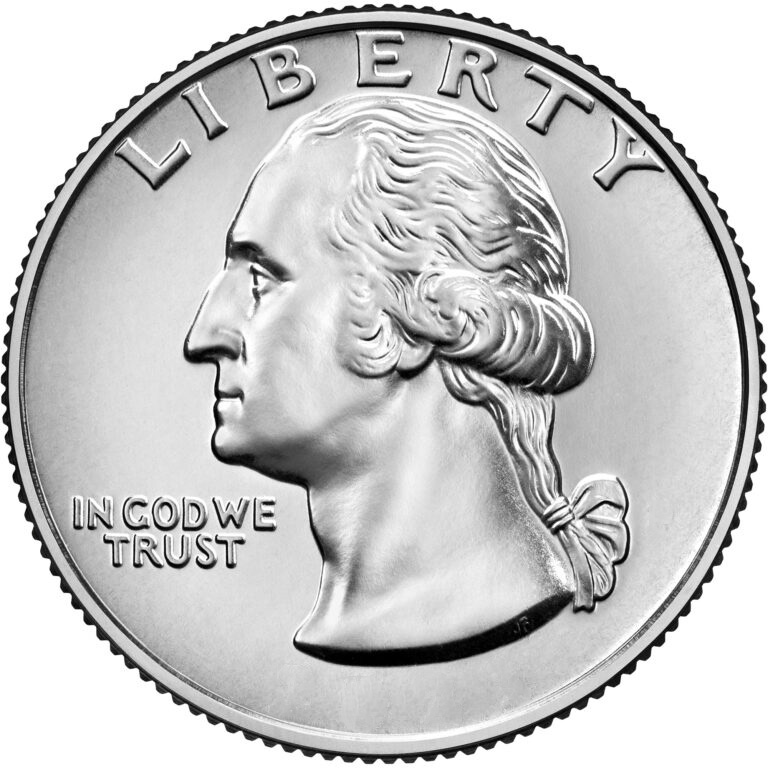
The single most important thing to know about Washington quarters: quarters dated 1964 and earlier are 90% silver; quarters dated 1965 and later are clad copper-nickel. That one dividing line creates two completely different value tiers. A common 1955 quarter in worn condition is worth several times its face value purely on silver content. The same-grade 1966 quarter is worth exactly twenty-five cents.
This chart covers all three eras of the Washington quarter: the silver era (1932–1964) with its key dates and bullion floor, the clad commons era (1965–1998), and the modern program era (1999–present) where a handful of low-mintage issues and errors attract real collector premiums. Values are pulled from the LuckyCoin catalog; the full grade-by-grade breakdown lives on the Washington quarter price guide.
Era 1: Pre-1965 silver quarters (1932–1964)
Every Washington quarter struck before 1965 contains 0.1808 troy ounces of pure silver. That silver content sets a hard floor on value regardless of grade — even a heavily worn example is worth at least the current spot price of silver multiplied by 0.1808. To calculate today's floor, multiply the live silver spot price (per troy ounce) by 0.1808. Any collector premium sits on top of that floor.
Most silver-era Washington quarters are common dates worth a modest premium over melt. The exceptions are the two 1932 key dates and a handful of low-mintage semi-keys from the 1930s and 1950s. For help finding the mintmark on any of these coins, see our guide on how to read mint marks.
Key-date value table: the coins that matter most
The three entries below represent the dates most likely to be significantly underpriced in an uninformed sale. If you find any of these in a collection, price them carefully before trading or selling.
1932-D Washington Quarter — mintage: 436,800
The 1932-Dis the rarest business-strike Washington quarter ever made. Denver produced fewer than half a million examples in the series' inaugural year, and most circulated heavily — genuine Mint State examples are genuinely scarce. At MS-66 the catalog value reaches $90,000.
| Grade | Catalog Value | What this grade looks like |
|---|---|---|
| G-4 | $75 | Washington's outline clear; motto legible; flat details |
| VG-8 | $80 | Hair lines visible above ear; full rim |
| F-12 | $100 | Most hair detail visible; high points worn smooth |
| VF-20 | $130 | Details sharp; light wear on cheekbone and hair |
| XF-40 | $210 | All details sharp; trace wear on highest points only |
| AU-50 | $320 | Slight wear on high points; luster breaking |
| AU-58 | $800 | Faintest wear; nearly full mint luster |
| MS-60 | $1,100 | No wear; heavy bag marks or contact marks |
| MS-63 | $1,600 | No wear; scattered marks; acceptable luster |
| MS-64 | $2,600 | Minor distracting marks; above-average strike |
| MS-65 | $11,000 | Strong strike; few marks; full luster |
| MS-66 | $90,000 | Exceptional preservation; near-perfect surfaces |
1932-S Washington Quarter — mintage: 408,000
The San Francisco companion to the 1932-D is even lower in mintage — 408,000 pieces — yet in Mint State it is actually a bit more available than the 1932-D, because more 1932-S examples were set aside at issue. In circulated grades the two are roughly comparable in rarity; in MS grades the 1932-D is the harder of the pair. Both coins are genuine key dates and command substantial premiums over melt at every grade.
| Grade | Catalog Value | What this grade looks like |
|---|---|---|
| G-4 | $70 | Washington's outline clear; motto legible; flat details |
| VG-8 | $80 | Hair lines visible above ear; full rim |
| F-12 | $90 | Most hair detail visible; high points worn smooth |
| VF-20 | $120 | Details sharp; light wear on cheekbone and hair |
| XF-40 | $160 | All details sharp; trace wear on highest points only |
| AU-50 | $210 | Slight wear on high points; luster breaking |
| AU-58 | $290 | Faintest wear; nearly full mint luster |
| MS-60 | $370 | No wear; heavy bag marks or contact marks |
| MS-63 | $700 | No wear; scattered marks; acceptable luster |
| MS-64 | $1,000 | Minor distracting marks; above-average strike |
| MS-65 | $2,900 | Strong strike; few marks; full luster |
| MS-66 | $50,000 | Exceptional preservation; near-perfect surfaces |
1937-D Washington Quarter — mintage: 7,189,600
With over seven million struck, the 1937-D is technically a common date — but it illustrates the silver melt floor at work. In every grade from G-4 through AU-58 the catalog value sits in the low teens to mid-double digits, reflecting bullion value plus a small collector premium. The jump from MS-65 ($160) to MS-67 ($800) shows how condition rarity creates premiums even on otherwise common dates.
| Grade | Catalog Value | What this grade looks like |
|---|---|---|
| G-4 | $12.50 | Washington's outline clear; flat details |
| VG-8 | $12.50 | Hair lines visible; full rim |
| F-12 | $12.50 | Most hair detail visible |
| VF-20 | $12.50 | Details sharp; light wear on highest points |
| XF-40 | $19 | All details sharp; trace wear only |
| AU-50 | $40 | Slight wear; luster breaking |
| AU-58 | $65 | Faintest wear; nearly full luster |
| MS-60 | $75 | No wear; heavy contact marks |
| MS-63 | $100 | No wear; scattered marks |
| MS-64 | $110 | Minor distracting marks |
| MS-65 | $160 | Strong strike; few marks; full luster |
| MS-66 | $260 | Exceptional surfaces |
| MS-67 | $800 | Near-perfect; top of population range |
1955-D Washington Quarter — mintage: 3,182,400
The 1955-D is the lowest-mintage Washington quarter of the 1950s and a genuine semi-key date. In circulated grades through AU-58 it trades close to melt ($12.50), but condition rarity creates a dramatic jump at the top: MS-67 catalog value is $10,000. If you find a sharply struck, original-luster 1955-D quarter, it's worth having professionally graded.
| Grade | Catalog Value | What this grade looks like |
|---|---|---|
| G-4 through AU-58 | $12.50 | Worn to nearly full luster; bullion-floor range |
| MS-60 through MS-63 | $12.50 | No wear; moderate to light contact marks |
| MS-64 | $26 | Minor distracting marks |
| MS-65 | $55 | Strong strike; few marks; full luster |
| MS-66 | $110 | Exceptional surfaces |
| MS-67 | $10,000 | Condition rarity; near the top of the population |
1964-D Washington Quarter (last silver year) — mintage: 704,135,528
The 1964-D is the most common Washington quarter ever struck — over 704 million pieces — and in any circulated grade it's worth spot silver and nothing more ($12.50 catalog in G-4 through MS-63). Its significance is as the last year of silver composition. Any Washington quarter dated 1964 or earlier is 90% silver. The 1964-D is also notable for condition rarity at the top of the scale: MS-68 catalog value is $40,000, reflecting how rarely these heavily circulated coins survived in gem condition.
| Grade | Catalog Value | Notes |
|---|---|---|
| G-4 through MS-63 | $12.50 | Bullion floor; common date |
| MS-64 | $12.50 | Still essentially melt |
| MS-65 | $26 | Light collector premium begins |
| MS-66 | $55 | Above-average surfaces |
| MS-67 | $500 | Condition rarity premium |
| MS-68 | $40,000 | Extreme condition rarity |
Catalog snapshot. Silver spot price moves daily and directly affects the bullion floor on all pre-1965 quarters. Check current dealer pricing and the live Washington quarter price guide before any transaction.
Era 2: Clad commons (1965–1998)
In 1965 the Mint eliminated silver from circulating quarters entirely, switching to a copper-nickel clad sandwich with no precious-metal content. Washington quarters from 1965 through 1998 — with very few exceptions — are worth face value in circulated condition. A worn 1974 quarter is worth $0.25 period. A worn 1983 quarter is worth $0.25.
The exceptions worth noting:
- No-mintmark errors and a few semi-keys: Occasional missing-mintmark errors and a handful of low-mintage clad dates carry modest premiums in high Mint State, but nothing approaching the silver key dates. Always check the individual coin page for current values before assuming a premium.
- Proof and silver proof sets: From 1992 onward, the Mint offered silver proof quarters (90% silver) in collector sets. These are not circulation strikes and trade on silver content plus proof premium.
- Condition rarities: Like the 1964-D example above, any common-date clad quarter certified MS-68 or higher by PCGS or NGC can command a significant premium purely because so few survived in that condition.
For most collectors, clad-era Washington quarters from 1965–1998 are filler coins — worth putting in a Washington quarter set to complete the run, but not worth paying a premium for in circulated condition.
Era 3: State Quarters, ATB, and modern programs (1999–present)
The 50 State Quarters program launched in 1999 brought Washington quarters back to wide public attention. The reverse designs changed five times per year, with each state honored in the order it ratified the Constitution or was admitted to the union. That program ran through 2008, followed by the America the Beautiful quarters (2010–2021) and the American Women quarters (2022–2025).
Most 50 State Quarters in circulated condition are worth face value — mintages were enormous, in the hundreds of millions per design. Where collector value does appear:
- Low-mintage ATB issues: A handful of America the Beautiful quarters — notably the 2012 San Francisco business strikes (struck in quantities of roughly 1.4 million per design) and the 2019-W and 2020-W West Point issues (2 million per design) — have mintages well below the program average and carry modest premiums in Mint State.
- State Quarter errors: The State Quarter program produced a notable number of error coins — wrong planchet strikes, missing clad layers, doubled dies, and the famous Wisconsin extra-leaf varieties. These can be worth hundreds to thousands of dollars depending on the error type and grade.
- Silver proof State Quarters: Issued in collector sets, these 90% silver pieces trade above face on silver content plus proof premium.
Explore the full modern quarter catalog on the U.S. quarters page.
The silver melt floor explained
Every pre-1965 Washington quarter contains exactly 0.1808 troy ounces of fine silver(the coin is 90% silver by weight; a quarter weighs 6.25 grams, giving 5.625 grams of silver, which equals approximately 0.1808 troy ounces). Multiply current silver spot price by 0.1808 to get today's melt floor for any silver Washington quarter — or use the silver melt calculator to total a roll, a bag, or any mix of silver coins at once.
This floor matters in two practical ways:
- No silver Washington quarter is ever worth less than melt. A dealer may offer below spot for convenience, but in a fair transaction, G-4 examples of common silver-era dates should fetch at least melt value.
- Key dates are priced above melt from G-4 upward. The 1932-D at $75 in G-4 is many times the silver melt value — that premium is entirely collector-driven based on the low mintage and key date status.
LuckyCoin automatically tracks the silver content of every pre-1965 quarter in your collection and shows your live bullion value as silver prices move — no manual math required.
Quick authentication guide for key dates
The 1932-D and 1932-S command prices that make them targets for alteration. The two most common fakes are a genuine 1932 Philadelphia quarter (no mintmark, worth melt) with an added D or S, and a genuine 1940-D or similar common date with the date altered to 1932.
- Mintmark placement:On Washington quarters through 1964, the mintmark appears on the reverse at the bottom, just to the right of the bow in the torch's ribbon. A real 1932-D or 1932-S mintmark is part of the die — look for consistent depth with the surrounding field. An added mintmark often sits slightly proud of the field and shows tool marks under magnification.
- Date consistency: On an altered date, the digits often show inconsistent depth, slightly different font weight, or traces of the original date under magnification.
- Get it slabbed above $100: For any coin claimed to be a 1932-D or 1932-S, PCGS or NGC authentication is strongly recommended before paying more than a few dollars over melt. Both services identify altered mintmarks and dates routinely.
- What years of Washington quarters are silver?
- All Washington quarters dated 1964 and earlier are 90% silver, containing 0.1808 troy ounces of pure silver. Quarters dated 1965 and later are copper-nickel clad with no silver content — with the exception of silver proof sets issued by the Mint for collectors from 1992 onward, which are not circulation strikes.
- How much is a silver Washington quarter worth today?
- The minimum is the silver melt value: 0.1808 times the current spot price of silver per troy ounce. Common silver-era dates (most 1940s–1964 quarters) trade near that floor in worn condition. Key dates like the 1932-D and 1932-S start at $70–$75 in G-4 — many times melt — due to their low mintages.
- Which Washington quarter is the rarest and most valuable?
- The 1932-D, with a mintage of just 436,800, is generally considered the key date of the Washington quarter series. In G-4 it catalogs at $75; in MS-66 the catalog value reaches $90,000. The 1932-S (408,000 minted) is close behind, reaching $50,000 in MS-66.
- Are State Quarters (1999–2008) worth anything?
- Most circulated State Quarters are worth face value — $0.25 — due to their enormous mintages. Exceptions include certified high-grade examples (MS-67 and above), silver proof versions from collector sets, and genuine error coins such as the Wisconsin extra-leaf varieties. If you have a State Quarter with an unusual appearance — extra detail, missing design element, or wrong metal color — it may be worth examining more closely.
- How do I find the mintmark on a Washington quarter?
- On quarters dated 1932–1964, the mintmark (D for Denver, S for San Francisco; no mark for Philadelphia) appears on the reverse at the bottom, just to the right of the ribbon bow below the eagle. From 1968 onward, the mintmark moved to the obverse above the date. Our mint mark reading guide covers the exact location for every year.
- Should I clean my old Washington quarters before selling?
- No. Cleaning silver coins — even gentle polishing — removes the original toning and surface texture that graders use to assess authenticity and grade. A cleaned coin will be labeled "details" or "cleaned" by PCGS or NGC and can sell for significantly less than an original-surface example of the same grade. Store as found and let a professional grader assess condition.
- What is the 1955-D Washington quarter worth, and why is MS-67 so expensive?
- In circulated condition through MS-63, the 1955-D catalogs at $12.50 — essentially silver melt value. The dramatic jump to $10,000 at MS-67 reflects condition rarity: with only 3,182,400 minted and most going into heavy circulation, examples that survived in near-perfect condition are genuinely scarce at the population level. The same pattern — flat value through AU, then a sharp condition-rarity spike — appears across many Washington quarter dates.