Roosevelt Dime Errors and Key Dates: What's Actually Worth Money
Catalog values and authentication details — roosevelt dime errors.
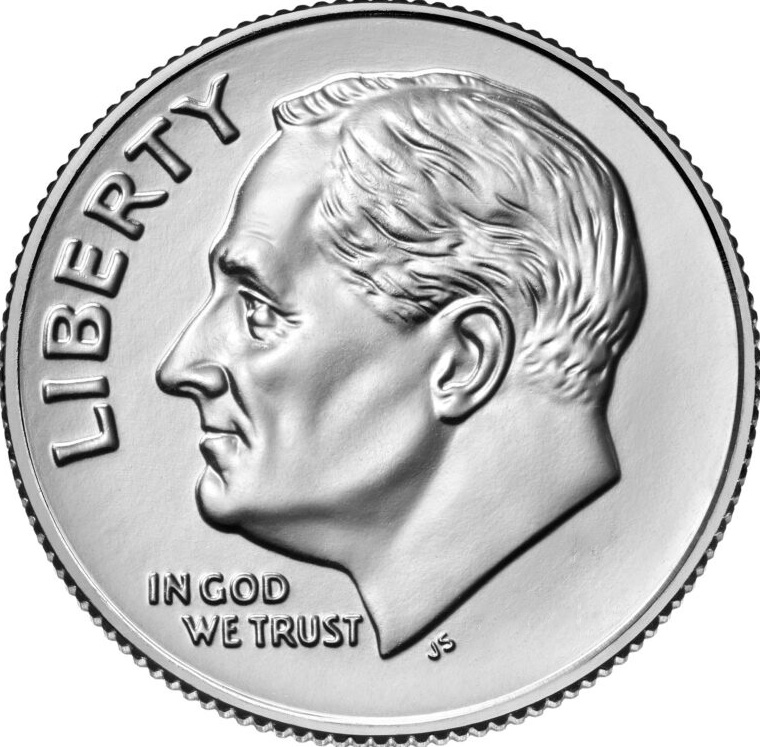
Pick up any Roosevelt dime from your change and it is almost certainly worth exactly ten cents — or, if dated 1964 or earlier, its 90% silver melt value. But a small number of Roosevelt dimes are four-figure coins hiding in plain sight: proof sets missing a mintmark, a circulating business strike missing its "P," and a handful of silver-era dates that quietly command premiums in high grade. This guide covers which ones actually matter, what the catalog says they are worth, and how to tell a real missing-mintmark error from a worn or damaged coin.
The full grade-by-grade breakdown for every Roosevelt dime date and variety lives on the Roosevelt dime series page. What follows is a focused look at the coins worth stopping for.
Series context: silver era, clad era, proof errors
The Roosevelt dime launched in 1946, the year after Franklin Roosevelt's death, replacing the Mercury dime. Like its predecessor it was struck in 90% silver through 1964. Starting in 1965 the Mint switched to a copper-nickel clad composition — the familiar sandwich coin still in production today.
That composition change matters for collectors in two ways. First, any Roosevelt dime dated 1964 or earlier carries silver value regardless of collector grade. Second, the Mint introduced proof coins struck at the San Francisco facility starting in 1968 after a hiatus, using an "S" mintmark on proofs — which is exactly why a proof missing that S is a recognized error. Business-strike coins from Philadelphia carried no mintmark at all until 1980, when the "P" was added, making a 1982 Philadelphia coin missing its P equally notable.
For a broader look at the US dime series and how mintmarks work across all denominations, see our guide on how to read mint marks.
Silver-era key dates: 1949-S and 1955
Most silver Roosevelt dimes trade close to melt in circulated grades. Two dates stand out as genuine collector keys: the 1949-S and the 1955 Philadelphia issue. Both had lower mintages than their contemporaries and carry measurable premiums in high Mint State grades.
1949-S Roosevelt Dime
San Francisco struck 13,150,000 dimes in 1949 — low by Roosevelt standards for the era. In circulated grades the coin moves in line with silver melt, but the MS-68 level jumps dramatically, reflecting how few survivors meet that standard.
| Grade | Approximate Value | What this grade looks like |
|---|---|---|
| VF-20 | $5 | Light even wear; all major details visible |
| XF-40 | $5 | Slight wear on high points only |
| AU-50 | $6 | Trace wear; most original luster present |
| AU-58 | $11 | Faintest wear; full luster nearly intact |
| MS-60 | $21 | No wear; heavy bag marks or imperfections |
| MS-63 | $30 | No wear; scattered contact marks |
| MS-64 | $40 | Minor blemishes; above-average eye appeal |
| MS-65 | $45 | Strong strike; only light, scattered marks |
| MS-66 | $55 | Well struck; very minor imperfections |
| MS-67 | $80 | Virtually flawless; sharp strike throughout |
| MS-68 | $2,100 | Essentially perfect; population-level rarity |
Catalog snapshot. For live pricing and the full Sheldon-scale chart, see the Roosevelt dime series page.
1955 Roosevelt Dime
Philadelphia struck roughly 12.5 million dimes in 1955 — the lowest Philadelphia business-strike mintage of the silver Roosevelt era. Like the 1949-S, the coin trades near melt through MS-66, then separates sharply at the top of the population.
| Grade | Approximate Value | What this grade looks like |
|---|---|---|
| VF-20 | $5 | Light even wear; all major details visible |
| XF-40 | $5 | Slight wear on high points only |
| AU-50 | $5 | Trace wear; most original luster present |
| AU-58 | $5 | Faintest wear; full luster nearly intact |
| MS-60 | $5 | No wear; heavy bag marks or imperfections |
| MS-63 | $5 | No wear; scattered contact marks |
| MS-64 | $6 | Minor blemishes; above-average eye appeal |
| MS-65 | $11 | Strong strike; only light, scattered marks |
| MS-66 | $23 | Well struck; very minor imperfections |
| MS-67 | $100 | Virtually flawless; sharp strike throughout |
| MS-68 | $2,600 | Essentially perfect; population-level rarity |
Catalog snapshot. Coin markets move — verify current dealer pricing before any transaction.
For both the 1949-S and the 1955, the practical takeaway is the same: in grades through MS-67 the premiums over silver melt are modest. The real money is in top-pop MS-68 coins, and those are few enough that professional grading by PCGS or NGC is essential before paying any significant premium.
The No S Proof errors: 1968, 1970, 1975, 1983
Starting in 1968, the San Francisco Mint produced proof Roosevelt dimes bearing an "S" mintmark for inclusion in annual proof sets sold to collectors. On four occasions — 1968, 1970, 1975, and 1983 — at least one proof die was used without the S mintmark being applied, and finished coins made it into proof sets before the error was caught. Each date produced only a small number of confirmed No S examples.
The 1975 No S Proof is widely considered the rarest of the group, with only two confirmed specimens known. The 1968 No S and 1983 No S have higher known populations but are still scarce enough to command significant auction premiums. Because the 1968 No S Proof and 1982 No P (see below) are not currently in the LuckyCoin catalog [catalog-missing], no dollar figures are cited here — consult recent PCGS or NGC auction records for current market levels before buying or selling.
All confirmed No S Proof Roosevelt dimes should be in PCGS or NGC slabs. Any raw coin offered as a No S Proof deserves extreme skepticism: the mintmark on a genuine proof is a crisp, deeply impressed feature, and a missing S is verified by its total absence rather than any ambiguity about a worn or filled letter.
The 1982 No P: a business-strike error anyone could have found
The 1982 No P Roosevelt dime is different in character from the No S Proof errors. It is a regular circulation business strike — not a proof coin — that left the Philadelphia Mint without the "P" mintmark that Philadelphia had been adding to all its coins since 1980. An unknown number entered circulation through normal channels, which means some were found in pocket change by alert collectors in 1982 and 1983.
Because this is a circulated business strike rather than a proof, the population in collector hands spans a range of grades from well-worn to Mint State. Values vary significantly by grade and certification status, but no figures are available in the current LuckyCoin catalog [catalog-missing] — check recent PCGS or NGC price guides for current market levels.
The practical question for anyone sorting through 1982 dimes: the mintmark position on a Roosevelt dime is on the obverse, above the date to the left of Roosevelt's neck. On a genuine 1982 No P, that area is completely blank. On a normal 1982-P, the P is clearly present. There is no in-between — a worn or filled mintmark on a Roosevelt dime is still visible as a raised lump; it does not disappear entirely the way it can on some older series.
How to spot a missing mintmark
Missing or altered mintmarks are the most common source of confusion — and the most common basis for fraudulent upgrades — across the entire Roosevelt dime series. Here is a systematic approach before paying any premium:
Use at least 5× magnification
A quality loupe at 5× to 10× is enough to evaluate mintmarks on dimes. On a genuine No P or No S coin, the field where the mintmark should appear is completely smooth — no raised bump, no ghost image, no trace of a letter. If you see any lump or remnant, the mintmark is present but filled with grease or worn nearly flat, which is not the same error and carries no premium.
Know the exact mintmark location
On Roosevelt dimes struck 1946–1964, the mintmark (D or S) appears on the reverse at the bottom left, near the torch base. From 1968 onward on proof coins, the S is on the obverse above the date. From 1980 onward on Philadelphia business strikes, the P is on the obverse in the same location. Knowing exactly where to look prevents you from misreading the wrong area of the coin. See our full guide on how to read mint marks for position diagrams across all US denominations.
Verify surface integrity around the mintmark zone
Removed mintmarks — where someone has polished or abraded a mintmark off a coin to fake a No S or No P — leave a disturbed field: the metal around the affected area looks different under raking light, often showing a subtle depression or tooling marks. A genuine missing-mintmark error has a completely undisturbed, original field surface. This distinction is best evaluated in hand under a good light source, not from photos.
Insist on a slab for any significant purchase
For any Roosevelt dime error offered at more than nominal value, a PCGS or NGC slab is non-negotiable. Both services specifically identify No S and No P designations on their labels and have authenticated the known populations of each date. A raw coin claimed to be a 1975 No S Proof or a 1982 No P deserves professional authentication before money changes hands.
Most Roosevelt dimes are common — and that is fine
It is worth being direct: the vast majority of Roosevelt dimes you will ever encounter are worth face value in circulated condition, or silver melt if dated 1964 or earlier. The series ran for nearly 80 years with annual mintages routinely exceeding 100 million coins. Common dates in worn grades are abundant, and no amount of hunting through pocket change will produce a 1975 No S Proof or a Mint State 1949-S.
That is not a reason to ignore the series — the Roosevelt dime is one of the most completable sets in US numismatics, the silver coins are a tangible connection to mid-century American monetary history, and the legitimate errors are genuinely exciting finds. But calibrate expectations: the coins that matter are rare because they are genuinely rare, not because they are waiting to be found in circulation in 2025.
For silver Roosevelt dimes and their melt value context, see our guide to pre-1965 silver coins.
- Which Roosevelt dimes are actually worth money?
- The highest-value Roosevelt dimes fall into two categories. First, the No S Proof errors (1968, 1970, 1975, 1983) — proof coins that left San Francisco without the S mintmark. Second, the 1982 No P — a circulation business strike that left Philadelphia without the P mintmark added since 1980. Among standard dates, the 1949-S and 1955 carry meaningful premiums only at the very top of the population (MS-68), where catalog values reach $2,100 and $2,600 respectively.
- How do I tell if my Roosevelt dime is missing a mintmark?
- Use at least 5× magnification and examine the correct location: on proofs from 1968 onward and Philadelphia business strikes from 1980 onward, the mintmark is on the obverse above the date to the left of Roosevelt's neck. A genuine missing-mintmark coin has a completely smooth, undisturbed field in that spot — no bump, no ghost, no remnant. If you see any raised lump, the mintmark is present but filled or worn, which carries no error premium.
- Are Roosevelt dimes before 1965 silver?
- Yes. All Roosevelt dimes dated 1964 and earlier were struck in 90% silver. Starting in 1965 the Mint switched to copper-nickel clad. Silver Roosevelt dimes in circulated condition are worth their melt value based on the current silver spot price. See our pre-1965 silver coins guide for melt calculations.
- What is the rarest Roosevelt dime?
- The 1975 No S Proof is generally considered the rarest Roosevelt dime, with only two confirmed specimens known. It commands the highest prices of any Roosevelt dime at auction. The 1968 No S Proof and 1983 No S Proof have slightly larger known populations but are still significant rarities.
- Can I find a 1982 No P dime in circulation?
- It is theoretically possible — the 1982 No P is a circulation business strike, not a proof, so coins did enter normal channels. In practice, the date is over 40 years old and the error has been documented since the 1980s, so most examples have been picked out by collectors. Finding one today in pocket change would be exceptional luck.
- Should I clean an old Roosevelt dime before selling it?
- No. Cleaning any coin — including Roosevelt dimes — damages the original surface and significantly reduces value. Professional graders at PCGS and NGC flag cleaned coins as "details" grades, which sell at a substantial discount to problem-free examples. Store as found and submit raw for grading if you believe you have a key date or error.
- Do Roosevelt dimes have any doubled-die errors worth looking for?
- Doubled-die varieties exist across the Roosevelt series but most are minor and carry only small premiums. No Roosevelt dime doubled-die commands anywhere near the premium of the 1955 Lincoln cent doubled die, for example. If you suspect a doubled die on a Roosevelt dime, compare against documented variety listings from CONECA or the Cherrypickers' Guide before assigning significant value.