Peace Dollar Key Dates: Every Year Worth Looking For
Catalog values, history, and authentication — peace dollar key dates.
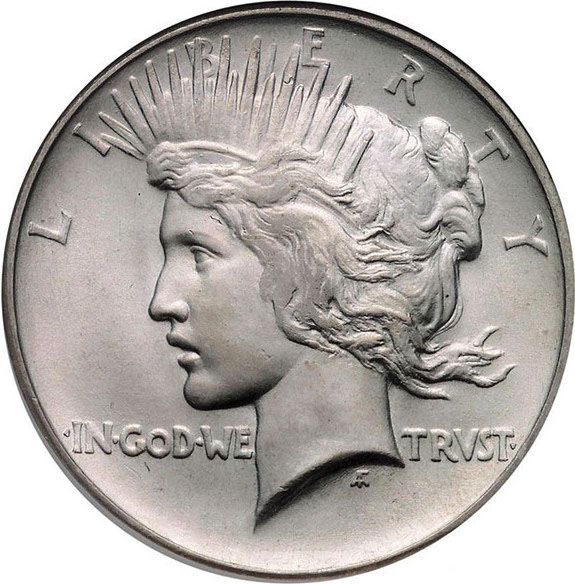
The Peace dollar ran for only fifteen years — 1921 through 1935, with a one-year gap in 1929–1933 — and the complete series contains far fewer date-and-mintmark combinations than the Morgan dollar that preceded it. That compact checklist makes Peace dollars an appealing collecting goal, but the series still has a handful of dates that will stop you cold: the high-relief 1921, the low-mintage 1928 Philadelphia issue, and the deceptively difficult 1934-S. This guide covers each key date, what the catalog says they're actually worth, and how the Peace dollar series fits alongside the Morgan dollar as a parallel collecting pursuit.
For a full series overview and every date-mintmark combination in one place, see the Peace Dollar series page. Background on the coin's design and political context is covered in the Peace Dollar history guide.
Series context: 15 years, three mints, one design
The Peace dollar was authorized to mark the end of World War I and struck in 90% silver at the Philadelphia, Denver, and San Francisco mints. Designer Anthony de Francisci's Liberty portrait on the obverse and the perched eagle on the reverse remained essentially unchanged for the entire run — the only major design shift was the move from the high-relief style used in 1921 to the shallower relief adopted for 1922 and all subsequent years. Total issue counts across the run varied enormously: some years produced tens of millions of coins; others barely cracked a million. That variance is where the collector interest lives.
All Peace dollars carry a silver melt floor regardless of date. At any given silver spot price, even the most common examples have a base value — but the key dates carry premiums far above melt that are driven entirely by collector demand and grade scarcity. You can find current melt and catalog values across the full series on the Peace Dollar price guide.
Key date 1: 1921 — the only high-relief year
The 1921 Peace dollar is unique in the series for two reasons: it was struck in high relief, giving Liberty's portrait and the eagle a sharper, more sculptural look than any later Peace dollar, and its mintage of 1,006,473 is modest by Peace dollar standards. No other year of the series used the high-relief dies in regular production, so the 1921 stands apart visually as well as numerically. (A small number of 1922 high-relief pattern coins were struck but never released for circulation.) When the Mint shifted to lower relief for 1922, it was primarily for production efficiency — the high-relief strikes required multiple blows per planchet and wore dies more quickly.
The 1921 is the only Peace dollar struck solely at Philadelphia; there are no 1921-D or 1921-S issues. Because high-relief coins show wear differently than their shallower counterparts — the highest points flatten quickly — examples in grades above XF-40 carry steep premiums.
| Grade | Approximate Value | What this grade looks like |
|---|---|---|
| AG-3 | $100 | Heavily worn; date and motto barely legible |
| G-4 | $120 | Liberty outline clear; major detail flat |
| VG-8 | $150 | Some hair and face detail visible; full rim |
| F-12 | $180 | Most hair detail visible; eagle feathers show |
| VF-20 | $200 | Most details sharp; light wear on cheek and hair |
| XF-40 | $260 | All details sharp; trace wear on highest points only |
| AU-50 | $340 | Light wear on high points; most luster present |
| AU-55 | $380 | Slight wear; luster nearly complete |
| AU-58 | $400 | Faintest wear; original mint luster mostly intact |
| MS-60 | $700 | No wear; heavy contact marks; lackluster surfaces |
| MS-62 | $800 | No wear; noticeable marks but some luster |
| MS-63 | $1,100 | Moderate marks; acceptable luster and strike |
| MS-64 | $1,800 | Minor marks; good luster; above-average strike |
| MS-65 | $3,500 | Few marks; strong luster; well struck |
| MS-66 | $9,000 | Exceptional surfaces; nearly mark-free |
| MS-67 | $130,000 | Top of the population; flawless original surfaces |
Catalog snapshot. Coin markets move — for live pricing see the Peace Dollar price guide.
Key date 2: 1928 — lowest-mintage Philadelphia Peace dollar
The 1928 Philadelphia issue is the rarest Peace dollar by mintage among regular business strikes: only 360,649 were produced, the lowest figure of any date in the series. The Mint had dramatically curtailed silver dollar production by the mid-1920s as existing stockpiles proved more than adequate for commerce, and 1928 caught the tail end of that pullback before the series went on hiatus entirely from 1929 through 1933.
Unlike the 1921, the 1928 is in standard low relief, so a circulated example looks similar to any other Peace dollar at first glance. The date and the absence of a mintmark — Philadelphia coins carry none — are the only distinguishing features. That subtlety means raw 1928 dollars offered in mixed lots occasionally get mislabeled, so verify the date carefully under magnification before paying a premium.
| Grade | Approximate Value | What this grade looks like |
|---|---|---|
| AG-3 | $210 | Heavily worn; date legible; rim mostly gone |
| G-4 | $220 | Liberty outline clear; major detail flat |
| VG-8 | $230 | Some face and hair detail; full rim |
| F-12 | $240 | Most hair detail; eagle feathers outlined |
| VF-20 | $260 | Details mostly sharp; light wear on high points |
| XF-40 | $290 | All details sharp; only trace wear |
| AU-50 | $390 | Light wear on high points; most luster present |
| AU-55 | $500 | Slight wear; luster nearly complete |
| AU-58 | $500 | Faintest wear; original mint luster mostly intact |
| MS-60 | $600 | No wear; heavy contact marks |
| MS-62 | $700 | No wear; noticeable marks but some luster |
| MS-63 | $1,000 | Moderate marks; acceptable luster and strike |
| MS-64 | $1,200 | Minor marks; good luster |
| MS-65 | $4,000 | Few marks; strong luster; well struck |
| MS-66 | $24,000 | Exceptional preservation; nearly mark-free |
Catalog snapshot. For current eBay sold data and the full Sheldon scale, see the Peace Dollar price guide.
Key date 3: 1934-S — common in low grade, scarce in mint state
The 1934-S has a mintage of 1,011,000 — respectable by the series' late-run standards — which is why well-worn examples trade close to melt value and regularly turn up in dealer junk boxes. What makes the 1934-S a genuine key date is what happens above AU-50: the price curve becomes extremely steep, very quickly. An AU-50 already commands $500; an MS-60 jumps to $3,800; and an MS-65 reaches $10,000. The reason is that relatively few mint-state examples survived — many were released into commercial channels and circulated heavily in the West before the silver dollar series ended in 1935.
The 1934-D from the same year makes a useful comparison: its mintage of 1,569,500 is higher, and its mint-state premiums are substantially lower at every grade. Seeing both coins side by side illustrates how San Francisco's 1934 striking quality and distribution patterns differed from Denver's.
1934-S values by grade
| Grade | Approximate Value | What this grade looks like |
|---|---|---|
| AG-3 | $50 | Heavily worn; date and S mintmark legible |
| G-4 | $50 | Liberty outline clear; major detail flat |
| VG-8 | $50 | Some face detail; full rim |
| F-12 | $55 | Most hair detail; eagle feathers outlined |
| VF-20 | $75 | Details mostly sharp; light wear on high points |
| XF-40 | $180 | All details sharp; only trace wear |
| AU-50 | $500 | Light wear on high points; most luster present |
| AU-55 | $1,100 | Slight wear; luster nearly complete |
| AU-58 | $1,900 | Faintest wear; original mint luster mostly intact |
| MS-60 | $3,800 | No wear; heavy contact marks; luster diminished |
| MS-62 | $6,000 | No wear; noticeable marks but some luster |
| MS-63 | $8,000 | Moderate marks; acceptable luster and strike |
| MS-64 | $9,000 | Minor marks; good luster |
| MS-65 | $10,000 | Few marks; strong luster; well struck |
| MS-66 | $35,000 | Exceptional preservation; nearly mark-free |
1934-D values by grade (comparison)
| Grade | Approximate Value | What this grade looks like |
|---|---|---|
| AG-3 | $50 | Heavily worn; date and D mintmark legible |
| G-4 | $50 | Liberty outline clear; major detail flat |
| VG-8 | $50 | Some face detail; full rim |
| F-12 | $50 | Most hair detail; eagle feathers outlined |
| VF-20 | $50 | Details mostly sharp; light wear on high points |
| XF-40 | $75 | All details sharp; only trace wear |
| AU-50 | $100 | Light wear on high points; most luster present |
| AU-55 | $120 | Slight wear; luster nearly complete |
| AU-58 | $160 | Faintest wear; original mint luster mostly intact |
| MS-60 | $190 | No wear; heavy contact marks |
| MS-62 | $250 | No wear; noticeable marks but some luster |
| MS-63 | $400 | Moderate marks; acceptable luster and strike |
| MS-64 | $800 | Minor marks; good luster |
| MS-65 | $2,000 | Few marks; strong luster; well struck |
| MS-66 | $6,000 | Exceptional preservation; nearly mark-free |
Catalog snapshot. Markets move — check the Peace Dollar price guide for live data.
Common dates: 1922–1925 and the silver melt floor
The years 1922, 1923, 1924, and 1925 saw massive Peace dollar production — tens of millions of coins per year across Philadelphia, Denver, and San Francisco. These dates are abundant in every grade through MS-64 and trade close to silver melt value in worn condition. A G-4 example from any of those years typically commands just a small premium above the silver content of the coin, making them ideal for anyone who wants to hold 90% silver without paying a collector premium. For more context on silver content and melt values across pre-1965 coinage, see the pre-1965 silver coins guide.
Even among the common dates, the San Francisco mint issues from 1925-S, 1926-S, and 1927-S carry modest semi-key premiums above the Philadelphia issues from those years — San Francisco typically produced fewer dollars — but none approach the pricing cliffs seen on the 1921, 1928, or 1934-S. If you're building the series on a budget, filling the common Philadelphia and Denver slots first is straightforward.
Authentication: Peace dollars and when slabs matter
Peace dollars are counterfeited less aggressively than Morgan dollars because the series has fewer extreme rarities and the design is somewhat harder to replicate convincingly. That said, key-date Peace dollars in high grades do attract alterations, and the same general rules apply.
Mintmark additions
The 1928 Philadelphia coin has no mintmark, but a forger could attempt to alter a genuine 1928-S (San Francisco), which was struck in larger numbers than the Philadelphia issue, or to remove a mintmark from a different date. More commonly, worn common-date dollars get fraudulently cleaned and artificially toned to simulate higher-grade examples. Examine the fields under 5x magnification: genuine luster flows in concentric lines from the strike; artificial toning applied over hairlines sits flat and uneven.
When to insist on a slab
For any 1921 Peace dollar priced above AU-50, any 1928 at any grade, or any 1934-S above VF-20, a PCGS or NGC slab is the standard of practice. The value gap between a problem-free genuine coin and a cleaned or altered example is large enough that buying raw at full retail carries real financial risk. A slabbed 1928 in MS-63 is worth around $1,000 per the catalog; a raw example claiming the same grade should sell at a meaningful discount unless you can authenticate it yourself or have it examined first.
Peace dollars vs. Morgan dollars as a collecting series
The Morgan dollar series ran from 1878 to 1921 and contains well over 100 date-mintmark combinations, including several extreme rarities (the 1895 proof-only Philadelphia issue being the most notorious). A complete Morgan set in any grade is a decades-long project that requires serious capital. The Peace dollar series, by contrast, has 24 regular business-strike date-mintmark combinations — a set that a determined collector can realistically complete in a few years. For more on the Morgan side of the comparison, see the Morgan dollar key dates guide.
The tradeoff: the Peace dollar's 1934-S in mint state costs as much as several mid-tier Morgan keys, and the 1921 high-relief in MS-65 is not cheap. But the total capital required for a complete Peace dollar set in circulated grades is a fraction of what a complete Morgan set demands. For a collector who wants a finished, frameable set of 90% silver dollars within a realistic budget and timeline, the Peace dollar series is the more achievable goal.
Both series, along with every other US dollar issue, are cataloged on the US Dollars series page.
- What is the rarest Peace dollar?
- By mintage, the 1928 Philadelphia issue is the rarest regular business-strike Peace dollar at 360,649 coins. The 1921 is the only high-relief year and commands the highest mint-state premiums across the series, with an MS-67 valued at $130,000 in the catalog.
- What is a 1921 Peace dollar worth?
- In Good (G-4) condition, around $120. In Fine (F-12), around $180. In Extremely Fine (XF-40), around $260. In Mint State MS-63, around $1,100. Top-population MS-67 examples reach $130,000. The 1921 is the only high-relief Peace dollar and carries a premium at every grade above the common-date issues.
- What is a 1928 Peace dollar worth?
- Even in heavily worn AG-3 condition the 1928 catalogs at $210 — well above melt — reflecting its low mintage of 360,649. In VF-20 it reaches $260, in XF-40 it's $290, and in MS-63 it hits $1,000. An MS-66 example catalogs at $24,000, the highest circulated-series value in the catalog for this date.
- Why is the 1934-S so expensive in mint state?
- The 1934-S had a mintage of 1,011,000 — not unusual for a late Peace dollar — but most of those coins circulated heavily, leaving relatively few mint-state survivors. The price curve is dramatic: an XF-40 is $180, an AU-50 jumps to $500, and MS-60 reaches $3,800. Grades above MS-65 are genuinely scarce in certified populations.
- Which Peace dollar dates are common and close to silver melt?
- The years 1922, 1923, 1924, and 1925 produced tens of millions of coins and trade close to silver melt value in circulated grades. These are good entry points for anyone who wants to hold 90% silver without paying a collector premium. See the pre-1965 silver coins guide for current melt context.
- Should I buy a raw or slabbed key-date Peace dollar?
- For any 1928 at any grade, any 1921 above AU-50, or any 1934-S above VF-20, insist on a PCGS or NGC slab. The price difference between a genuine problem-free coin and a cleaned or altered example is large enough that buying raw at full retail carries real risk. Below those thresholds, raw coins from reputable dealers are generally fine.
- How does completing a Peace dollar set compare to a Morgan dollar set?
- The Peace dollar series has roughly two dozen regular business-strike date-mintmark combinations, versus roughly 100 for the Morgan series. A complete Peace dollar set in circulated grades is achievable for most dedicated collectors; a complete Morgan set in any grade requires considerably more time and capital. The Peace dollar is generally considered the more accessible completion goal of the two series.