Peace Dollar: The Story of America's Last Silver Dollar (1921–1935)
Catalog values, history, and authentication — peace dollar history.
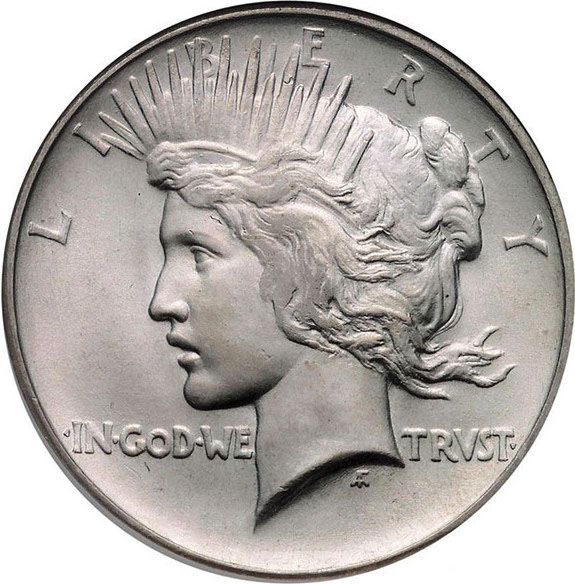
The Peace Dollar ran as a circulating coin for fifteen years — 1921 through 1935, with a three-year gap in the middle — before Depression-era economics ended production. Struck to mark the end of the First World War and designed by a sculptor whose own wife served as the model for Liberty, it was the last 90%-silver business-strike dollar issued by the United States. The series returned in 2021 as a collector-only program at the San Francisco and Philadelphia mints, now struck in .999 fine silver, and continues annually today.
This guide covers the design competition that created it, the two distinct relief types, the production history across three separate coinage runs, the three key dates every collector needs to know, the aborted 1965 reissue that almost added a fourth coinage era, and the modern 2021-present program. Value tables for the three catalog coins — the 1921, the 1928, and the 1934-S — appear in their respective sections.
Origin: the 1921 design competition and Teresa de Francisci
The Pittman Act of 1918 required the Treasury to replace millions of melted silver dollars with newly struck coins. The Morgan Dollar, already decades old, had been filling that role, but by late 1921 there was political appetite for a new design that reflected the war's end. Treasury Secretary Andrew Mellon authorized a competition among eight sculptors, setting a tight December 1921 deadline.
The winner was Anthony de Francisci, a 34-year-old Sicilian-born sculptor. His Liberty wears a radiate crown suggesting both the classical sun and — intentionally — the Statue of Liberty. The model for her face was his wife, Teresa Cafarelli de Francisci, a recent Italian immigrant. The reverse shows a bald eagle at rest on a mountain crag, the word PEACE inscribed on the rock below — the first explicit peace message on a circulating US coin.
The Pittman Act connection matters for understanding why Peace Dollars exist at all: the law mandated that an equivalent number of silver dollars be coined to replace every dollar melted down during the war, tying dollar production to bullion-coverage requirements rather than purely to commercial demand. Without it, the series might never have launched.
Two design types: 1921 high relief vs. 1922-onward low relief
The 1921 Peace Dollar is physically different from every other date in the series. De Francisci's original models were sculpted in high relief — deep, dramatically rounded contours like a Renaissance medal. The Philadelphia Mint struck only 1,006,473 examples before Mint engravers reduced the relief for 1922, flattening the fields slightly so that coins would stack properly, dies would last longer, and strike quality would be more consistent across large production runs.
The practical result for collectors: the 1921 is a one-year type coin. Anyone building a type set of 20th-century US silver needs one 1921 and at least one coin from 1922–1935. The high-relief design is widely considered the more artistically dramatic of the two.
1921 Peace Dollar: catalog values
With a mintage of 1,006,473 struck late in the year, the 1921 is scarcer than most dates in the series and commands a meaningful premium — especially in mint state, where the high relief makes a fully struck, mark-free example genuinely rare. Values below are from the LuckyCoin catalog; the full grade-by-grade chart is on the Peace Dollar series page.
| Grade | Approximate Value | What this grade looks like |
|---|---|---|
| AG-3 | $100 | Heavily worn; design outline visible; date legible |
| G-4 | $120 | Major design elements clear; fine details flat |
| VG-8 | $150 | Some hair and feather detail emerging |
| F-12 | $180 | Most detail visible; moderate wear on high points |
| VF-20 | $200 | Sharp details with light wear on highest points |
| XF-40 | $260 | All details sharp; trace wear on hair and eagle |
| AU-50 | $340 | Slight wear; most mint luster present |
| AU-55 | $380 | Faint wear on highest points; luster nearly complete |
| AU-58 | $400 | Barely perceptible wear; strong luster |
| MS-60 | $700 | No wear; numerous contact marks |
| MS-62 | $800 | No wear; several noticeable marks |
| MS-63 | $1,100 | No wear; minor marks; pleasing luster |
| MS-64 | $1,800 | No wear; few minor marks; above-average strike |
| MS-65 | $3,500 | Sharp strike; nearly mark-free; full luster |
| MS-66 | $9,000 | Exceptional preservation; trivial imperfections |
| MS-67 | $130,000 | Top of population; virtually flawless |
Catalog snapshot. Coin markets move — for any transaction, verify current dealer pricing and the live grade-by-grade chart.
Production history: three coinage runs
The Peace Dollar's production history breaks into three distinct chapters, each driven by different economic forces.
First run: 1921–1928
After the 1921 high-relief launch, Philadelphia switched to the low-relief design and production ramped up dramatically. The years 1922 and 1923 alone account for the majority of the series' total mintage, with Philadelphia, Denver, and San Francisco all striking large quantities. Output then declined through the mid-1920s as the post-war silver-replacement obligation under the Pittman Act wound down. The 1928 Philadelphia issue, with a mintage of only 360,649, is the smallest of the entire series and one of the three key dates — see its value table below.
Mid-series gap: 1929–1933
No Peace Dollars were struck for five years. The Great Depression collapsed commercial demand for silver dollars; the coins were circulating poorly even before the economy contracted, and the Mint saw no reason to produce more. This gap has no collector consequence for date-set builders — there are simply no coins to find — but it does mean that the series has a clean three-era structure rather than one continuous run.
Second run: 1934–1935
The Silver Purchase Act of 1934 revived dollar coinage briefly. Only four date-mintmark combinations appeared: 1934-P, 1934-D, 1934-S, and 1935-P and 1935-S. Of these the 1934-S is the third key date of the series — see its value table below. Production ended in 1935 and was never resumed under the original design.
Key date: 1928 Peace Dollar
The 1928 Philadelphia issue carries the lowest mintage of any regularly struck Peace Dollar: 360,649. Because it was struck late in the first coinage run when demand was falling, distribution was uneven, and many examples saw heavy circulation before collectors recognized the date's significance. Catalog values from the LuckyCoin database:
| Grade | Approximate Value | What this grade looks like |
|---|---|---|
| AG-3 | $210 | Heavily worn; design and date readable |
| G-4 | $220 | Major details clear; surfaces heavily flat |
| VG-8 | $230 | Modest detail in hair and feathers |
| F-12 | $240 | Most detail visible; even wear |
| VF-20 | $260 | Sharp with light wear on high points |
| XF-40 | $290 | All details sharp; only trace wear |
| AU-50 | $390 | Slight wear; most luster intact |
| AU-55 | $500 | Faint wear; nearly full luster |
| AU-58 | $500 | Barely perceptible wear; strong luster |
| MS-60 | $600 | No wear; numerous contact marks |
| MS-62 | $700 | No wear; several noticeable marks |
| MS-63 | $1,000 | No wear; minor marks; pleasing luster |
| MS-64 | $1,200 | No wear; few minor marks |
| MS-65 | $4,000 | Sharp strike; nearly mark-free |
| MS-66 | $24,000 | Exceptional preservation; population rarity |
Catalog snapshot. For any transaction, verify current dealer pricing and the live grade-by-grade chart.
Key date: 1934-S Peace Dollar
The 1934-S presents a counterintuitive case: its mintage of 1,011,000 is nearly three times that of the 1928, yet in higher grades it is dramatically more expensive. The explanation is strike quality. San Francisco's 1934 dollar dies produced consistently weak strikes — Liberty's hair above the ear and the eagle's breast feathers are typically flat even on technically uncirculated coins. Finding a sharply struck, fully lustrous 1934-S in MS-63 or above is genuinely difficult, which compresses the population at the top grades and sends prices sharply higher. Catalog values:
| Grade | Approximate Value | What this grade looks like |
|---|---|---|
| AG-3 | $50 | Heavily worn; outline and date visible |
| G-4 | $50 | Major details present; surfaces flat |
| VG-8 | $50 | Modest detail visible |
| F-12 | $55 | Most detail visible; even moderate wear |
| VF-20 | $75 | Sharp with light wear on highest points |
| XF-40 | $180 | All details sharp; trace wear only |
| AU-50 | $500 | Slight wear; most luster intact |
| AU-55 | $1,100 | Faint wear; nearly full luster |
| AU-58 | $1,900 | Barely perceptible wear; strong luster |
| MS-60 | $3,800 | No wear; numerous contact marks |
| MS-62 | $6,000 | No wear; several noticeable marks |
| MS-63 | $8,000 | No wear; minor marks; pleasing luster |
| MS-64 | $9,000 | No wear; few minor marks |
| MS-65 | $10,000 | Sharp strike; nearly mark-free |
| MS-66 | $35,000 | Exceptional preservation; very low population |
Catalog snapshot. For any transaction, verify current dealer pricing and the live grade-by-grade chart.
The 1965 reissue that never happened
In 1965, with silver being stripped from the coinage system, Congress briefly authorized the striking of Peace Dollars dated 1964 — a political gesture toward Western silver-mining states that had lobbied for continued silver-dollar production. The Denver Mint struck 316,076 examples before the project was cancelled and all coins were ordered melted. No 1964-dated Peace Dollar has ever been confirmed in private hands; possessing one would technically be illegal under current law, as the coins were never officially released. This episode has no collecting consequence — there are no coins to acquire — but it does underscore how politically charged silver-dollar policy remained decades after the series ended.
The Eisenhower Dollar series, launched in 1971, used clad metal rather than silver for circulation strikes, marking a permanent break from the 90%-silver dollar tradition the Peace Dollar had represented.
The modern Peace Dollar program: 2021–present
On January 5, 2021, President Trump signed legislation authorizing the United States Mint to issue Morgan and Peace Dollars for the centennial of the 1921 transition between the two designs. The 2021 Peace Dollar — released August 10, 2021 with a mintage of 200,000 — carried no mint mark (matching the original Philadelphia coins) and was struck in .999 fine silver with an uncirculated finish. Each modern coin contains 0.858 troy ounces of pure silver, more than the 0.7734 oz in an original 90%-silver Peace Dollar.
No 2022 Peace Dollar was produced — the Mint announced plans for 2022 issues but cancelled them in March 2022, citing supply-chain problems, production capacity limits, and the rising price of silver. The program resumed in 2023 with three finishes: an Uncirculated struck at Philadelphia (no mint mark, 275,000 mintage limit), a Proof struck at San Francisco (S mint mark), and a Reverse Proof issued as part of a two-coin set with the Morgan Dollar. The 2023 Uncirculated sold out on its release day. The Mint has continued the program annually since: 275,000 Uncirculated coins were authorized for 2024 and 150,000 for 2025.
Modern Peace Dollars are collector-only issues, not legal-tender circulation strikes. They reproduce de Francisci's original design with the addition of the current year as the date. Most date-set collectors treat the 1921–1935 run as the "real" series and the 2021-present coins as a separate modern type, though some collectors pursue both.
Where the Peace Dollar sits in collecting today
Most collectors approach the Peace Dollar as the natural companion to the Morgan Dollar. The two series together cover every 90%-silver business-strike dollar from 1878 through 1935, and many collectors complete one before tackling the other. The Peace series is the shorter and — for most dates — considerably cheaper of the two; the three key dates (1921, 1928, 1934-S) are expensive but not in the same stratosphere as the rarest Morgans.
For collectors interested in silver coinage more broadly, our guide to pre-1965 silver coins covers the full landscape of 90% silver US issues, and our Morgan Dollar key dates guide runs through the most important dates in the preceding series. The full US Dollars series index on LuckyCoin lists every dollar type with live catalog values.
- What years were Peace Dollars made?
- The original circulating series was struck in two runs: 1921–1928 and 1934–1935, totaling fifteen date-mintmark combinations across Philadelphia, Denver, and San Francisco. After a long gap, the US Mint resumed striking Peace Dollars as collector coins in 2021 and again from 2023 onward (no 2022 issue). The modern program is ongoing.
- What is a Peace Dollar made of?
- Original business-strike Peace Dollars (1921–1935) are 90% silver and 10% copper — the same composition as Morgan Dollars and other pre-1965 US silver coins — and contain approximately 0.7734 troy ounces of pure silver. Modern Peace Dollars (2021-present) are struck in .999 fine silver and contain 0.858 troy ounces of pure silver per coin.
- Which Peace Dollar is the rarest?
- By mintage, the 1928 Philadelphia issue at 360,649 coins is the lowest of the series. The 1934-S (1,011,000 mintage) is comparably valuable in higher grades because of its notoriously weak strikes, which make sharply detailed mint-state examples extremely scarce. The 1921 commands a premium as a one-year high-relief type coin.
- What is a Peace Dollar worth?
- Common-date circulated Peace Dollars (1922, 1923, 1925) trade close to their silver melt value in worn grades. Key dates are significantly higher: a 1928 in Good (G-4) catalogs at $220; a 1934-S in the same grade at $50, though its value rises sharply above XF — an AU-58 1934-S catalogs at $1,900. The 1921 in G-4 catalogs at $120. See each coin's page for the full grade chart.
- Is the 1921 Peace Dollar different from later Peace Dollars?
- Yes — the 1921 was struck in high relief using de Francisci's original sculpted models, giving it deeper, more dramatic contours than any other date in the series. Starting in 1922 the Mint reduced the relief for production practicality. The 1921 is therefore a distinct one-year type that many collectors acquire separately from their date set.
- Were any Peace Dollars made after 1935?
- 316,076 Peace Dollars dated 1964 were struck at Denver in 1965, but all were melted before release and the US Mint maintains that none are legally held in private hands. The series then returned in 2021 as a collector coin marking the design's centennial, paused in 2022, and resumed annually from 2023 onward — issued in uncirculated, proof, and reverse-proof finishes from Philadelphia and San Francisco.
- Should I clean my Peace Dollar?
- No. Cleaning silver coins — even gentle polishing — removes the natural toning and surface texture that graders look for. A cleaned Peace Dollar will receive a "details" designation from PCGS or NGC rather than a numeric grade, which significantly reduces its value and resale appeal. Store as found and have any notable example authenticated by a professional grading service.