Mercury Dime Value Chart by Year (1916–1945)
Catalog values and authentication details — mercury dime value chart.
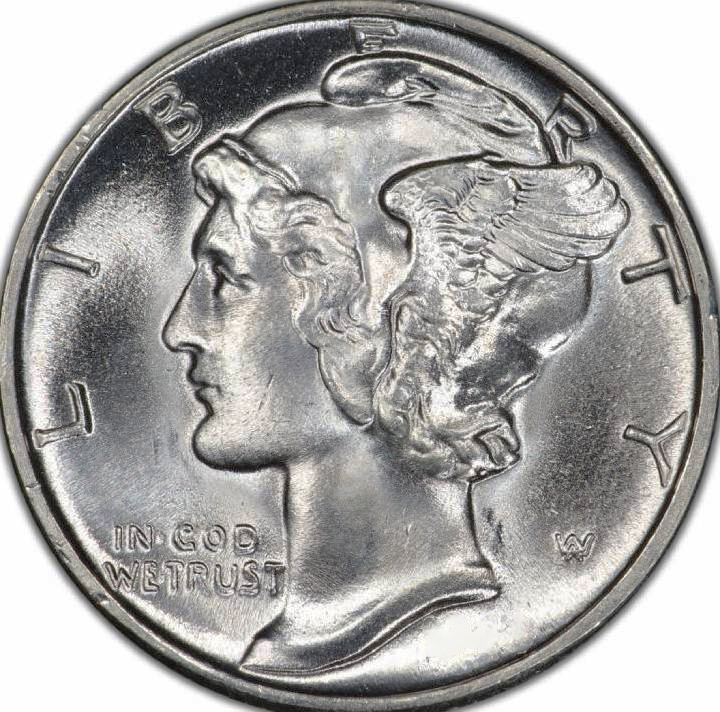
The Mercury dime ran for exactly thirty years, from 1916 through 1945, and every single one contains 0.0723 troy ounces of pure silver. That silver floor means even the most worn common date is never truly worthless — but the series also contains some of the most valuable small coins in American numismatics, led by the famous 1916-D, which commands four-to-five figures in any gradable condition.
This mercury dime value chart covers the full series: the designer and design, the silver melt baseline, common-date premiums, the four classic key dates with grade-by-grade prices, the two famous overdate varieties, and a quick guide to telling a Mercury dime apart from a Roosevelt or Barber dime by sight.
Series overview: Weinman's Winged Liberty Head
The coin is officially called the Winged Liberty Head dime. The "Mercury" nickname stuck almost immediately because the winged cap on Liberty's head resembled the helmet of the Roman messenger god. The design was created by sculptor Adolph A. Weinman, who also designed the Walking Liberty half dollar issued the same year. Weinman placed his monogram — a small "AW" — just above the date on the obverse.
The reverse features a fasces (a Roman bundle of rods bound around an axe) crossed by an olive branch, intended to symbolize the nation's military readiness combined with a desire for peace. The design is widely regarded as one of the most beautiful in 20th-century American coinage. Production ran from 1916 through 1945, when the Roosevelt dime replaced it following Franklin D. Roosevelt's death.
All Mercury dimes are 90% silver and 10% copper, struck at Philadelphia (no mintmark), Denver (D), and San Francisco (S). See our guide to reading mint marks if you're unsure where to look — on Mercury dimes, the mintmark sits on the reverse to the left of the fasces.
Common dates: the silver melt floor
The majority of Mercury dimes minted between 1923 and 1940 are "common dates" — meaning mintages were high enough that worn survivors are abundant. In heavily circulated grades (AG-3 through G-4), these coins trade at or just above silver melt value. At current silver prices, the 0.0723 oz silver content gives every Mercury dime a built-in floor regardless of grade.
Common dates in VF-20 or better begin to carry modest collector premiums above melt, and MS-65 Full Bands examples (where the horizontal bands on the fasces are fully separated and sharply struck) can reach hundreds of dollars even on otherwise unremarkable dates. The Mercury dime price guide on LuckyCoin lists every date and mintmark with live grade-by-grade values.
Key dates: value tables by grade
Four dates stand apart from the rest of the series and command significant premiums even in well-worn condition. Values below are from the LuckyCoin catalog.
1916-D — the key date
With only 264,000 struck, the 1916-D Mercury dime is the rarest regular-issue date in the series. Denver had just received the new dies late in the year, and production was cut short — making it an immediate rarity. By the time collectors realized what had happened, most had already entered heavy circulation. A dedicated guide to authentication and pricing lives at our 1916-D Mercury dime page.
| Grade | Value | What this grade looks like |
|---|---|---|
| AG-3 | $900 | Date and D mintmark barely legible; heavily worn |
| G-4 | $1,500 | Outline clear; major details flat |
| VG-8 | $1,900 | Some hair and wing detail visible; full rim |
| F-12 | $2,600 | Most details visible; fasces bands flat |
| VF-20 | $6,000 | Most details sharp; light wear on high points |
| XF-40 | $7,000 | All details sharp; trace wear only |
| AU-50 | $9,000 | Slight wear on highest points; luster mostly intact |
| MS-60 | $12,000 | No wear; noticeable contact marks |
| MS-62 | $14,000 | No wear; moderate marks |
| MS-63 | $20,000 | No wear; minor marks; good luster |
| MS-64 | $24,000 | Above-average preservation; few marks |
| MS-65 | $26,000 | Sharp strike; nearly mark-free |
| MS-66 | $37,000 | Exceptional preservation; strong luster |
1921 — post-WWI low mintage
The economic slowdown following World War I dramatically cut dime production in 1921. Philadelphia struck only 1,230,000 dimes that year — one of the lowest Philadelphia mintages in the entire series — and most went into hard use. Survivors in VF and above are genuinely scarce.
| Grade | Value | What this grade looks like |
|---|---|---|
| AG-3 | $30 | Heavily worn; date legible |
| G-4 | $50 | Outline clear; major details flat |
| VG-8 | $80 | Some detail visible; full rim |
| F-12 | $130 | Most details visible |
| VF-20 | $290 | Most details sharp; light wear on high points |
| XF-40 | $500 | All details sharp; trace wear |
| AU-50 | $900 | Slight wear on highest points; luster mostly intact |
| MS-60 | $1,300 | No wear; noticeable contact marks |
| MS-62 | $1,600 | No wear; moderate marks |
| MS-63 | $1,800 | No wear; minor marks |
| MS-64 | $2,100 | Above-average preservation |
| MS-65 | $3,200 | Sharp strike; nearly mark-free |
| MS-66 | $10,000 | Exceptional preservation |
1921-D — Denver's scarce companion
Denver's 1921 output was even lower than Philadelphia's: 1,080,000 pieces. The 1921-D tends to come weakly struck, especially on the bands of the fasces, making full-strike Mint State examples particularly difficult to find. In circulated grades it commands a modest premium over the Philadelphia issue; in high Mint State the spread widens significantly.
| Grade | Value | What this grade looks like |
|---|---|---|
| AG-3 | $45 | Heavily worn; date and D legible |
| G-4 | $65 | Outline clear; major details flat |
| VG-8 | $130 | Some detail visible; full rim |
| F-12 | $190 | Most details visible |
| VF-20 | $390 | Most details sharp; light wear on high points |
| XF-40 | $700 | All details sharp; trace wear |
| AU-50 | $1,200 | Slight wear; luster mostly intact |
| MS-60 | $1,500 | No wear; noticeable contact marks |
| MS-62 | $1,900 | No wear; moderate marks |
| MS-63 | $2,400 | No wear; minor marks |
| MS-64 | $3,200 | Above-average preservation |
| MS-65 | $3,400 | Sharp strike; nearly mark-free |
| MS-66 | $6,000 | Exceptional preservation |
1926-S — the sleeper semi-key
The 1926-S is often called a "sleeper" in the series. Its mintage of 1,520,000 is not dramatically low on paper, but the coins were heavily circulated in the West, and the San Francisco dies of this period frequently produced weakly struck coins. Finding a sharply struck 1926-S in XF or better is genuinely difficult, which drives the steep premium in upper circulated and Mint State grades.
| Grade | Value | What this grade looks like |
|---|---|---|
| AG-3 | $6 | Heavily worn; date and S legible |
| G-4 | $13 | Outline clear; major details flat |
| VG-8 | $16 | Some detail visible; full rim |
| F-12 | $30 | Most details visible |
| VF-20 | $80 | Most details sharp; light wear on high points |
| XF-40 | $260 | All details sharp; trace wear |
| AU-50 | $400 | Slight wear; luster mostly intact |
| MS-60 | $1,100 | No wear; noticeable contact marks |
| MS-62 | $1,200 | No wear; moderate marks |
| MS-63 | $1,900 | No wear; minor marks |
| MS-64 | $2,500 | Above-average preservation |
| MS-65 | $3,900 | Sharp strike; nearly mark-free |
| MS-66 | $6,000 | Exceptional preservation |
Catalog snapshot. Coin markets move — for current pricing across all Mercury dime dates and grades, see the live Mercury dime price guide.
The 1942/1 overdate varieties
Two of the most famous varieties in the Mercury dime series are the 1942/1 (Philadelphia) and 1942/1-D (Denver) overdates. Both were created when 1941-dated dies were re-punched with a 1942 date, leaving the underlying "1" partially visible beneath the "2" in the date. The doubling is visible to the naked eye on well-preserved examples and unmistakable under 5× magnification.
Both overdate varieties are highly collectible and carry substantial premiums over normal 1942 dimes. However, numeric values for the 1942/1 and 1942/1-D are not currently in the LuckyCoin catalog [catalog-missing] — check the Mercury dime price guide for the most current figures, or consult a PCGS or NGC price guide directly before any transaction. As with all popular varieties, professional slabbing by PCGS or NGC is strongly recommended; the overdate feature must be confirmed, not assumed.
How to identify a Mercury dime at a glance
Three silver dime designs circulated in overlapping periods and turn up together in old collections and dealer junk boxes. Here's how to tell them apart quickly:
- Mercury dime (1916–1945):Obverse shows Liberty facing left, wearing a winged cap. The date appears at lower left, with a small "AW" monogram just above it. Reverse shows a fasces crossed by an olive branch, with "ONE DIME" below. Mintmark (D or S) is on the reverse to the left of the fasces.
- Barber dime (1892–1916):Obverse shows Liberty facing right in a laureate crown — a more formal, classical portrait. Reverse has a simple eagle. If you see a right-facing portrait on a pre-1916 dime, it's a Barber. See the full US dimes series overview for context.
- Roosevelt dime (1946–present): Obverse shows Franklin D. Roosevelt facing left; the design is noticeably more modern and the torch replaces the fasces on the reverse. Pre-1965 Roosevelt dimes are also 90% silver.
All three types are 90% silver for dates through 1964, so even a misidentified coin has silver value — but a Mercury dime in a key date or high grade is worth dramatically more than a Roosevelt or Barber of the same year.
Silver content: why every Mercury dime is a silver coin first
Each Mercury dime contains exactly 0.07234 troy ounces of pure silver (the coin is 2.5 grams total weight at 90% silver). This gives every Mercury dime a hard melt floor tied directly to the spot silver price. At $30/oz silver, that floor is roughly $2.17 per coin; at $35/oz it rises to roughly $2.53. Common circulated Mercury dimes typically trade at a modest premium above melt — often described as "junk silver" by bullion dealers — while key dates and higher-grade coins carry numismatic premiums well above that floor. The silver melt calculator totals any quantity of Mercury dimes at live spot in seconds.
The practical implication: if someone is offering a worn, common-date Mercury dime for less than current silver melt value, it's worth buying on metal alone. If they're offering a claimed key date at melt value, that price is too good to be true and authentication is warranted.
For a complete view of all US silver dimes in one place, the Mercury dime series page on LuckyCoin lists every date and mintmark with current melt value calculated automatically at live spot prices.
Where to go next
The full Mercury dime price guide on LuckyCoin covers every date from 1916 through 1945 with grade-by-grade values and live eBay sold data. If you suspect you have a 1916-D, our dedicated 1916-D Mercury dime guide walks through authentication in detail — fake D mintmarks added to common Philadelphia coins are the most frequent counterfeit in the series. And if you're new to reading mintmarks in general, the how to read mint marks guide covers every US denomination and location.
- What is a Mercury dime worth?
- It depends entirely on the date, mintmark, and grade. Common dates in worn condition trade at or just above silver melt value — roughly $2–$4 at typical silver prices. Key dates like the 1916-D start at $900 even in heavily worn AG-3. A full grade-by-grade breakdown for every date is on the Mercury dime price guide.
- Which Mercury dime years are the most valuable?
- The 1916-D is the single most valuable regular-issue date, starting at $900 in AG-3 and reaching $37,000 in MS-66. The 1921 and 1921-D are the next most valuable in circulated grades, followed by the 1926-S — which is inexpensive in low grades but jumps sharply in XF and above due to strike quality issues. The 1942/1 and 1942/1-D overdate varieties are also highly sought [catalog-missing for current pricing].
- How do I tell if my dime is a Mercury or a Roosevelt?
- Check the obverse portrait. Mercury dimes (1916–1945) show Liberty facing left wearing a winged cap. Roosevelt dimes (1946–present) show Franklin D. Roosevelt facing left with a noticeably more modern design. Both are silver through 1964. If the date is 1945 or earlier, it's a Mercury dime.
- Are Mercury dimes still made of silver?
- All Mercury dimes minted from 1916 through 1945 are 90% silver, containing 0.07234 troy ounces of pure silver per coin. The series ended in 1945 and was replaced by the Roosevelt dime in 1946. Roosevelt dimes from 1946 through 1964 are also 90% silver; from 1965 onward they are clad with no silver content.
- What is the 1942/1 overdate and how do I spot it?
- The 1942/1 overdate occurred when a 1941-dated die was re-punched with a 1942 date, leaving traces of the underlying "1" visible beneath the "2." Both Philadelphia (1942/1) and Denver (1942/1-D) produced overdate coins. The doubling is visible to the naked eye in good lighting and unmistakable under low magnification. Because of the premium these coins carry, have any suspected overdate confirmed by PCGS or NGC before buying or selling.
- Should I clean my Mercury dimes?
- No. Cleaning silver coins removes original surface luster and leaves microscopic hairlines that professional graders identify immediately. A cleaned Mercury dime receives a "details" grade that significantly reduces its value versus an original-surface example of the same wear level. Store Mercury dimes in an acid-free holder and never wipe, polish, or dip them.
- What does "Full Bands" mean on a Mercury dime?
- Full Bands (FB) refers to the horizontal bands on the fasces on the reverse being fully struck and completely separated. It requires a sharp, well-centered die strike and is absent on weakly struck coins. PCGS and NGC designate qualifying Mint State examples as "FB," and Full Bands coins command meaningful premiums over non-FB examples at the same numerical grade — sometimes several times the non-FB price on popular dates.