1916-D Mercury Dime: Value, History, and How to Spot a Real One
Only 264,000 1916-D Mercury Dimes were ever struck, making it the lowest-mintage Mercury and the key date of the entire series. Full grade-by-grade catalog values, history, and authentication tips.
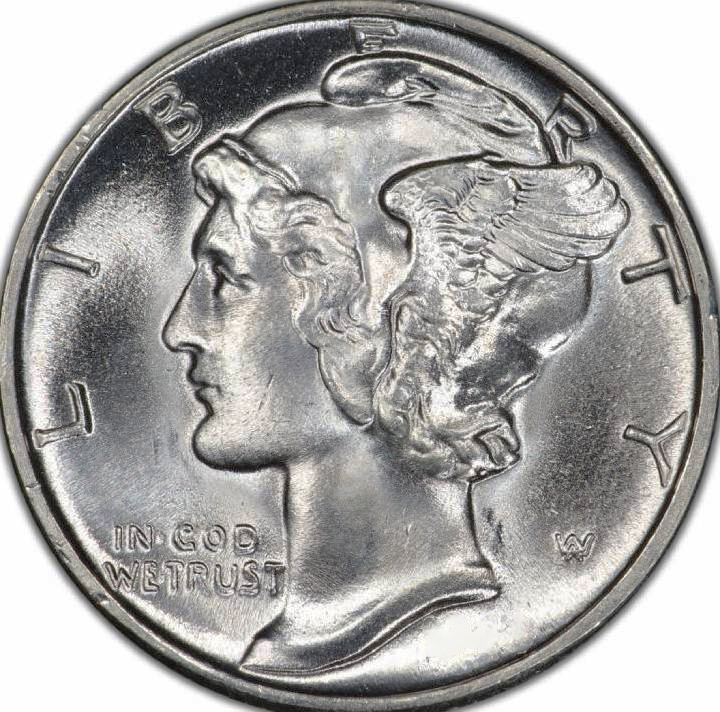
The 1916-D Mercury Dime is the key date of the entire Mercury series. Only 264,000 were struck in Denver in 1916 — by far the lowest production figure in a 30-year run that produced billions of dimes. Even a heavily-worn example trades in four figures, and high-grade examples reach into the tens of thousands.
This guide covers what the coin is actually worth at every grade, why Denver's 1916 mintage was so small, and how to tell a real 1916-D from the most common counterfeits — typically a 1916 Philadelphia coin with a fake D mintmark added.
What it's worth (catalog values by grade)
Values are pulled from the LuckyCoin catalog. The full grade-by-grade chart, including every Sheldon-scale grade and live eBay listings, lives on the 1916-D coin page.
| Grade | Approximate Value | What this grade looks like |
|---|---|---|
| G-4 | $1,500 | Heavy wear; date and D mintmark legible |
| F-12 | $2,600 | Most details visible; partial Liberty headband |
| VF-20 | $3,500 | Most details sharp; clear headband detail |
| XF-40 | $5,500 | Slight wear on highest points |
| AU-58 | $7,500 | Trace wear, most luster intact |
| MS-63 | $20,000 | No wear; minor contact marks; good strike |
| MS-65 | $26,000 | Sharp strike, near mark-free |
| MS-66 | $37,000 | Exceptional preservation |
For comparison, the 1916 Philadelphia Mercury from the same year is a common date — G-4 around $5, MS-63 around $80, MS-65 around $160. The mintmark-driven price ramp is dramatic. The 1916-S from San Francisco lands between the two — also relatively common, similar pricing to the Philadelphia.
Why Denver struck so few
The Denver Mint had limited press capacity in 1916, and most of it was committed to producing Standing Liberty Quarters — a brand-new design also debuting that year. The Mercury dime, also a brand-new design replacing the Barber dime, got whatever press time was left over. The result: 22 million dimes from Philadelphia, 10 million from San Francisco, and only 264,000 from Denver.
Most 1916-D dimes that left Denver entered circulation immediately. Almost none were saved as souvenirs at the time of issue — the date was unremarkable, the design was new but uncontroversial, and nobody knew yet that 1916-D would become a key date. By the time collectors realized the mintage was unusually low, the coins had been in pocket change for years and most had been worn down or spent.
That explains the modern population: plenty of 1916-Ds in lower grades (G-4, VG-8, F-12), very few in mint state, almost none with full original luster.
How to tell a real 1916-D from a counterfeit
Because the price gap between a 1916 Philadelphia ($5 G-4) and a 1916-D ($1,500 G-4) is so large, the most common counterfeit is a real 1916 Philadelphia coin with a fake D mintmark added. Three checks separate the real thing from this alteration:
1. The D mintmark style
The 1916 D mintmark used by the Denver Mint was a specific font and size — a small, slightly recessed D about 1mm tall with a particular curl shape. Added D mintmarks (typically applied with a punch or transferred from another coin) usually look too clean, too sharp at the edges, or sit too high on the field surface instead of being struck into it.
Comparison reference: examine the D on a known authentic 1916-D (in a slab) under 10× magnification, and compare to the D on a candidate. Real Ds show the same character profile as the rest of the coin's details — same wear, same strike depth.
2. Mintmark position
The D sits on the reverse, just left of the fasces base, near the bottom edge of the coin. Real 1916-D mintmarks are positioned precisely — counterfeit additions often sit slightly off-center relative to the genuine mintmark zone.
3. Slab requirement above $300
Any coin claimed to be a 1916-D priced above $300 should come with a PCGS, NGC, or ANACS slab. Period. All three grading services have authenticated thousands of authentic 1916-Ds and catalogued the exact die characteristics. Buying raw at full retail is a setup for buying a counterfeit. The authentication cost ($30–100) is rounding error compared to the coin's value.
Mercury dime grading and the "Full Bands" designation
Mercury dimes use the same Sheldon scale (1-70) as all US coins, but they have one additional specialty designation — Full Bands (FB). The fasces (bundle of rods) on the reverse has horizontal bands wrapping around it. On well-struck mint-state coins, both bands are completely separated by a clear dividing line. On weak strikes, they merge.
A 1916-D in MS-63 with Full Bands is significantly more valuable than the same grade without — the FB designation is a separate line on the price chart and can multiply value 2-3x at higher grades. For 1916-D in particular, FB examples are extremely rare because Denver's strikes that year tended toward weak.
Where the 1916-D sits in a Mercury collection
Most Mercury collectors save the 1916-D for last, the same way Lincoln cent collectors save the 1909-S VDB. It's by far the most expensive date in the series, often more than the rest of the set combined. The realistic path is to build out the rest of the Mercury catalog first — common dates, semi-keys (1921, 1921-D), the famous 1942/1 overdate — and then commit to the 1916-D when budget and timing align.
For mint-mark identification across every US denomination, see our How to Read Mint Marks on US Coins guide. The Mercury dime mintmark sits in an unusual location compared to most modern coins — left of the fasces base on the reverse, not next to the date on the obverse.
- How can I tell if my 1916 dime is the rare D version?
- Look for a small D mintmark on the reverse, just left of the base of the fasces (the bundle of rods). If there's no D, it's either the common 1916 Philadelphia ($5–$160 depending on grade) or the 1916-S ($5–$260). The D is small and easy to miss without a magnifier.
- What is a 1916-D Mercury dime worth?
- In Good (G-4) condition, around $1,500. In Fine (F-12), around $2,600. In Mint State (MS-63), around $20,000. Top- grade examples (MS-66 with Full Bands) reach into the tens of thousands.
- Why is the 1916-D so much rarer than the Philadelphia or San Francisco?
- Denver had limited press capacity in 1916 and most of it was used for the new Standing Liberty Quarter. Only 264,000 dimes were struck at Denver that year — compared to 22 million in Philadelphia and 10 million in San Francisco.
- Are 1916-D Mercury dimes still in circulation?
- Essentially no. The series ended in 1945, all Mercury dimes were 90% silver and pulled from circulation in the 1960s silver-coin removal, and the 1916-D specifically has been a recognized key date for over a century. Modern finds come from inherited collections and estate sales, not from change.
- How do I authenticate a 1916-D before buying?
- For any coin priced over $300, insist on a PCGS, NGC, or ANACS slab. The most common counterfeit is a real 1916 Philadelphia coin with a fake D mintmark added — graders spot these immediately by mintmark style and position.