Liberty Head 'V' Nickel: 1883–1913 Series Overview
Catalog values, history, and authentication — v nickel.
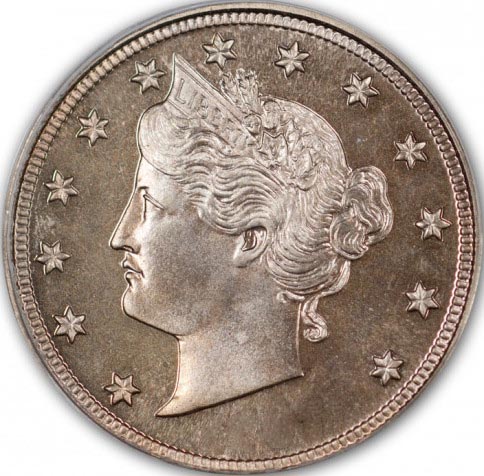
The Liberty Head Nickel— known to collectors simply as the "V Nickel" for the Roman numeral on its reverse — ran from 1883 to 1912 and bridges two of the most beloved US nickel series: the Shield Nickel before it and the Buffalo Nickelafter. Designed by Charles E. Barber, the coin had a thirty-year run on American pocket change, generated one of the great fraud stories in US Mint history, and closed with one of numismatics' most enduring mysteries — five coins that officially should not exist.
This guide covers the full series arc: the 1883 redesign and the infamous "No CENTS" variety, the branch-mint issues that bookend the run, the two key dates (1885 and 1912-S) with catalog values at every grade, and what is actually known about the 1913 Liberty Nickels.
Charles E. Barber and the 1883 redesign
By the early 1880s the Shield Nickel, introduced in 1866, had worn out its welcome both aesthetically and mechanically — its busy reverse design made clean strikes difficult. Mint Chief Engraver Charles E. Barber was tasked with a replacement. His solution was a classical bust of Liberty facing left, crowned with a coronet inscribed LIBERTY, surrounded by thirteen stars. The reverse carried a large Roman numeral "V" within a wreath, with the legend UNITED STATES OF AMERICA above and E PLURIBUS UNUM at the bottom.
The design is clean and authoritative — a deliberate contrast to the Shield Nickel's clutter. Barber's Liberty portrait is among the more refined of the era. Production began in early 1883 and the coin entered circulation that spring.
The 1883 "No CENTS" variety and the racketeer nickel
Barber's original reverse omitted the word CENTS entirely — the Roman numeral V was deemed sufficient to convey denomination. That assumption proved costly almost immediately. The new nickel was nearly the same size as a five-dollar gold piece, and opportunists quickly recognized that a gold-plated 1883 No CENTS nickel could be passed as a five-dollar gold coin to inattentive shopkeepers. The practice became common enough that newspapers reported on it, and the scheme gave these coins their lasting nickname: the racketeer nickel.
The Mint acted swiftly. By mid-1883, revised dies added the word CENTS in small letters beneath the V on the reverse. The two 1883 varieties — No CENTS and With CENTS — are both collectible today. The No CENTS version saw higher production before the change and survives in greater numbers; the With CENTS 1883 had the larger production run for the year. Both are affordable entry points to the series, typically priced well below the key dates.
Collectors should note that gold-plated No CENTS nickels were also intentionally preserved as souvenirs at the time, so plated examples are not necessarily fraud pieces — they are simply not numismatically desirable without a genuine authentication story. A plain, unplated No CENTS 1883 is what belongs in a collection.
Series continuity: same design from 1883 to 1912
After the CENTS correction, Barber's design ran unchanged for nearly three decades. Philadelphia struck the vast majority of Liberty Nickels throughout the series — branch mints did not produce V Nickels until the very end of the run. This means most dates from 1884 through 1911 are Philadelphia-only issues, and while some years have lower mintages than others, the series is generally approachable for collectors building a complete date set.
The exceptions are the two genuine key dates: 1885, with a Philadelphia mintage of just 1,472,700 — low by the standards of an era when nickels circulated heavily — and the 1912-S, the lowest-mintage coin in the entire series. See the value tables below.
Branch-mint issues: 1912-D and 1912-S
For virtually the entire Liberty Nickel run, Philadelphia was the sole mint striking the coin. That changed only in the final production year. In 1912, both Denver and San Francisco produced V Nickels for the first and only time. The 1912-D is scarce; the 1912-S with a mintage of just 238,000 pieces is the rarest business-strike issue in the series by a wide margin.
For collectors unfamiliar with reading branch-mint marks on early twentieth-century US coins, see our guide to reading mint marks. On the Liberty Nickel, the mintmark appears on the reverse to the left of CENTS at the bottom of the coin.
Key date values: 1885 Liberty Nickel
The 1885 is the first key date collectors encounter when building the series. Its 1,472,700 mintage sounds substantial in isolation, but the coin saw heavy circulation and most examples are well worn. Finding a problem-free example above VF is genuinely difficult.
| Grade | Approximate Value | What this grade looks like |
|---|---|---|
| AG-3 | $240 | Heavily worn; date legible, design outline only |
| G-4 | $340 | Liberty's outline clear; major details flat |
| VG-8 | $700 | Some hair and coronet detail visible |
| F-12 | $900 | Most hair detail visible; LIBERTY fully readable |
| VF-20 | $1,200 | Most details sharp; light wear on highest points |
| XF-40 | $1,500 | All details sharp; trace wear on hair and cheek |
| AU-50 | $2,100 | Slight wear on high points; most luster intact |
| AU-55 | $2,200 | Faintest wear; luster nearly complete |
| AU-58 | $2,300 | Almost uncirculated; original mint luster mostly intact |
| MS-60 | $2,500 | No wear; noticeable contact marks or blemishes |
| MS-62 | $3,400 | No wear; several distracting marks |
| MS-63 | $4,000 | No wear; minor contact marks |
| MS-64 | $6,000 | Sharp strike; few minor marks |
| MS-65 | $8,000 | Gem; nearly mark-free, strong luster |
| MS-66 | $11,000 | Exceptional preservation; very few marks |
Catalog snapshot. Coin markets move — for any transaction, check current dealer pricing and the live grade-by-grade chart.
Key date values: 1912-S Liberty Nickel
The 1912-S is the lowest-mintage business-strike Liberty Nickel at 238,000 pieces. Unlike the 1885, which at least had Philadelphia production behind it, the 1912-S is the sole source for that San Francisco date. Even worn examples trade at a significant premium, and the coin becomes genuinely expensive above XF.
| Grade | Approximate Value | What this grade looks like |
|---|---|---|
| AG-3 | $110 | Heavily worn; date and mintmark barely legible |
| G-4 | $150 | Liberty's outline clear; major details flat |
| VG-8 | $190 | Some hair detail; full rim present |
| F-12 | $210 | Most hair detail visible; LIBERTY readable |
| VF-20 | $500 | Most details sharp; light wear on highest points |
| XF-40 | $1,100 | All details sharp; trace wear on hair and cheek |
| AU-50 | $1,400 | Slight wear on high points; most luster intact |
| AU-55 | $1,700 | Faintest wear; luster nearly complete |
| AU-58 | $1,800 | Almost uncirculated; original mint luster mostly intact |
| MS-60 | $1,900 | No wear; noticeable contact marks or blemishes |
| MS-62 | $1,900 | No wear; several distracting marks |
| MS-63 | $2,100 | No wear; minor contact marks |
| MS-64 | $2,400 | Sharp strike; few minor marks |
| MS-65 | $3,200 | Gem; nearly mark-free, strong luster |
| MS-66 | $6,000 | Exceptional preservation; very few marks |
Catalog snapshot. Coin markets move — for any transaction, check current dealer pricing and the live grade-by-grade chart.
One important note on 1912-S authentication: because the S mintmark appears only this one year on the Liberty Nickel, altered coins — typically a 1912 Philadelphia with a fake S added — do appear in the market. Any 1912-S above Good condition warrants a PCGS or NGC slab before a significant purchase.
The legendary 1913 Liberty Nickel
The Liberty Head design was officially replaced by the Buffalo Nickel beginning in 1913. No 1913-dated Liberty Nickels were authorized for production. And yet five of them exist.
The coins surfaced publicly around 1920, when a former Mint employee named Samuel W. Brown displayed all five at the American Numismatic Association convention and began advertising to acquire 1913 Liberty Nickels. Many numismatic historians have concluded that Brown — who had worked at the Philadelphia Mint in 1913 — likely arranged for the coins to be struck, though Q. David Bowers and others have noted that legitimate explanations (Mint Medal Department production for cabinet purposes, or trial pieces struck in late 1912) cannot be ruled out. How exactly the dies were used has never been conclusively established. What is known: all five specimens have been authenticated, all five have documented ownership histories stretching back to the 1920s, and all five have sold for prices in the millions. The Eliasberg specimen — graded PR-66 and considered the finest known — set the public auction record at $4.56 million in a 2018 Stack's Bowers sale, and the Olsen specimen (famously featured on Hawaii Five-O) brought $3.7 million at a Heritage auction in January 2010.
The 1913 Liberty Nickel is not a coin that any collector should expect to encounter. It is mentioned here because it is inseparable from the series narrative and because "I found a 1913 Liberty Nickel" is one of the most common misidentification claims in numismatics — nearly always the result of a worn date on a Buffalo Nickel or a misread 1910 or 1918. If you believe you have one, the path forward is straightforward: contact PCGS or NGC directly.
The Buffalo Nickel takes over in 1913
Treasury Secretary Franklin MacVeagh authorized a new nickel design in the early 1910s as part of the broader push — begun under Theodore Roosevelt — to replace the workmanlike Barber-era coinage with more artistic designs. Sculptor James Earle Fraser's design — a Native American portrait on the obverse and an American bison on the reverse — entered production in early 1913 and immediately displaced the Liberty Head design. The Buffalo Nickel ran until 1938.
For collectors, the Liberty Nickel series thus sits in a clean bracket: 1883 through 1912, Philadelphia only except for the final year, with two defined key dates and one legendary phantom. Building a complete circulated set of Philadelphia dates is achievable at modest cost for most years; adding the 1885 and 1912-S pushes the budget meaningfully higher. See our Buffalo Nickel key dates guide for what comes next in the five-cent series, and our Jefferson Nickel guide for the wartime silver issues that follow.
- What is a V Nickel?
- "V Nickel" is the common collector name for the Liberty Head Nickel struck from 1883 to 1912. The nickname comes from the large Roman numeral V on the reverse, which served as the denomination marker. The obverse shows a classical bust of Liberty facing left, designed by Chief Engraver Charles E. Barber.
- What is the "No CENTS" 1883 nickel and is it valuable?
- The original 1883 Liberty Nickel omitted the word CENTS from the reverse, relying on the Roman numeral V alone. Fraudsters quickly gold-plated these coins and passed them as five-dollar gold pieces — earning them the nickname "racketeer nickels." The Mint corrected the design mid-year by adding CENTS below the V. Both 1883 varieties are collectible, but neither is a key date; circulated examples of both are affordable for most collectors.
- What are the key dates in the Liberty Nickel series?
- The two primary key dates are the 1885 (Philadelphia mintage of 1,472,700, with values from $240 in AG-3 up to $11,000 in MS-66) and the 1912-S (mintage of 238,000 — the lowest in the series — with values from $110 in AG-3 up to $6,000 in MS-66). The 1912-D is also scarce. All other dates are primarily Philadelphia strikes and are generally more available.
- How do I tell if I have a 1913 Liberty Nickel?
- Genuine 1913 Liberty Nickels are among the rarest US coins — only five are known to exist, all accounted for with established ownership histories. A coin you find in a collection or purchase cheaply is almost certainly not one of them. The most common misidentifications are Buffalo Nickels with worn or damaged dates that obscure the design type. If you genuinely believe you have a 1913 Liberty Nickel, submit it directly to PCGS or NGC for authentication.
- Were all Liberty Nickels made in Philadelphia?
- Almost. Philadelphia struck the Liberty Nickel exclusively from 1883 through 1911. Branch-mint production happened only in 1912, when both Denver (1912-D) and San Francisco (1912-S) struck V Nickels for the first and only time. The 1912-S at 238,000 pieces is the lowest-mintage business strike in the entire series.
- Should I buy a raw or slabbed Liberty Nickel?
- For common dates in circulated grades, raw coins from reputable dealers are fine. For the 1885 or 1912-S above Good condition — or any coin presented as a 1912-D or 1912-S — a PCGS or NGC slab is strongly recommended. Both key dates have been subject to mintmark alteration, and the premium paid for an authenticated example is well worth the protection against buying a doctored coin.
- What replaced the Liberty Nickel?
- The Buffalo Nickel, designed by sculptor James Earle Fraser, replaced the Liberty Head design in 1913 and ran until 1938. It was followed by the Jefferson Nickel, which has been produced continuously since 1938. See our Buffalo Nickel key dates guide for the series that immediately followed.