Jefferson Nickel Key Dates and the Silver Wartime Issues
Catalog values and authentication details — jefferson nickel value.
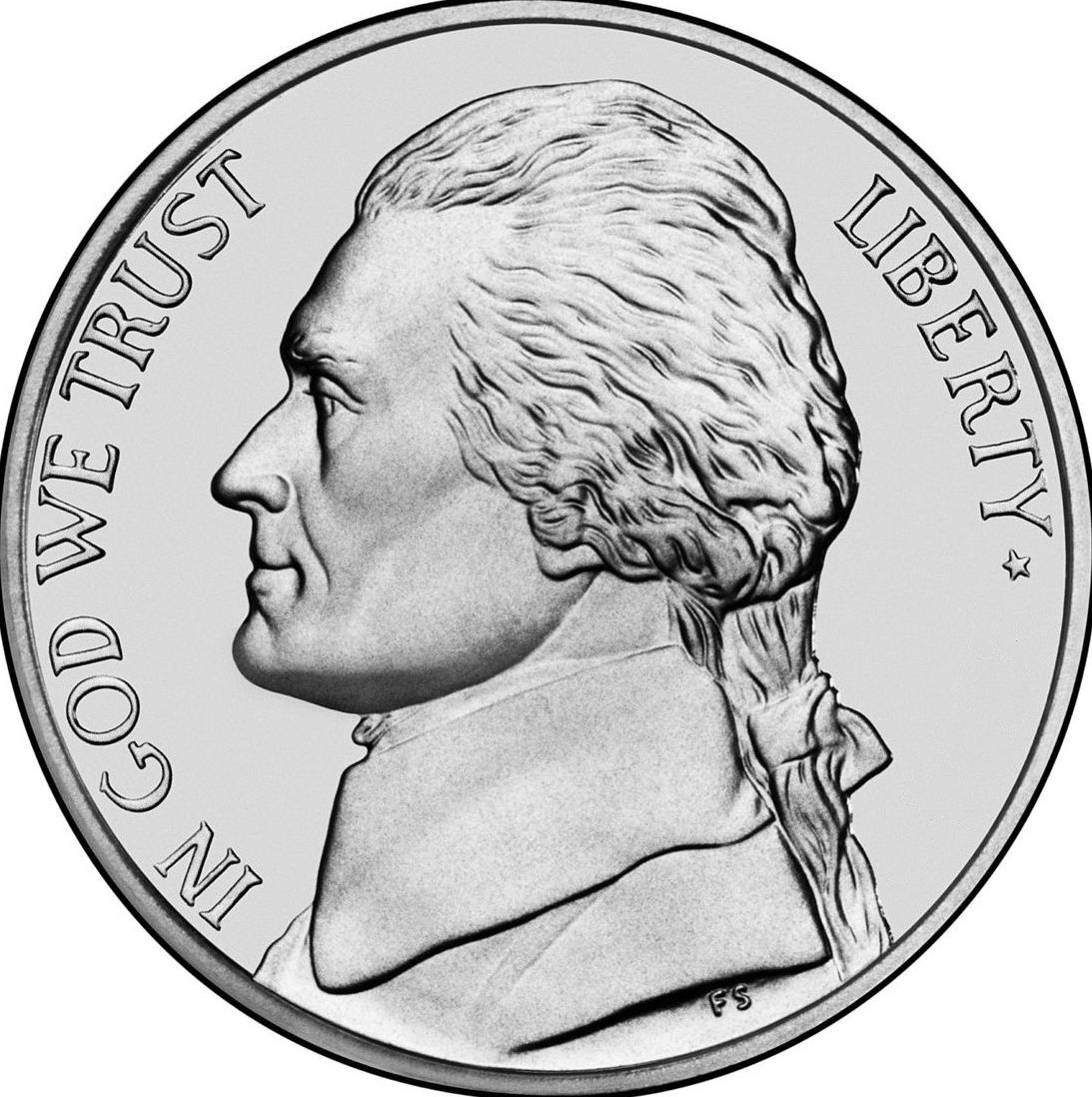
Most Jefferson nickels pulled from a change jar are worth exactly five cents. A small handful are worth far more — and two of them are hiding in plain sight in everyday coins. The 1942–1945 wartime nickels contain 35% silver and can be identified in seconds with no magnification. The 1950-D is the lowest-mintage circulating Jefferson ever struck. And the 1939 Doubled Monticello variety rewards collectors patient enough to hunt for it.
This guide walks through the series context, the catalog values for every key date we have data on, how to identify a silver wartime nickel at a glance, and what to do once you find one.
Series context: Felix Schlag and the Jefferson nickel
The Jefferson nickel debuted in 1938, replacing the Buffalo nickel after a 25-year run. The Mint held an open design competition won by sculptor Felix Schlag, whose portrait of Thomas Jefferson on the obverse and rendering of Monticello on the reverse have anchored the series ever since. The design has been updated twice — a westward journey commemorative run in 2004–2005 and a portrait update in 2006 — but the core Jefferson / Monticello theme remains. The full series overview lives on the Jefferson nickel series page.
Standard composition is 75% copper / 25% nickel. The notable exception is the wartime period of mid-1942 through 1945, when nickel was diverted to the war effort and the alloy was changed to 56% copper, 35% silver, and 9% manganese. That silver content is what makes those dates collectible regardless of grade — and identifiable without a scale or acid test.
The wartime silver nickels (1942–1945)
Congress authorized the composition change in 1942, and the Philadelphia Mint began striking silver-alloy nickels partway through that year. To signal the change to Treasury sorters, the Mint moved the mintmark from beside the date on the obverse to a large letter above Monticello on the reverse — and for the first time, Philadelphia-struck coins received a mintmark at all (a large P). Denver coins show a large D and San Francisco a large S in the same position.
Every wartime nickel contains 0.05626 troy ounces of silver. At any modern silver price the melt value far exceeds face value, so even heavily worn wartime nickels carry a meaningful premium above five cents. See our pre-1965 silver coins guide for melt-value math that applies to the full range of US silver coinage.
1942-P wartime nickel — catalog values
The 1942-P was struck in large numbers — 57,873,000 — so the coin itself is common. Its value floors at silver content in lower grades and climbs sharply only in gem Mint State. The large P above Monticello is the fastest way to confirm a silver example.
| Grade | Approximate Value | What this grade looks like |
|---|---|---|
| VG-8 | $2 | Major design elements visible; heavy wear throughout |
| F-12 | $2 | All lettering sharp; moderate wear on high points |
| VF-20 | $2 | Light wear; Monticello columns distinct |
| XF-40 | $2 | Slight wear on Jefferson's cheek and hair |
| AU-50 | $5 | Trace wear; most luster intact |
| AU-58 | $6 | Faintest wear; nearly full luster |
| MS-60 | $7 | No wear; bag marks and contact present |
| MS-63 | $10 | Moderate luster; few noticeable marks |
| MS-64 | $15 | Above-average strike and surface |
| MS-65 | $21 | Strong luster; minor imperfections only |
| MS-66 | $30 | Well struck; nearly mark-free |
| MS-67 | $110 | Exceptional preservation; sharp full steps a plus |
| MS-68 | $3,900 | Essentially perfect; very few known |
Catalog snapshot. Coin markets move — for current pricing and the live grade-by-grade chart, visit the Jefferson nickel series page.
1942-D — catalog values
The 1942-D is the non-silver Denver issue struck before Denver transitioned to the silver alloy. With only 13,938,000 struck, it is meaningfully scarcer than the 1942-P wartime issue and commands a stronger premium across most circulated grades. It does not carry the large mintmark above Monticello — the D appears in the standard small position beside the date — and it is standard copper-nickel alloy, not silver.
| Grade | Approximate Value | What this grade looks like |
|---|---|---|
| VG-8 | $0.40 | Major design elements visible; heavy wear |
| F-12 | $0.50 | All lettering sharp; moderate wear |
| VF-20 | $2 | Light wear; Monticello columns distinct |
| XF-40 | $6 | Slight wear on highest points |
| AU-50 | $9 | Trace wear; most luster intact |
| AU-58 | $11 | Faintest wear; nearly full luster |
| MS-60 | $15 | No wear; bag marks and contact present |
| MS-63 | $21 | Moderate luster; few noticeable marks |
| MS-64 | $30 | Above-average strike and surface |
| MS-65 | $45 | Strong luster; minor imperfections only |
| MS-66 | $65 | Well struck; nearly mark-free |
| MS-67 | $210 | Exceptional preservation |
| MS-68 | $6,000 | Essentially perfect; condition rarity |
Catalog snapshot. Markets move — verify current pricing before any transaction.
The 1950-D: lowest-mintage circulating Jefferson
After World War II the wartime alloy was discontinued and the series returned to standard copper-nickel. Most postwar Jefferson nickels are common. The exception is the 1950-D, struck at the Denver Mint in a mintage of only 2,630,030 — the lowest production run of any circulation-strike Jefferson nickel in the entire series. Collectors recognized the low mintage immediately, and quantities were set aside in Mint State from the start, which is why the coin is available in high grades but still commands a premium.
| Grade | Approximate Value | What this grade looks like |
|---|---|---|
| VG-8 | $6 | Major design elements visible; heavy wear |
| F-12 | $6 | All lettering sharp; moderate wear |
| VF-20 | $7 | Light wear; Monticello columns distinct |
| XF-40 | $7 | Slight wear on highest points |
| AU-50 | $8 | Trace wear; most luster intact |
| AU-58 | $9 | Faintest wear; nearly full luster |
| MS-60 | $9 | No wear; bag marks and contact present |
| MS-63 | $10 | Moderate luster; few noticeable marks |
| MS-64 | $11 | Above-average strike and surface |
| MS-65 | $21 | Strong luster; minor imperfections only |
| MS-66 | $55 | Well struck; nearly mark-free |
| MS-67 | $210 | Exceptional preservation |
Catalog snapshot. Markets move — verify current pricing before any transaction.
Note that the premium over face value is modest in lower circulated grades — a worn 1950-D at $6–$7 is not a windfall. The real premium kicks in at XF and above, where fewer examples survived without the contact marks that come from bulk coin handling.
Notable varieties: 1939 Doubled Monticello and the 1943/2-P overdate
The 1939 Doubled Monticello is the best-known early Jefferson variety. A doubled die on the reverse creates a visible doubling of the Monticello building and the word FIVE CENTS under magnification. Because catalog data for this variety is not currently available in the LuckyCoin database [catalog-missing], we are not publishing numeric values here — check a current printed price guide or PCGS CoinFacts for recent auction records before buying or selling. Authentication by PCGS or NGC is strongly recommended for any example claimed to show this doubling, as the effect can be mimicked by machine doubling, which carries no premium.
The 1943/2-P overdate — where a 1942-dated die was repunched with a 1943 date, leaving ghost remnants of the 2 visible inside the 3 — is another variety that attracts serious collector interest; as a 1943-P it is a wartime silver issue. Both varieties reward collectors who study die characteristics under a loupe rather than chasing mintage numbers alone.
How to identify a wartime silver nickel in change
The Mint designed the wartime identification system to be fast and foolproof for Treasury sorters, which means it works just as well for collectors today. Flip the coin to the reverse and look at the top of Monticello:
- Large P, D, or S above the dome = silver wartime nickel (1942–1945). Set it aside.
- No mintmark or a small mintmark beside the date on the obverse = standard copper-nickel composition.
No scale, no acid, no magnet needed. The large reverse mintmark is exclusive to the wartime silver alloy years. Once you know what to look for, a wartime nickel takes about two seconds to identify in any coin roll or collection. For a broader primer on reading mintmarks across all US series, see our how to read mint marks guide.
One caution: the 1942-P wartime issue started partway through the year, so not every 1942-P is silver. Only the ones with the large P above Monticello on the reverse are the silver wartime type. A 1942 Philadelphia coin without any reverse mintmark is the earlier copper-nickel issue.
Silver content and melt value
Each wartime nickel (1942 large-mintmark through 1945) contains exactly 0.05626 troy ounces of silver. To calculate current melt value, multiply that figure by the spot price of silver. Dealer buy prices for common-date wartime nickels in worn condition typically run somewhat below melt; gem examples command a collector premium above melt. Our pre-1965 silver coins guide covers melt math for Roosevelt dimes, Washington quarters, and Franklin half dollars alongside the wartime nickels, so you can total up a mixed silver find in one place.
Because the silver content is fixed regardless of grade, a heavily worn AG-3 wartime nickel and a VF-20 wartime nickel carry the same melt value. The collector premium above melt only becomes meaningful at XF-40 and higher, and for key dates and varieties at any grade.
Where these coins fit in a Jefferson nickel collection
Building a complete Jefferson nickel set is one of the more approachable challenges in US coin collecting — most dates are common and inexpensive, and the series is still being minted. The wartime silver issues (1942–1945) are natural targets early in the build because they are identifiable by design feature rather than mintage research, and even worn examples have silver value as a floor. The 1950-D is typically the last piece collectors add: low mintage, widely recognized, and priced accordingly even in circulated grades. Varieties like the 1939 Doubled Monticello are optional specialty pursuits that reward patient searchers.
For comparison with other five-cent designs, the Buffalo nickel series has its own key dates — including the 1913-S Type 2 and 1926-S — that overlap in price range with the rarer Jefferson issues. The full family of US nickel series is on the US nickels overview page.
- How do I know if my nickel is silver?
- Flip it to the reverse. If there is a large P, D, or S mintmark directly above the dome of Monticello, it is a wartime silver nickel (1942–1945) containing 35% silver. Standard Jefferson nickels have no reverse mintmark or a small mintmark beside the date on the obverse only.
- What is a 1950-D Jefferson nickel worth?
- In worn circulated grades (VG through XF), catalog values range from $6 to $7. The premium grows at higher grades: AU-58 is $9, MS-65 is $21, MS-66 is $55, and MS-67 is $210. The low mintage of 2,630,030 makes it the key date for circulating Jefferson nickels, but the premium in lower grades is modest.
- Are all 1942 nickels silver?
- No. The composition change happened partway through 1942. Only 1942-dated coins with a large mintmark above Monticello on the reverse are the 35% silver wartime type. A 1942 Philadelphia coin without any reverse mintmark is standard copper-nickel. Denver did not strike silver-alloy nickels until 1943.
- How much silver is in a wartime nickel?
- Each wartime nickel (any date 1942–1945 with the large reverse mintmark) contains 0.05626 troy ounces of silver. Multiply that figure by the current spot price of silver to get the melt value. A roll of 40 wartime nickels holds approximately 2.25 troy ounces of silver.
- What is the 1939 Doubled Monticello variety?
- It is a doubled-die variety on the 1939 Philadelphia Jefferson nickel where the Monticello building and FIVE CENTS lettering show visible doubling under magnification. Catalog pricing for this variety is not currently in the LuckyCoin database [catalog-missing], so we recommend checking PCGS CoinFacts or a current printed price guide for recent auction records. Authentication by a third-party grading service is recommended before buying or selling.
- Should I clean a wartime nickel before selling it?
- No. Cleaning any coin — including wartime nickels — removes original surface and destroys collector value. Even a gentle rinse can leave microscopic hairlines that cause a professional grading service to note cleaning as a problem. The silver melt value is unaffected by surface condition, but any collector premium above melt depends on original, undamaged surfaces.
- Is the 1942-D Jefferson nickel a wartime silver coin?
- No. The 1942-D is a standard copper-nickel coin struck before Denver transitioned to the silver alloy. It has no large mintmark above Monticello on the reverse. It is worth collecting for its relatively low mintage of 13,938,000, with catalog values ranging from $0.40 in VG-8 up to $6,000 in MS-68, but it contains no silver.