1916 Standing Liberty Quarter: Value, History, and Authentication
Catalog values, history, and authentication — 1916 standing liberty quarter value.
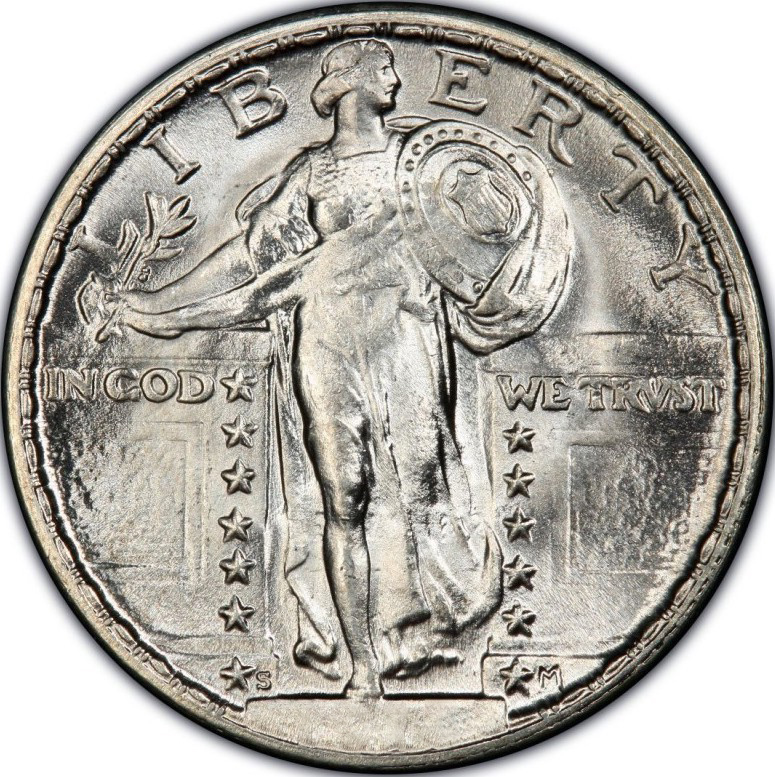
The 1916 Standing Liberty Quarter is one of the rarest regularly-issued 20th-century US coins. Only 52,000 were struck — a run so small that the Philadelphia Mint produced more coins of almost any other denomination in a single afternoon. The design, featuring a bare-chested Liberty stepping through a gateway, lasted just months in its original form before public pressure forced a redesign. First-year scarcity, a one-year Type 1 obverse, and a century of collector demand combine to make the 1916 the capstone of the entire Standing Liberty Quarter series.
This guide covers the coin's catalog values at every grade, why mintage stopped at 52,000, how to distinguish a genuine 1916 from the most common counterfeit (an altered 1917), and what to do if you find a Standing Liberty quarter with no visible date.
What it's worth (catalog values by grade)
Values below come from the LuckyCoin catalog. The full grade-by-grade chart with current sold-listing data lives on the 1916 Standing Liberty Quarter coin page.
| Grade | Approximate Value | What this grade looks like |
|---|---|---|
| AG-3 | $2,600 | Date barely visible; Liberty's outline present but flat |
| G-4 | $3,200 | Date readable; major design elements worn smooth |
| VG-8 | $5,000 | Outline of shield visible; some detail in gown |
| F-12 | $6,000 | Most major details present; high points worn flat |
| VF-20 | $8,000 | Design details clear; wear on Liberty's breast and head |
| XF-40 | $9,000 | All details sharp; trace wear on highest relief points |
| AU-50 | $11,000 | Slight wear on Liberty's head and breast; luster in fields |
| AU-55 | $11,000 | Faint wear; most original luster intact |
| AU-58 | $12,000 | Barely perceptible wear; nearly full luster |
| MS-60 | $13,000 | No wear; bagmarks and contact marks present |
| MS-63 | $17,000 | No wear; scattered moderate marks |
| MS-64 | $21,000 | Minor distracting marks; sharp strike |
| MS-65 | $26,000 | Strong eye appeal; only minor blemishes |
| MS-66 | $37,000 | Exceptional surface quality; well struck |
| MS-67 | $70,000 | Virtually perfect; top of the population |
Catalog snapshot. Coin markets move — for any transaction, verify against current dealer pricing and the live grade-by-grade chart.
Why only 52,000: a mid-year design change
Through 1915 and into 1916, the quarter dollar slot was occupied by the Barber Quarter, a long-running design that had been in continuous production since 1892. The Treasury Department commissioned sculptor Hermon Atkins MacNeil to replace it as part of a broader beautification of US coinage. The new design — Liberty standing in an open gateway, right arm raised holding an olive branch, left arm supporting a shield, and her torso bare — was approved and dies were finally ready late in 1916.
With only weeks left in the calendar year, the Philadelphia Mint struck just 52,000 coins before production halted for the year-end die change. No other mint struck the quarter in 1916; there is no 1916-D or 1916-S. The entire mintage came from a single facility in a single short run. Compare that with the 1917 Type 1 Philadelphia quarter, which had a mintage of 8,740,000 — more than 168 times larger — and you understand immediately why the 1916 commands the premiums it does.
The design itself also lasted in its original form for only one full calendar year. By 1917, public objection to Liberty's exposed breast led to a redesign that added a coat of mail covering the figure. That revision created the Type 2 design, which ran through 1930. The 1916 is therefore both a key date by mintage and the sole Philadelphia example of the Type 1 first-year obverse.
How to identify an authentic 1916
The Type 1 obverse: bare-chested Liberty
Every genuine 1916 Standing Liberty quarter — and every 1917 Type 1 — shows Liberty's right breast exposed above the gown line. From 1917 Type 2 onward, the same figure wears a full coat of chain mail across the torso. If the coin you're examining has a mailed breast, it is not a 1916 and not a Type 1 at all.
No mintmark means Philadelphia
The 1916 was struck only in Philadelphia, which did not use a mintmark during this era. There should be no letter on the obverse. If you see a D or S on what is claimed to be a 1916, it is altered or misidentified. For a primer on reading mintmarks across the series, see our guide to reading mint marks.
The date position and font
On the Standing Liberty quarter, the date appears recessed into the base below Liberty's feet — a design choice that caused notorious wear problems (more on that below). On a genuine 1916, the date reads clearly as "1916." The numeral 6 in particular has a distinctive closed loop; counterfeiters altering a 1917 sometimes leave tool marks around the last digit.
How to authenticate: the 1917 Type 1 alteration problem
Because the 1917 Type 1 Philadelphia quarter shares the same obverse design as the 1916 — bare-chested Liberty, no mintmark — and cataloged at VG-8 for just $50, it is the overwhelming favorite source coin for counterfeiters. The fraud: grind or recut the "7" in the date into a "6," then present the coin as a 1916 worth thousands. Here is how to detect it.
1. Examine the last digit under magnification
A genuine 1916 has a "6" that was struck from the die in a single action — the loop, the tail, and the field around it are all at the same surface level with no tool disturbance. An altered "7" typically shows a filled or heavily rounded top where the horizontal bar of the 7 was removed, uneven metal flow around the digit, and sometimes a slight raised burr at the edge of the modified area. Even experienced forgers leave microscopic evidence under a 10x loupe.
2. The field around the date should be undisturbed
When the recessed date area is altered, the surrounding field — already a shallow, protected pocket — picks up polishing marks or tool drag lines. On a genuine coin, the recessed area should show only the wear pattern consistent with circulation or storage, not the directional scratches of a graver or Dremel tool.
3. Overall proportions of the date
Compare the entire date against a reference photograph of a genuine 1916. An altered coin will usually retain the digit spacing and style of a 1917, with only the last digit reworked, which experienced eyes can detect under side-by-side comparison. PCGS and NGC both publish high-resolution type images.
4. Third-party grading for any transaction over $500
Given that even a heavily worn genuine 1916 in AG-3 catalogs at $2,600, there is no defensible reason to buy a raw (unslabbed) coin at anything near full retail. PCGS and NGC have seen enough genuine 1916 quarters and altered 1917s to catch virtually all altered-date fakes. A slabbed genuine 1916 commands premium retail; an unslabbed 1916 should command deep skepticism.
The recessed-date problem: dateless Standing Liberty quarters
MacNeil's original design placed the date in a recessed panel at the base of the figure. In theory this protected the date from wear. In practice, the recessed area accumulated dirt and the high-relief surrounding rim caused uneven striking pressure, leaving dates weakly impressed on many coins from the start. Once coins circulated, the date wore away faster than virtually any other denomination of the era. The result: a huge population of "dateless" Standing Liberty quarters that cannot be identified by year.
A dateless Standing Liberty quarter from the Standing Liberty series is typically worth only a small premium over silver melt as a type coin regardless of which year it came from. There is no premium for a dateless coin that might be a 1916, because "might be" cannot be sold at 1916 prices.
Nic-A-Date acid restoration
A commercial product called Nic-A-Date applies a mild acid to the date area, etching the recessed metal slightly differently depending on the original die impression and revealing a faint date on coins where the digits were struck adequately but later worn. The technique genuinely works on many Standing Liberty quarters. The catch: any coin treated with Nic-A-Date is considered chemically altered and will receive a "details" or "net" grade from PCGS or NGC, not a straight numerical grade. A Nic-A-Date treated 1916, even if the date reads clearly after treatment, will not slab as a straight MS or AU coin and will sell at a significant discount to an untreated example. Use it to satisfy curiosity, not to increase resale value.
The 1916 in context: where it sits in the series
For collectors building a complete Standing Liberty Quarter set, the 1916 is the undisputed key date — more expensive in every grade than any other issue in the series. The full history of the design, including the Type 1 to Type 2 transition and the 1925 recessed-date correction, is covered in our Standing Liberty Quarter history guide. Collectors who complete the Standing Liberty series often move on to the Washington Quarter, which took over the denomination in 1932; the 1932-D Washington Quarter is that series' own classic key date.
Most serious collectors acquire the 1916 last, after filling the more affordable dates. In lower grades it is expensive but achievable; a G-4 at $3,200 is within reach for a committed collector. Mint-state examples are genuinely rare — the 52,000 mintage, combined with the fact that most coins went directly into circulation in 1916–1917 pocket change, means the surviving uncirculated population is very small.
- How rare is the 1916 Standing Liberty quarter?
- With a mintage of just 52,000, the 1916 is one of the lowest-mintage regularly-issued US quarters of the 20th century. For comparison, the 1917 Type 1 Philadelphia quarter — same design, next year — had a mintage of 8,740,000. Most of the 52,000 1916 coins went into circulation immediately and were heavily worn by the time collectors recognized the rarity.
- What is a 1916 Standing Liberty quarter worth?
- Catalog values range from $2,600 in AG-3 (barely readable date) to $70,000 in MS-67. A G-4 grades at $3,200; a VF-20 at $8,000; and an MS-65 at $26,000. These are catalog reference points — actual transaction prices vary. Always check current dealer and auction data before buying or selling.
- How do I tell a 1916 from a 1917 Type 1?
- Both coins share the same bare-chested Liberty obverse and no mintmark. The only difference is the date. Examine the last digit under magnification: a genuine "6" should show no tool marks, filled areas, or disturbed metal around the loop. The 1917 Type 1 is a common source coin for altered-date counterfeits because it catalogs at just $26 in G-4 versus $3,200 for a genuine 1916 G-4. Have any raw coin authenticated by PCGS or NGC before paying significant money.
- Why do so many Standing Liberty quarters have no date?
- MacNeil's original design placed the date in a recessed panel at the base of the coin. Many coins were weakly struck there to begin with, and the shallow relief of the date area wore smooth quickly in circulation. This is a series-wide issue, not unique to the 1916. A dateless Standing Liberty quarter is worth only a few dollars as a type coin regardless of what year it might have been.
- Does Nic-A-Date work on Standing Liberty quarters, and should I use it?
- The acid treatment can reveal a readable date on coins that were adequately struck but later worn. However, any coin treated with Nic-A-Date is considered chemically altered by PCGS and NGC and will receive a "details" designation rather than a clean numerical grade. A treated 1916 with a revealed date will sell at a steep discount compared to an untouched example of the same grade. Use it to satisfy curiosity about what you have, not to increase resale value.
- Should I have my 1916 Standing Liberty quarter professionally graded?
- Yes, for any coin you believe is a genuine 1916. Even in AG-3 the catalog value is $2,600, which makes third-party authentication by PCGS or NGC essential — both for confirming authenticity and for establishing a clean grade record that protects resale value. Do not clean, dip, or treat the coin in any way before submission.
- What replaced the Standing Liberty quarter?
- The Washington Quarter replaced the Standing Liberty in 1932, marking the 200th anniversary of George Washington's birth. The transition year produced its own key date — the 1932-D — which is the rarest early Washington quarter.