Indian Head Penny Value Chart by Year (1859–1909)
Catalog values and authentication details — indian head penny value chart.
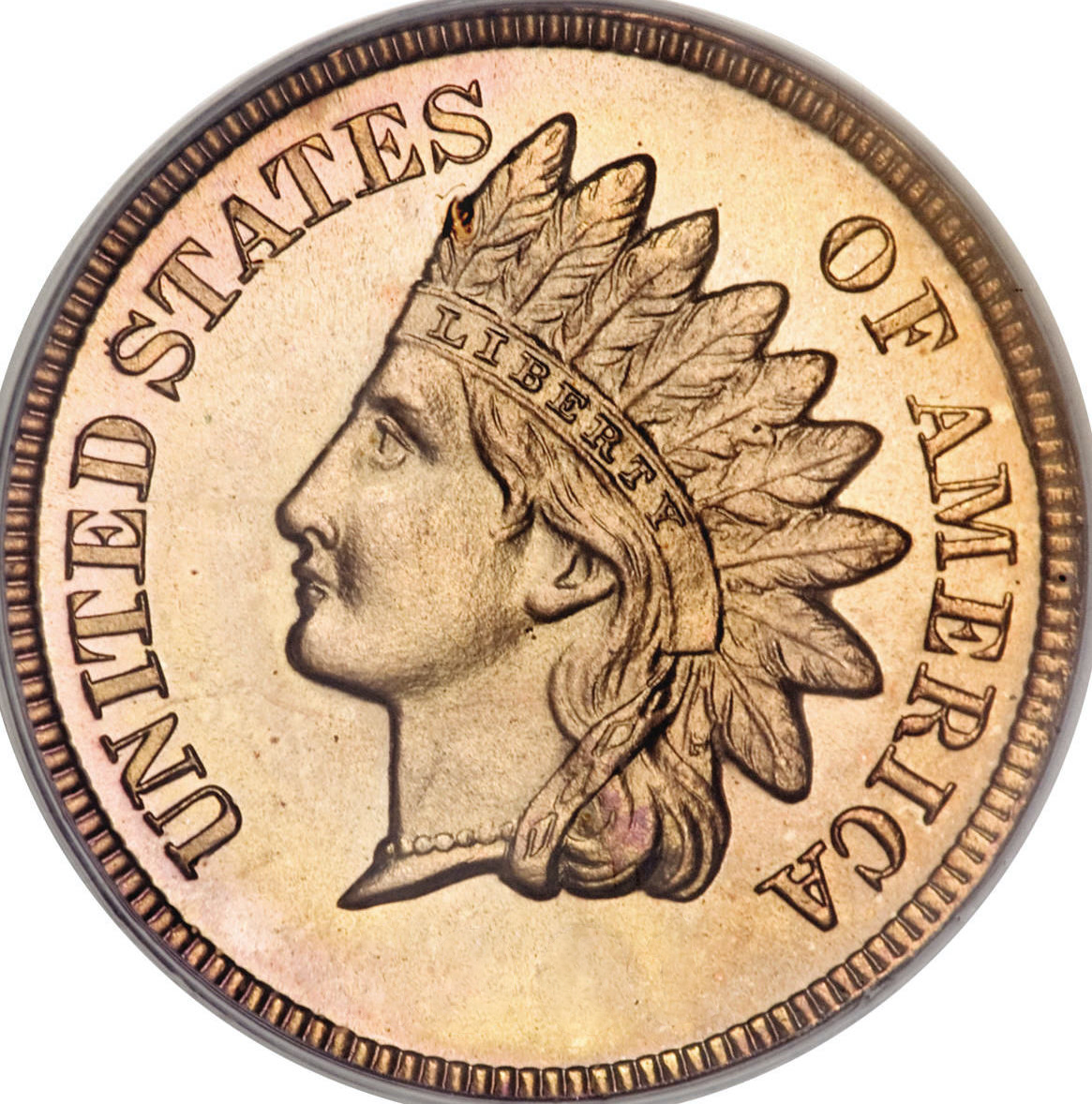
The Indian Head cent ran for exactly fifty years — from 1859, when it replaced the Flying Eagle cent, through 1909, when the Lincoln cent took its place. In that half-century the Mint struck billions of Indian Head cents, but a handful of dates came out in such small numbers that they now sell for hundreds or thousands of dollars even in heavily worn condition.
This guide gives you a year-by-year value chart for the series, explains the two composition changes that affect how you identify and grade these coins, and walks through the key dates that drive real collector demand. For a full interactive grade-by-grade breakdown, see the Indian Head cent price guide.
Composition history: two metals, three designs
Indian Head cents were not always bronze. The series opened in 1859 with a copper-nickel alloy (88% copper, 12% nickel) that gave the coins a pale, almost silvery look compared to modern cents. That composition ran through 1864 and produced coins that are harder, more resistant to wear, and notably thicker than what came after.
In 1864 the Mint switched to bronze (95% copper, 5% tin and zinc), which is the familiar reddish-brown metal most collectors associate with the series. The bronze coins are slightly thinner and lighter. That same year, engraver James B. Longacre added a small "L"— his initial — to the ribbon on the Indian's headdress. The 1864 "L on Ribbon" variety is therefore the first bronze Indian Head cent to carry that detail, and it commands a significant premium over the plain 1864 bronze [catalog-missing].
The bronze composition and the "L" on the ribbon stayed for the rest of the series through 1909. When grading bronze Indian Head cents, the original red mint color commands the highest premiums; most survivors have mellowed to red-brown or full brown.
Key dates at a glance
Five dates stand apart from the rest of the series. Their low mintages, collector demand, or unique variety status push values well above the common-date range at every grade.
| Date | Mintage | G-4 Value | VF-20 Value | MS-63 Value | Why it matters |
|---|---|---|---|---|---|
| 1864 L on Ribbon | — | [catalog-missing] | [catalog-missing] | [catalog-missing] | First bronze cent; Longacre's initial on ribbon |
| 1872 | 4,042,000 | $90 | $370 | $1,600 | Low-mintage early bronze; scarce in all grades |
| 1877 | 852,500 | $600 | $1,300 | $9,000 | Classic key date; lowest Philadelphia mintage |
| 1908-S | 1,115,000 | $80 | $130 | $800 | First San Francisco Indian Head cent |
| 1909-S | 309,000 | $400 | $600 | $1,900 | Final year, lowest mintage of the series |
Catalog snapshot. For live grade-by-grade pricing, visit the Indian Head cent price guide.
Full value tables for key dates
1859 — first-year copper-nickel (mintage: 36,400,000)
The 1859 is the only year to feature the original laurel-wreath reverse. In 1860 the Mint replaced it with an oak wreath surmounted by a federal shield, the design that would run for the rest of the series. As the first-year coin of the series in the copper-nickel alloy, the 1859 draws collector interest beyond what its mintage alone would suggest.
| Grade | Value | What this grade looks like |
|---|---|---|
| AG-3 | $10 | Date readable; heavy wear throughout |
| G-4 | $14 | Outline clear; LIBERTY on headband worn smooth |
| VG-8 | $16 | Some letters of LIBERTY visible |
| F-12 | $26 | Most of LIBERTY clear; feather tips worn |
| VF-20 | $45 | Full LIBERTY; light wear on high points |
| XF-40 | $120 | All details sharp; trace wear on hair curls |
| AU-58 | $340 | Faintest wear; most original luster present |
| MS-63 | $900 | No wear; minor contact marks |
| MS-64 | $1,600 | Sharp; few distracting marks |
| MS-65 | $2,900 | Gem; near mark-free surfaces |
| MS-66 | $6,000 | Exceptional preservation |
1869 — scarce early bronze (mintage: 6,420,000)
The late 1860s produced several lower-mintage dates as post-Civil War coin hoarding gradually subsided. The 1869 is the most collected of these semi-key dates, with values that climb steeply above VF.
| Grade | Value | What this grade looks like |
|---|---|---|
| AG-3 | $65 | Date readable; surfaces heavily worn |
| G-4 | $80 | Outline clear; headband letters worn flat |
| VG-8 | $130 | Partial LIBERTY visible |
| F-12 | $200 | Most of LIBERTY present |
| VF-20 | $320 | Full LIBERTY; moderate wear on feathers |
| XF-40 | $500 | All details sharp; trace wear only |
| AU-58 | $700 | Slight friction; luster mostly intact |
| MS-63 | $1,300 | No wear; scattered contact marks |
| MS-64 | $1,900 | Above-average surfaces |
| MS-65 | $3,200 | Gem quality |
| MS-66 | $26,000 | Condition rarity at this grade |
1872 — low-mintage bronze (mintage: 4,042,000)
With just over four million struck, the 1872 is the scarcest Philadelphia date in the bronze era aside from 1877. MS-66 examples are exceptional rarities — the jump from $2,900 at MS-65 to $60,000 at MS-66 tells the story.
| Grade | Value | What this grade looks like |
|---|---|---|
| AG-3 | $75 | Heavily worn; date identifiable |
| G-4 | $90 | Major design elements visible; headband flat |
| VG-8 | $160 | Some LIBERTY letters present |
| F-12 | $240 | LIBERTY mostly complete |
| VF-20 | $370 | Full LIBERTY; wear on feather tips |
| XF-40 | $500 | Sharp details; trace wear on high points |
| AU-58 | $800 | Minimal wear; original luster visible |
| MS-63 | $1,600 | No wear; minor marks |
| MS-64 | $2,100 | Better than average surfaces |
| MS-65 | $2,900 | Gem; few contact marks |
| MS-66 | $60,000 | Extreme condition rarity |
1877 — the classic key date (mintage: 852,500)
The 1877 is to Indian Head cents what the 1909-S VDB is to Lincoln cents: the one date every collector knows, wants, and budgets for last. With fewer than 852,500 struck — the lowest Philadelphia mintage of the entire series — even a heavily worn example commands $330 at AG-3. For a deep dive into this coin's history and authentication, see the 1877 Indian Head cent guide.
| Grade | Value | What this grade looks like |
|---|---|---|
| AG-3 | $330 | Date readable; heavy wear throughout |
| G-4 | $600 | Outline clear; LIBERTY worn flat |
| VG-8 | $700 | Partial LIBERTY visible |
| F-12 | $1,000 | Most of LIBERTY readable |
| VF-20 | $1,300 | Full LIBERTY; moderate wear on feathers |
| XF-40 | $2,400 | Sharp details; trace wear only |
| AU-58 | $4,000 | Faintest wear; nearly full luster |
| MS-63 | $9,000 | No wear; scattered contact marks |
| MS-64 | $13,000 | Sharp; few distracting marks |
| MS-65 | $17,000 | Gem quality |
| MS-66 | $130,000 | Condition rarity; top of the population |
1908-S — the first San Francisco Indian Head cent (mintage: 1,115,000)
Before 1908 every Indian Head cent came from Philadelphia. The 1908-S was the first struck at San Francisco, and at just over one million pieces it is a genuine semi-key date. The "S" mintmark appears on the reverse beneath the wreath — see how to read mint marks if you're new to locating them. Fakes made by adding an S to a common 1908 Philadelphia coin do exist; have any raw example over $150 authenticated.
| Grade | Value | What this grade looks like |
|---|---|---|
| AG-3 | $75 | Date and S mintmark readable |
| G-4 | $80 | Design outline clear; headband flat |
| VG-8 | $100 | Some LIBERTY letters visible |
| F-12 | $120 | Most of LIBERTY present |
| VF-20 | $130 | Full LIBERTY; light wear on feather tips |
| XF-40 | $190 | Sharp details; trace wear only |
| AU-58 | $280 | Slight friction; strong luster |
| MS-63 | $800 | No wear; minor contact marks |
| MS-64 | $1,000 | Above-average surfaces |
| MS-65 | $1,900 | Gem; near mark-free |
| MS-66 | $5,000 | Exceptional preservation |
1909-S — the series finale (mintage: 309,000)
The last Indian Head cent struck at San Francisco had a mintage of just 309,000 — the lowest of any regular-issue date in the series. It shares its final year with the debut of the Lincoln cent, which began striking in mid-1909. The 1909-S Indian Head cent benefits from the same collector narrative as its Lincoln counterpart: a last-year, low-mintage coin from the same mint, same year. In G-4 it starts at $400, and by MS-63 it reaches $1,900.
| Grade | Value | What this grade looks like |
|---|---|---|
| AG-3 | $210 | Date and S mintmark readable; heavy wear |
| G-4 | $400 | Outline clear; LIBERTY worn smooth |
| VG-8 | $500 | Partial LIBERTY visible |
| F-12 | $500 | Most of LIBERTY present |
| VF-20 | $600 | Full LIBERTY; moderate wear on feathers |
| XF-40 | $800 | Sharp details; trace wear on high points |
| AU-58 | $1,100 | Faintest wear; strong original luster |
| MS-63 | $1,900 | No wear; scattered contact marks |
| MS-64 | $2,400 | Better-than-average surfaces |
| MS-65 | $3,700 | Gem quality |
| MS-66 | $16,000 | Condition rarity; top-tier preservation |
What common dates are worth
Outside the five key and semi-key dates above, most Indian Head cents struck between 1880 and 1907 had Philadelphia mintages ranging from roughly 15 million to over 100 million pieces. In well-worn condition (G-4 to F-12), these common dates typically sell for $2–$10 depending on the specific year and the current retail environment. In MS-63 with original red-brown color, common dates generally run from a few dozen to a few hundred dollars depending on the date and the strength of original color. Check the individual coin page for current grade-by-grade values before any transaction.
The practical takeaway: if you find an Indian Head cent in a jar of old coins, check the date first. Most are worth a modest premium over face value as collectibles. The five dates above are worth checking specifically because they break significantly from the common-date range even in poor condition.
How to grade an Indian Head cent
The single most useful focal point for grading Indian Head cents is the word LIBERTYinscribed on the headband of the Indian's headdress. Because it sits on one of the highest points of the design, LIBERTY wears away faster than almost anything else on the coin. Collectors and dealers use it as a quick shorthand:
- AG-3 / G-4: LIBERTY completely flat or missing; only the outline of the headband remains.
- VG-8: At least three letters of LIBERTY visible, though not necessarily sharp.
- F-12: All seven letters of LIBERTY visible, though some may be weak.
- VF-20 to VF-35: Full LIBERTY with all letters bold; some wear on feather tips and hair curls.
- XF-40 to AU-58: Full, sharp LIBERTY; wear is limited to the very highest points of the hair and feathers.
- MS (Mint State): No wear at all under magnification; only contact marks and luster quality separate MS-60 from MS-66.
For San Francisco coins (1908-S and 1909-S), also check the S mintmark on the reverse. It appears just below the wreath tip at the bottom of the coin. A weak, mushy S that seems pressed into the surface rather than struck cleanly can indicate an added mintmark — see how to read mint marks for what an authentic San Francisco mintmark should look like.
Cleaned and altered coins to avoid
Indian Head cents attract two categories of problematic coins: cleaned examples and altered-mintmark fakes.
Cleaning is extremely common in this series. Many collectors in the early twentieth century routinely polished their coins. A cleaned Indian Head cent shows hairline scratches under a loupe, unnatural brightness or a pink-orange color instead of original red or brown, and flat, lifeless fields. Professional grading services (PCGS and NGC) will body-bag — meaning they authenticate but do not grade — cleaned coins and note the problem on the label. A cleaned 1877 in otherwise VF condition can be worth a fraction of a problem-free example at the same grade.
Added S mintmarksare the other major hazard. Because the 1908-S and 1909-S are worth multiples of their Philadelphia counterparts, fakers have added S mintmarks to common 1908 and 1909 Philadelphia coins for decades. Signs of an added mintmark include a mark that sits slightly above the coin's field, inconsistent metal flow around the letter compared to the surrounding design, and a shape that doesn't match the authentic San Francisco punch of that era. For any raw 1908-S or 1909-S priced above $150, insist on a PCGS or NGC slab.
Where the Indian Head cent series sits in collecting today
The Indian Head cent is one of the most approachable long-running US series for collectors on a budget. A complete date set of the 46 Philadelphia issues (1859–1909, excluding the 1908-S and 1909-S) is achievable in circulated grades for a few hundred dollars — the common dates are genuinely inexpensive. Adding the two San Francisco coins raises the cost meaningfully, and the 1877 is the one date that makes the set a serious financial commitment.
Many collectors build an Indian Head cent set before or alongside a Lincoln Wheat Cent set, treating the two series as a natural pair — 1909 is the only year both designs were struck simultaneously. The entire Indian Head cent collection page shows current catalog values for every date and mintmark in the series.
- What is the most valuable Indian Head penny?
- The 1877 is the classic key date with the lowest Philadelphia mintage (852,500) and the highest values across all grades — from $330 in AG-3 up to $130,000 in MS-66. The 1909-S is the rarest by mintage (309,000) and is the second-most valuable date in the series.
- How do I find the mint mark on an Indian Head cent?
- Only two Indian Head cents carry a mint mark: the 1908-S and 1909-S. The S appears on the reverse, just below the bottom of the wreath near the ribbon knot. All other Indian Head cents were struck at Philadelphia and carry no mint mark. See our mint mark guide for photos and exact placement.
- What does a common Indian Head penny sell for?
- Most Indian Head cents from the 1880s through 1907 are worth roughly $2–$10 in heavily worn condition (G-4 to F-12). Uncirculated examples of common dates typically sell for more, but worn coins are plentiful. The five key and semi-key dates — 1864 L on Ribbon, 1872, 1877, 1908-S, and 1909-S — break well above this range even in poor condition.
- How can I tell if my Indian Head penny has been cleaned?
- Look at the fields (the flat background areas) under a loupe or strong magnifier. A cleaned coin will show fine parallel scratches called hairlines, and the color will look unnaturally bright or pinkish-orange rather than the warm red-brown of original copper surfaces. Cleaned coins are worth significantly less than problem-free examples at the same apparent grade.
- What is the 1864 L on Ribbon variety?
- In 1864 the Mint transitioned from copper-nickel to bronze and engraver James B. Longacre added a tiny "L" initial to the lower ribbon of the Indian's headdress on the obverse. Coins struck before the change have no L; those struck after do. The L on Ribbon variety is significantly scarcer and commands a notable premium over the plain 1864 bronze cent. Catalog pricing data for this variety was not available at time of publication [catalog-missing].
- Is the 1909-S Indian Head cent related to the 1909-S VDB Lincoln cent?
- They were struck the same year at the same San Francisco Mint, but they are separate coins and separate collectibles. The 1909-S Indian Head cent (309,000 mintage) marks the end of the Indian Head series. The 1909-S Lincoln Wheat cent marks the beginning of the Lincoln series. Collectors who want to represent that transitional year typically acquire both.
- Should I clean my Indian Head penny before selling it?
- No. Cleaning copper coins destroys the original surface patina and almost always reduces value. Even a gentle wipe with a cloth leaves microscopic scratches that grading services will detect and note as a problem. Store the coin as found and let a professional grader assess it in its current state.