1877 Indian Head Cent: The Series Key Date Worth Hundreds
Catalog values and authentication details — 1877 indian head penny value.
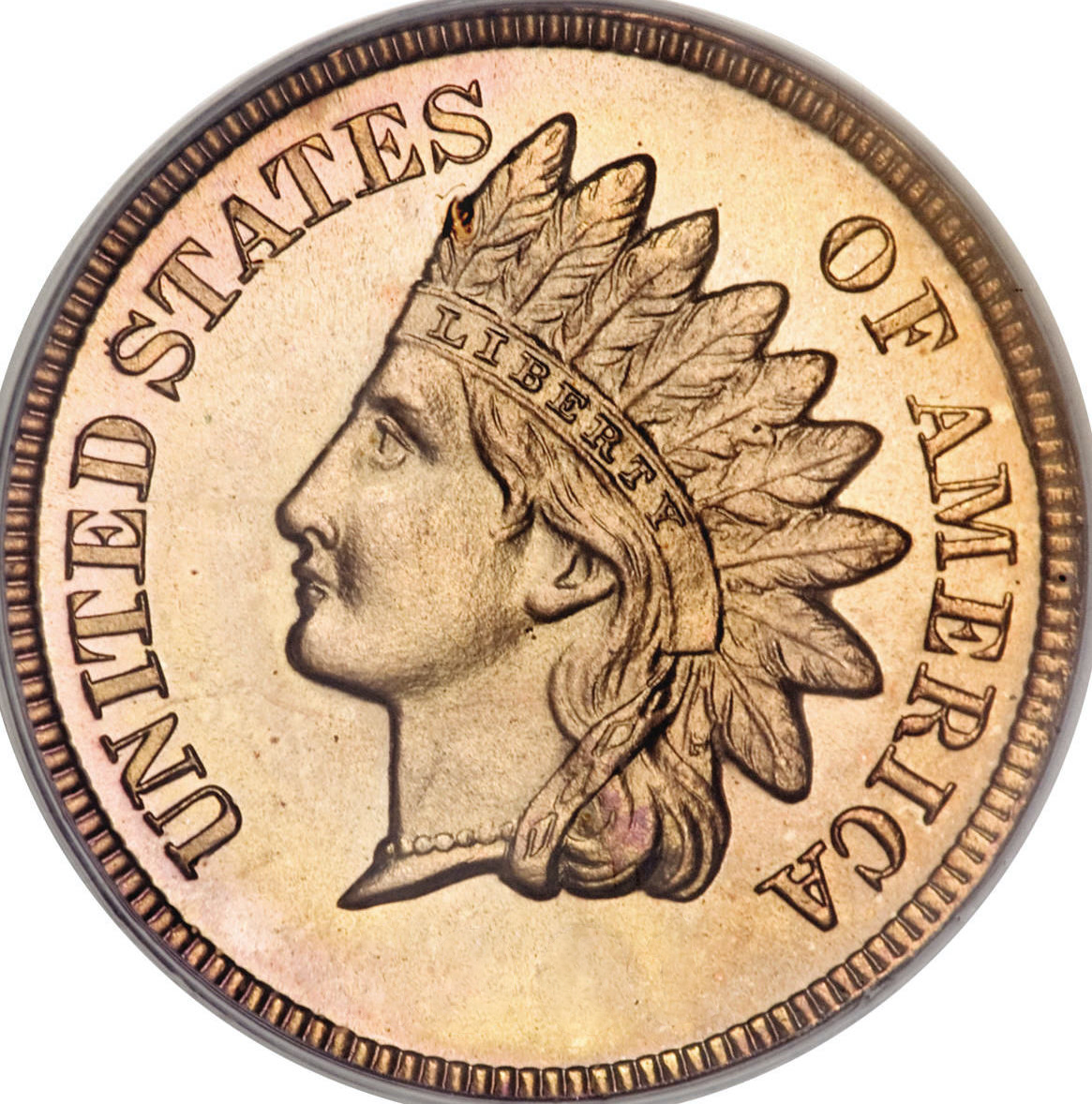
The 1877 Indian Head Cent is the coin that stops most Indian Head series collections cold. With only 852,500 struck — the lowest mintage of any regular-issue date in the entire 1859–1909 run — it is the one coin that routinely commands four-figure prices even in heavily worn condition. Collectors who have filled every other slot in an Indian Head album often save for years before they can afford a presentable 1877.
This guide covers why the mintage dropped so sharply in 1877, what the coin is worth at every grade from AG-3 through MS-66, how to spot the most common counterfeit (an altered 1879), and where the other Indian Head key dates — the 1908-S and 1909-S — fit into the picture.
The Indian Head Cent series: 1859–1909
The Indian Head Cent was designed by James Barton Longacre, the Mint's Chief Engraver, and entered circulation in 1859. The obverse shows Liberty wearing a Native American feathered headdress — a design choice that gave the coin its popular name despite the figure representing an allegorical Liberty rather than a Native American person. The reverse featured a laurel wreath in 1859, replaced by an oak wreath with a small shield in 1860, the design that persisted through the series' end in 1909.
The series predates the Lincoln cent by exactly fifty years. When Abraham Lincoln's portrait replaced the Indian Head design in 1909, the Indian Head cent was retired after a half-century run. Today the complete Indian Head Cent series spans 50 years of Philadelphia mintages plus two final San Francisco issues in 1908 and 1909 — and 1877 sits at the bottom of the mintage table by a wide margin.
Why only 852,500 were struck in 1877
The United States entered a severe economic depression following the Panic of 1873. By 1877 the contraction was still cutting deeply into commercial activity, and demand for small change collapsed alongside it. The Philadelphia Mint — the only facility striking cents that year — produced just 852,500 Indian Head Cents, compared to over 14 million the year before. When fewer goods are being bought, fewer pennies circulate, and the Mint simply didn't need to produce more.
The timing had an additional consequence: low-mintage coins produced during economic downturns often survive at lower rates than their numbers suggest, because hard times meant coins were spent heavily rather than saved. The 1877 cent that did survive into the twentieth century was more likely to be a heavily circulated, worn piece than an uncirculated example tucked away in a cabinet. That survival pattern shows up directly in today's census figures, where high-grade 1877 cents are genuinely rare.
1877 Indian Head Cent values by grade
Values below are pulled from the LuckyCoin catalog. The full grade-by-grade chart with current eBay sold listings lives on the Indian Head Cent series page.
| Grade | Approximate Value | What this grade looks like |
|---|---|---|
| AG-3 | $330 | Heavily worn; date barely legible, design outline only |
| G-4 | $600 | Date clear; LIBERTY on headband fully worn away |
| VG-8 | $700 | At least three letters of LIBERTY visible |
| F-12 | $1,000 | All of LIBERTY visible; feather tips worn flat |
| VF-20 | $1,300 | LIBERTY sharp; light wear on feather tips and ribbon ends |
| XF-40 | $2,400 | All details sharp; slight wear on highest points only |
| AU-50 | $2,900 | Trace wear; most mint luster present |
| AU-55 | $3,400 | Faint wear on Liberty's cheek and hair; luster strong |
| AU-58 | $4,000 | Barely perceptible wear; near-full luster |
| MS-60 | $5,000 | No wear; numerous contact marks; dull surfaces |
| MS-62 | $5,000 | No wear; several noticeable marks; some luster |
| MS-63 | $9,000 | No wear; minor marks; above-average luster |
| MS-64 | $13,000 | No wear; few light marks; strong luster |
| MS-65 | $17,000 | Sharp strike, nearly mark-free, full luster |
| MS-66 | $130,000 | Exceptional preservation; top of the population |
Catalog snapshot. Coin markets move — for any transaction, verify current dealer pricing and the live grade-by-grade chart.
Authentication: watch out for altered 1879 cents
Because the 1877 commands hundreds of dollars even in worn condition, it attracts the same class of counterfeiters who target every major US key date. The most common fake is not a struck counterfeit but an altered genuine coin: a 1879 Indian Head Cent with the "9" tooled or re-engraved to read "7." The 1879 is a common date worth a few dollars in circulated grades, making it an attractive raw material.
1. Examine the last digit of the date under magnification
On a genuine 1877, the "7" has a clean, die-struck appearance consistent with the other digits. On an altered 1879, the last digit often shows tooling marks, uneven metal flow, a slightly different depth than the surrounding numerals, or a tell-tale remnant of the rounded bottom of the original "9." Even a 10× loupe reveals the difference in most cases. Compare the digit thickness and serif style against the first "7" in 1877 — they should match exactly.
2. Check the die characteristics
Genuine 1877 cents were struck from a limited number of dies, and attribution specialists have documented die markers that appear on authentic examples. If you are spending significant money on a raw coin, cross-reference images against published die variety references before committing.
3. Insist on a PCGS or NGC slab above $300
Both grading services have seen thousands of 1877 Indian Head Cents and reject altered dates routinely. A raw coin priced at full 1877 value is a buyer-beware situation. A slabbed example removes date authenticity from the equation entirely. Given that even a G-4 genuine 1877 catalogs at $600, professional authentication pays for itself immediately.
How to grade Indian Head Cents: LIBERTY is the key
Indian Head Cents grade differently from most other US coins because the primary wear indicator is the word LIBERTYinscribed on the headband across Liberty's forehead. Graders count visible letters:
- AG-3: LIBERTY completely worn away; only the headband outline remains.
- G-4 to G-6: Headband outline visible but no letters of LIBERTY readable.
- VG-8: At least three letters of LIBERTY clear.
- F-12: All seven letters of LIBERTY visible, though some may be weak.
- VF-20 to VF-35: LIBERTY fully sharp; wear shows on feather tips and hair above the ear.
- XF-40 to XF-45: All detail sharp; only light wear on the very highest points.
- AU-50 and above: Trace wear or better; original mint luster present in protected areas.
Knowing where to look makes it much easier to grade a coin correctly before purchase. See our guide to reading mint marks for the broader context of how Philadelphia and San Francisco coins differ in this era — the 1877 has no mintmark because it was struck exclusively at Philadelphia.
The other Indian Head key dates: 1908-S and 1909-S
The 1877 is the dominant key date in the series, but two late-series San Francisco issues are required for a complete set and command meaningful premiums of their own. Both were struck when the Mint temporarily extended Indian Head Cent production to San Francisco — the only time in the series that any facility other than Philadelphia struck the design.
1908-S Indian Head Cent
Mintage: 1,115,000 — the first-ever San Francisco Indian Head Cent. Because collectors were caught off guard by the new mintmark, most 1908-S cents entered circulation without being set aside, producing a genuine scarcity at higher grades despite the seemingly adequate mintage.
| Grade | Approximate Value |
|---|---|
| AG-3 | $75 |
| G-4 | $80 |
| VG-8 | $100 |
| F-12 | $120 |
| VF-20 | $130 |
| XF-40 | $190 |
| AU-50 | $230 |
| AU-55 | $250 |
| AU-58 | $280 |
| MS-60 | $290 |
| MS-62 | $400 |
| MS-63 | $800 |
| MS-64 | $1,000 |
| MS-65 | $1,900 |
| MS-66 | $5,000 |
1909-S Indian Head Cent
Mintage: 309,000 — the final Indian Head Cent struck, and the lowest-mintage S-mint issue. Collectors in 1909 knew the design was being replaced by the new Lincoln cent, so more 1909-S cents were saved than typical, yet the mintage was so small that even saved examples are genuinely scarce. The 1909-S also shares a year with the famous 1909-S VDB Lincoln Cent, making 1909 one of the most important transition years in US cent collecting.
| Grade | Approximate Value |
|---|---|
| AG-3 | $210 |
| G-4 | $400 |
| VG-8 | $500 |
| F-12 | $500 |
| VF-20 | $600 |
| XF-40 | $800 |
| AU-50 | $900 |
| AU-55 | $1,000 |
| AU-58 | $1,100 |
| MS-60 | $1,200 |
| MS-62 | $1,300 |
| MS-63 | $1,900 |
| MS-64 | $2,400 |
| MS-65 | $3,700 |
| MS-66 | $16,000 |
Both S-mint values are from the LuckyCoin catalog. Check the live Indian Head series page for current pricing.
Where the 1877 fits in a broader cent collection
The Indian Head Cent bridges two earlier designs and the Lincoln series. The Flying Eagle Cent (1856–1858) preceded it; the Lincoln Wheat Cent followed from 1909 onward. Collectors who complete the Indian Head series often move directly into Lincolns, and the overlap year of 1909 — with both an Indian Head and the debut Lincoln cents — makes the transition particularly interesting. You can browse every US cent series on the US Cents series page.
Within the Indian Head set itself, most collectors approach the 1877 last, budgeting for it after the more affordable S-mint dates are secured. A circulated but clearly genuine 1877 in VG-8 at $700 is a reasonable entry point for collectors who want the date represented without spending four figures on a Fine or better example.
- How much is an 1877 Indian Head penny worth?
- It depends on condition. In AG-3 (heavily worn, date barely legible), around $330. In Good (G-4), around $600. In Fine (F-12), around $1,000. In Very Fine (VF-20), around $1,300. In Extremely Fine (XF-40), around $2,400. Mint State examples start at $5,000 and a gem MS-66 catalogs at $130,000.
- Why is the 1877 Indian Head penny so rare?
- The United States was in the depths of a post-Panic-of-1873 economic depression in 1877. Demand for small change collapsed, and the Philadelphia Mint struck only 852,500 cents that year — the lowest regular-issue mintage in the entire 1859–1909 Indian Head series. Most that did enter circulation were spent heavily and survived only in worn condition.
- How do I know if my 1877 Indian Head cent is genuine?
- The most common fake is an altered 1879 cent with the last digit reworked. Under magnification, check that the final "7" matches the first "7" in style, depth, and serif shape, and shows no tooling marks or remnants of the original "9." For any coin priced over $300, professional grading by PCGS or NGC is the only reliable authentication.
- What does LIBERTY visibility tell me about grade?
- LIBERTY inscribed on the headband is the primary grading indicator for Indian Head Cents. No visible letters means AG-3 or lower. Three or more letters visible puts the coin at VG-8. All seven letters visible and sharp reaches Fine (F-12) or better. A fully sharp, complete LIBERTY with only light wear on the feather tips is Very Fine (VF-20).
- What are the other key dates in the Indian Head cent series?
- After the 1877, the two San Francisco issues are the most sought-after: the 1909-S (mintage 309,000, cataloging at $400 in G-4) and the 1908-S (mintage 1,115,000, cataloging at $80 in G-4). Both are required for a complete set and are the only Indian Head Cents struck outside Philadelphia.
- Should I clean my 1877 Indian Head cent?
- No. Cleaning copper destroys original surface color and luster, leaving microscopic hairlines that professional graders flag immediately as "cleaned" or "details" — a designation that cuts value significantly. Store the coin as found and submit it to PCGS or NGC without any surface treatment.
- Is the 1877 Indian Head cent harder to find than the 1909-S VDB Lincoln?
- The 1877 has a higher mintage (852,500 versus 484,000 for the 1909-S VDB Lincoln), but it is significantly older and had a much longer exposure to heavy circulation before collectors recognized it as a key date. Both are genuine series keys; the 1877 tends to be more affordable in lower circulated grades, while the 1909-S VDB commands higher premiums across most of the grade spectrum.