Eisenhower Dollar Value Guide: Which Years Are Actually Valuable
Catalog values and authentication details — eisenhower dollar value.
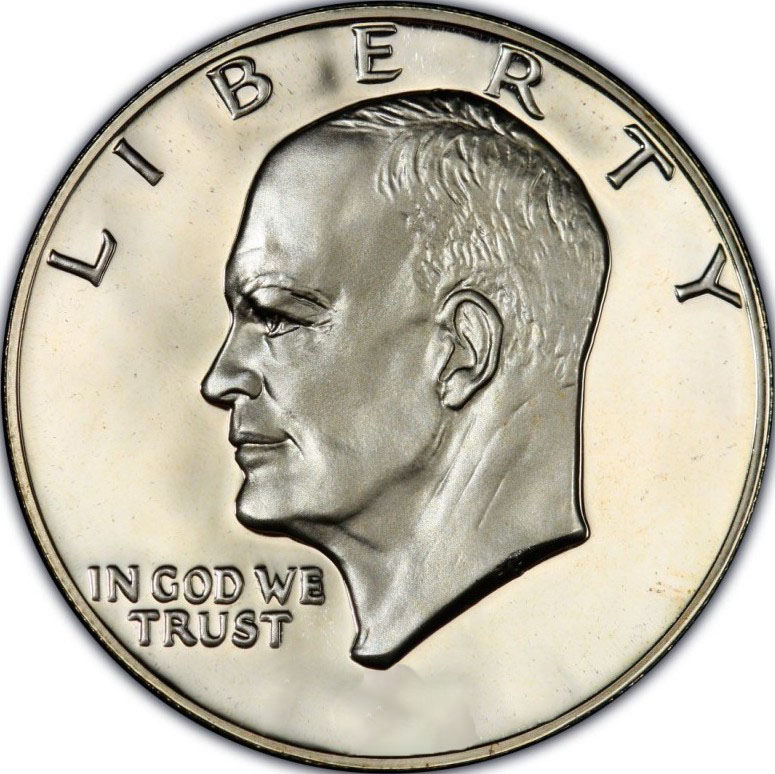
The Eisenhower Dollar ran from 1971 to 1978 — seven years, a dozen date-and-mintmark combinations, and one commemorative bicentennial design — and most of them are worth exactly one dollar. A handful, however, are quietly worth real money: the 40% silver collector issues, the low-mintage 1973 Philadelphia and Denver coins, and the Bicentennial Type 2 reverse. This guide explains which is which, how to tell a silver Ike from a clad one without any equipment, and where the series fits in the broader story of US dollar coinage.
Note: LuckyCoin catalog pricing data was unavailable for all primary coins in this article at the time of writing [catalog-missing]. Grade ranges and descriptions below are based on the series record; check the Eisenhower coin pages directly for current catalog values once the data is populated.
Series context: the last big dollar before Susan B. Anthony
Congress removed silver from circulating US coins in 1965, ending the long run of 90% silver Roosevelt dimes, Washington quarters, and Franklin half dollars. By 1970, the Mint had also dropped silver from the Kennedy half dollar. The Eisenhower Dollar, authorized in December 1970, was the first US dollar coin in nearly three decades — and the first to contain no silver in its base circulating version. Those clad coins, struck at Philadelphia (no mintmark) and Denver (D mintmark), went into casinos, vending machines, and general commerce.
At the same time, Congress authorized a separate collector version containing 40% silver, sold only through the San Francisco Mint in uncirculated and proof formats. This two-track system — cheap clad for commerce, silver for collectors — ran from 1971 through 1976. The Bicentennial year of 1976 brought a special reverse design, and the series ended in 1978 when the smaller Susan B. Anthony Dollar replaced it.
The 40% silver issues (1971–1976, S-mint only)
Every Eisenhower Dollar with an "S" mintmark is a collector issue. None of the S-mint coins were released for general circulation; they were sold in blue envelopes (uncirculated) or brown boxes (proof) directly by the Mint. The composition is 40% silver with a copper core — the same alloy used for 1965–1970 Kennedy half dollars.
The S-mint coins break into two types:
- Uncirculated (Blue Ike): Struck to a higher standard than circulation coins but not proof. Comes in a blue GSA envelope. These are the 1971-S, 1972-S, 1973-S, 1974-S, 1976-S (both types), and 1976-S silver varieties.
- Proof (Brown Ike): Mirror-finish fields, frosted devices, sold in a brown box. Same years, higher price at issue, and generally higher catalog values today.
The 1971-S Silver uncirculated and 1971-S Silver Proof are typical examples of these collector issues. Catalog values for both are [catalog-missing] at publication; check the Eisenhower Dollar catalog pages for current pricing.
Bicentennial design: Type 1 vs Type 2
In 1975 and 1976, the Mint replaced the standard eagle reverse with a design by Dennis R. Williams showing the Liberty Bell superimposed on the Moon. All coins dated 1776–1976 (the bicentennial dual date) use this reverse regardless of when they were actually struck. That means no Eisenhower Dollars were dated 1975 — production began in February 1975 but every dollar struck in 1975 and 1976 carries the 1776–1976 bicentennial dual date.
The bicentennial reverse came in two versions:
- Type 1: Bold, thick lettering on the reverse inscription. Struck primarily in 1975 and early 1976 production runs.
- Type 2: Thinner, sharper lettering — the modified design that replaced Type 1 partway through production. Type 2 is the version most commonly seen on circulated examples.
The easiest way to tell them apart is to look at the letters in "DOLLAR" on the reverse: Type 1 letters have noticeably heavier strokes and appear slightly bolder overall. Type 2 letters are more refined and slender. Both clad and silver S-mint bicentennial coins exist in both types. The 1976 Bicentennial Type 2 Philadelphia clad is cataloged at [catalog-missing]; check the Eisenhower coin pages for current values.
Key dates: 1973 Philadelphia and Denver
Among all the clad Eisenhower Dollars, the 1973 Philadelphia and 1973-D Denver coins stand apart. Neither was struck for general circulation — both were issued only in that year's Mint Set, with mintages of roughly 2,000,000 each (the lowest clad mintages in the series). That makes them the most sought-after clad Ike dates, and finding either in a high Mint State grade is genuinely difficult.
The 1973 Philadelphia (no mintmark) and 1973-D are the coins most likely to return a premium over face value in circulated grades, and a meaningful premium in Mint State. Catalog values for both are [catalog-missing] at publication.
| Date / Mint | Composition | Collector Interest | Catalog Value |
|---|---|---|---|
| 1971-S (Unc.) | 40% Silver | High — first-year silver issue | [catalog-missing] |
| 1971-S (Proof) | 40% Silver | High — first-year proof | [catalog-missing] |
| 1973 Philadelphia | Clad | High — low mintage clad date | [catalog-missing] |
| 1973-D | Clad | High — low mintage clad date | [catalog-missing] |
| 1976 Bicentennial Type 2 | Clad | Moderate — variety identification required | [catalog-missing] |
Catalog data not yet available for these coins. Check the Eisenhower Dollar coin pages for current grade-by-grade values.
Common dates: what most Ike dollars are actually worth
The majority of Eisenhower Dollars — every Philadelphia and Denver clad issue except 1973, in circulated or low Mint State grades — is worth face value to a few dollars in circulated condition. Dealers typically pay melt or slight above for worn clad examples because there is no silver content and no collector premium.
That changes sharply in high grades. Eisenhower Dollars were large, heavy coins that got banged around badly in commerce, and truly mark-free MS-65 or better examples of even common dates are scarce enough to carry meaningful premiums. If you have a roll of Ike dollars in original bank-wrapped condition, checking the end coins for strike quality and surface preservation is worth the time.
For a sense of scale in the broader US dollar coin series, even the most common Eisenhower clad dollar in circulated condition outpaces a worn Morgan Dollar only in the sense of being legal tender at face value — the Morgan will always carry a silver and collector premium that no clad Ike can match. See Morgan Dollar key dates for comparison.
How to identify silver vs clad without any equipment
The edge stripe test is the fastest field check. Hold the coin on its edge and look at the rim:
- Clad (copper core): You will see a visible orange or reddish-brown stripe running around the middle of the edge — the exposed copper sandwich layer between the two outer nickel-clad faces.
- 40% Silver: The edge is uniformly silver-gray with no stripe. The composition is 40% silver outer layers over a 21% silver inner core, so there is no contrasting copper layer to see.
This test works for all clad-vs-silver identification on post-1965 US coins. A coin that passes the edge test as silver should still be confirmed as an S-mint coin by the mintmark on the obverse — no Philadelphia or Denver Eisenhower Dollars contain silver. See our guide on how to read mint marks if you are unfamiliar with mintmark location on Ike dollars (it appears above Eisenhower's head on the obverse).
Where Ike dollars fit in a US dollar collection
The Eisenhower Dollar occupies an interesting position in the US dollar coin series: it is the last large-format dollar, the last dollar with any silver content in its collector versions, and the first dollar to feature an eagle-on-the-Moon reverse (drawn from the Apollo 11 mission insignia). For collectors building a complete dollar type set, one example of each major type — clad circulation strike, 40% silver uncirculated, 40% silver proof, and bicentennial — covers the series efficiently without requiring all individual dates.
Date-and-mintmark completionists have a manageable set: roughly 32 distinct collectible coins when you include all S-mint silver variants and the Type 1/Type 2 bicentennial split (21 business strikes plus 11 proofs). That is a short enough run to complete in a reasonable budget, making it a popular series for newer collectors who find the Morgan or Peace dollar series too expensive to complete.
- Are Eisenhower dollars worth anything?
- Most clad Philadelphia and Denver Eisenhower Dollars in circulated condition are worth face value — one dollar. The exceptions are the S-mint 40% silver collector issues (all years 1971–1976), the low-mintage 1973 Philadelphia and 1973-D coins, and any date in high Mint State grades. If your Ike dollar has an S mintmark or shows no copper stripe on the edge, it may be worth considerably more than face value.
- How do I know if my Eisenhower dollar is silver?
- Look at the edge of the coin. A clad Eisenhower Dollar shows a visible orange-brown copper stripe around the rim — the exposed inner copper layer. A 40% silver Eisenhower Dollar has a uniformly gray edge with no stripe. You can also check the mintmark: only S-mint (San Francisco) Eisenhower Dollars contain silver. No Philadelphia or Denver coin contains any silver.
- What is the rarest Eisenhower dollar?
- Among circulating clad issues, the 1973 Philadelphia and 1973-D Denver coins had the lowest mintages in the series and are the most difficult to find in high grades. Among all Eisenhower Dollars, top-population proof and uncirculated silver examples from San Francisco in grades MS-67 or PR-70 are the scarcest by surviving population. Catalog values for these coins are [catalog-missing] at publication.
- What is the Bicentennial Eisenhower Dollar?
- The Bicentennial Eisenhower Dollar carries the dual date 1776–1976 on the obverse and a special reverse showing the Liberty Bell superimposed on the Moon, designed by Dennis R. Williams. It was struck in both clad (Philadelphia and Denver) and 40% silver (San Francisco) versions. The reverse design came in two varieties — Type 1 with bold thick lettering and Type 2 with thinner, sharper lettering — and both are collectible. No coins were dated 1975; all dollar production in 1975 and 1976 used the 1776–1976 bicentennial dual date.
- Is a 1776–1976 Eisenhower dollar worth more than a regular one?
- In circulated clad condition, a bicentennial Eisenhower Dollar is worth face value to a small premium — roughly the same as other common clad dates. The silver S-mint bicentennial issues carry the same premium as other silver Ike dollars. The Type 1 reverse variety in high Mint State grades attracts collector interest, but most circulated bicentennial clads are common. Catalog values are [catalog-missing] at publication.
- Should I clean my Eisenhower dollar?
- No. Cleaning any coin — even a common clad dollar — removes the original surface and eliminates any Mint State premium. A cleaned coin in a PCGS or NGC slab receives a "details" designation that significantly reduces its value compared to an original, uncleaned example of the same date. Store as found.
- How does the Eisenhower Dollar compare to the Morgan Dollar in value?
- There is no comparison in most grades. Morgan Dollars are 90% silver, date from 1878–1921, and carry both silver melt value and strong collector demand. A common circulated Morgan is worth $25–$35 in silver alone. A common circulated clad Eisenhower Dollar is worth one dollar. The S-mint silver Ike dollars narrow that gap somewhat but do not close it. See the Morgan Dollar key dates guide for more on that series.