State Quarter Errors Worth Real Money: Which Ones to Look For
Catalog values and authentication details — state quarter errors.
Most 50 State Quarters are worth exactly twenty-five cents. Billions were struck between 1999 and 2008, and nearly all of them circulated freely into pocket change. But a small number left the Mint with die errors, die cracks, or grease-filled dies that created unmistakable anomalies — and those specific coins have sold for anywhere from $50 to several hundred dollars, sometimes more for top-grade certified examples [catalog-missing].
This guide covers the five most-discussed state quarter errors, what each one actually looks like on the coin, how to tell a genuine die error from a damaged or altered quarter, and what collectors have paid for certified examples.
Quick background: the 50 State Quarters program
The U.S. Mint launched the 50 State Quarters program in 1999, releasing five new reverse designs per year through 2008 — one for each state in the order it ratified the Constitution or joined the Union. Both the Philadelphia (P) and Denver (D) mints struck each design, and the San Francisco (S) mint produced proof versions for collectors. Total production across the program ran into the tens of billions of coins.
With that volume, die errors were statistically inevitable. The Mint catches most problems before coins ship, but some batches slip through. When they do, observant collectors who find them in change — or buy unsearched rolls — can pocket a meaningful premium.
The most valuable state quarter errors
2004-D Wisconsin Extra Leaf High and Extra Leaf Low
The Wisconsin quarter reverse shows an ear of corn, a wheel of cheese, and a cow's head. On a small number of Denver-minted 2004-D quarters, an extra leaf appears on the left side of the corn ear — either pointing upward (Extra Leaf High) or downward (Extra Leaf Low). These are the two most famous state quarter errors.
The origin of the extra leaf is debated among numismatists. Most researchers attribute it to a die gouge — likely caused by a metal shaving lodged on the die — while others argue the leaves are too distinct and deliberate to be accidental and suspect a Mint employee intentionally modified the die. The Mint never issued a formal explanation. Either way, the result is a clearly die-struck extra leaf that cannot be explained by damage after the coin left the Mint.
Catalog values for the 2004-D Wisconsin Extra Leaf High and Extra Leaf Low are not currently available in the LuckyCoin catalog [catalog-missing]. Certified examples in grades from VF through MS-65 have traded across a wide range at auction; consult current PCGS or NGC price guides and recent auction records before buying or selling.
2005-P Kansas “Humpback Bison”
The Kansas quarter reverse features a sunflower and a bison. On some Philadelphia-minted 2005-P examples, grease or die fill clogged the area above the bison's back during striking, leaving a raised blob that makes the animal appear hump-backed — hence the nickname. This is a classic grease-filled die error: lubricant or metal debris packs into the recessed design areas of the die and prevents metal from flowing into those spaces, so the struck coin shows a raised, featureless lump where detail should appear flat or absent.
Catalog values for the 2005-P Kansas Humpback are not currently available in the LuckyCoin catalog [catalog-missing]. The value of any specific example depends heavily on the severity of the fill — a dramatic, unmistakable hump commands a larger premium than a minor smear.
2005-P Minnesota Extra Tree
Minnesota's quarter reverse depicts a lake scene with pine trees and a loon. On a subset of 2005-P Philadelphia quarters, inadvertent die doubling during the single-squeeze hubbing process produced a ghost tree or extra spruce in the treeline above the lake; PCGS catalogs more than four dozen distinct doubled-die varieties on this issue, with the FS-801 (DDR-001) the most pronounced and desirable. Unlike the Wisconsin leaf, Minnesota extra tree errors vary considerably in their appearance from coin to coin, which makes grading and valuing them more subjective.
Catalog values for the 2005-P Minnesota Extra Tree are not currently available in the LuckyCoin catalog [catalog-missing].
1999-P Delaware “Spitting Horse”
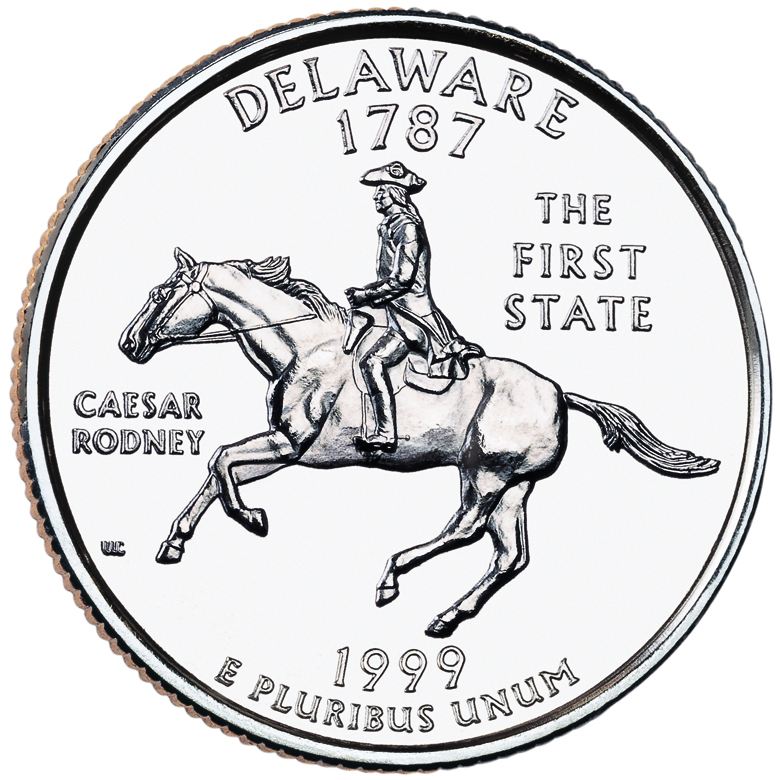
Delaware was the first state quarter released, in 1999. The reverse shows Caesar Rodney on horseback. On some Philadelphia-minted examples, a die crack runs from the horse's mouth outward, creating the appearance that the horse is spitting or drooling — giving the variety its collector nickname. Die cracks are stress fractures in the hardened steel die; as the die continues striking, the crack widens and eventually the die is retired, so coins struck earlier in the die's life show thin hairline cracks while late-die examples show broader, raised lines.
Catalog values for the 1999-P Delaware Spitting Horse are not currently available in the LuckyCoin catalog [catalog-missing].
Die errors vs. damage: how to tell the difference
The single biggest source of confusion in state quarter collecting is mistaking post-mint damage for a genuine die error. A coin that was scratched, gouged, or bent after leaving the Mint has no collector premium regardless of how unusual it looks. Here is how to distinguish the two:
- Die errors are raised, not incuse. Because a die error results from missing or extra metal in the die, the anomaly on the coin is almost always raised above the field. A gouge or scratch made after striking cuts intothe coin's surface and leaves a depressed channel with rough edges.
- Die errors are consistent across multiple examples. If the same anomaly appears on dozens of coins from the same mint and year in the same location, it's a die error. Post-mint damage is random and unique to each coin.
- Die cracks follow predictable patterns. A genuine die crack runs in a relatively straight or gently curved line and has smooth, rounded edges because it was struck by the remaining die surface. A scratch is jagged with sharp walls under magnification.
- Metal flow lines are intact around genuine errors. Under a loupe, you can often see the coin's original flow lines running up to and around a die error, undisturbed. Post-mint damage disrupts the flow lines because it was applied after they formed.
How to spot them in change and rolls
State quarter errors are scarce enough that casual searching rarely turns one up, but not so rare that the population is exhausted. Here is where finds still happen:
- Unsearched bank rolls. Order original-wrap rolls from banks rather than coin shop rolls, which have often been searched already. Focus on 2004 Denver rolls for Wisconsin and 2005 Philadelphia rolls for Kansas and Minnesota.
- Jar and drawer lots. State quarters collected casually by the public in jars, drawers, or piggy banks through the 2000s are the most likely hiding place. Error coins in these hoards were never identified by the original owner.
- Estate sales and flea markets. Sellers who price state quarters as face value or common collectibles occasionally include error coins in mixed lots.
A 10× loupe is enough magnification to identify the Wisconsin extra leaf and the Delaware die crack. The Kansas hump is visible to the naked eye on dramatic examples. Always examine the reverse carefully — that is where every major state quarter error lives. Check our guide on how to read mint marks to confirm which mint struck any quarter you're examining, since the Wisconsin and Minnesota errors are die-specific to one mint.
Catalog values by error
All five errors covered in this article are absent from the LuckyCoin catalog at time of publication [catalog-missing]. The table below reflects the general collector market based on publicly reported auction results and dealer pricing; treat these as orientation figures only, not precise valuations. For any transaction, consult current PCGS CoinFacts, NGC Price Guide, or recent eBay sold listings filtered to certified examples.
| Error | Mint | Typical Raw VF–XF | Certified MS-63 to MS-65 |
|---|---|---|---|
| 2004-D Wisconsin Extra Leaf High | Denver | [catalog-missing] | [catalog-missing] |
| 2004-D Wisconsin Extra Leaf Low | Denver | [catalog-missing] | [catalog-missing] |
| 2005-P Kansas Humpback Bison | Philadelphia | [catalog-missing] | [catalog-missing] |
| 2005-P Minnesota Extra Tree | Philadelphia | [catalog-missing] | [catalog-missing] |
| 1999-P Delaware Spitting Horse | Philadelphia | [catalog-missing] | [catalog-missing] |
These catalog records are missing from the current LuckyCoin database. Dollar values will populate here once records are added. Do not rely on this table for pricing decisions.
Should you get a state quarter error certified?
For the Wisconsin Extra Leaf errors in grades above XF, professional certification by PCGS or NGC is worth the submission fee. A slabbed example is dramatically easier to sell at full market value because the buyer does not have to trust their own attribution. For circulated examples of the Kansas hump or Delaware die crack — where raw retail prices are lower — the economics of certification are less clear and depend on how dramatic and well-defined the error is.
Never clean a state quarter before submission. Cleaning copper-nickel clad coins leaves hairlines and a processed look that grading services note on the label and which cuts value significantly.
Where state quarters fit in a broader collection
The 50 State Quarters program ran from 1999 through 2008 and was followed immediately by the America the Beautiful Quarters program, which featured national parks and ran through 2021. Collectors who complete the state quarter set often move into the ATB series next. Both programs share the same Washington obverse design that has appeared on U.S. quarters since 1932 — see the full Washington Quarter series for context on where state quarters sit in the longer lineage.
- What is the most valuable state quarter error?
- The 2004-D Wisconsin Extra Leaf High and Extra Leaf Low are generally considered the most significant state quarter errors by collector demand and certified population. Catalog values for these coins are not currently in the LuckyCoin database [catalog-missing], but certified high-grade examples have sold for meaningful premiums at major auctions. Consult current PCGS CoinFacts or NGC Price Guide for up-to-date figures.
- How do I know if my Wisconsin quarter has the extra leaf?
- Look at the left side of the corn ear on the reverse. On a normal 2004-D Wisconsin quarter, the corn husk flows smoothly down on the left. On the Extra Leaf High variety, an additional leaf points upward from the lower-left area of the corn. On the Extra Leaf Low, a leaf points downward. Both are clearly die-struck and visible with a 5–10× loupe. The coin must be a Denver-minted (D mintmark) 2004 Wisconsin quarter — Philadelphia struck Wisconsin quarters do not show this error.
- Is the Kansas Humpback Bison a rare coin?
- It is scarcer than a normal 2005-P Kansas quarter but not vanishingly rare — enough examples were distributed into circulation that collectors still find them in unsearched rolls and jar lots. The premium depends almost entirely on how dramatic the grease fill is. A subtle hump commands less interest than one that completely obscures the bison's back. Catalog values are currently missing from the LuckyCoin database [catalog-missing].
- Can post-mint damage look like a die error?
- Yes, and this is the most common mistake new collectors make. Post-mint damage — gouges, scratches, environmental corrosion — can superficially resemble die errors, but the key difference is that damage cuts into the coin's surface while die errors produce raised metal. Under a loupe, damaged areas show sharp, irregular walls and disturbed metal flow lines. Genuine die errors have smooth, rounded profiles consistent with being struck by the die. When in doubt, look for the same anomaly on multiple examples of the same date and mint — that confirms a die error rather than individual damage.
- Should I spend a state quarter error or save it?
- If you are confident you have identified a genuine die error — not post-mint damage — do not spend it. Even a circulated Wisconsin Extra Leaf or Delaware Spitting Horse in worn condition has collector value that far exceeds twenty-five cents. Put it in a 2×2 flip, label the date, mint, and variety name, and have it evaluated before making any decision. Catalog values are currently missing from the LuckyCoin database [catalog-missing], so check recent auction records for current market pricing.
- Do state quarter errors appear on proof coins too?
- The documented state quarter errors — Wisconsin Extra Leaf, Kansas Humpback, Minnesota Extra Tree, Delaware Spitting Horse — are all associated with circulation-strike coins from Philadelphia or Denver, not San Francisco proof issues. Proof dies and proof production receive more careful inspection, so die errors reaching released proof coins are exceedingly rare. If you have what appears to be an error on an S-mint proof quarter, professional authentication is essential before drawing any conclusions.