Saint-Gaudens $20 Double Eagle: Value Guide and the 1933 Story
Catalog values, history, and authentication — saint gaudens double eagle.
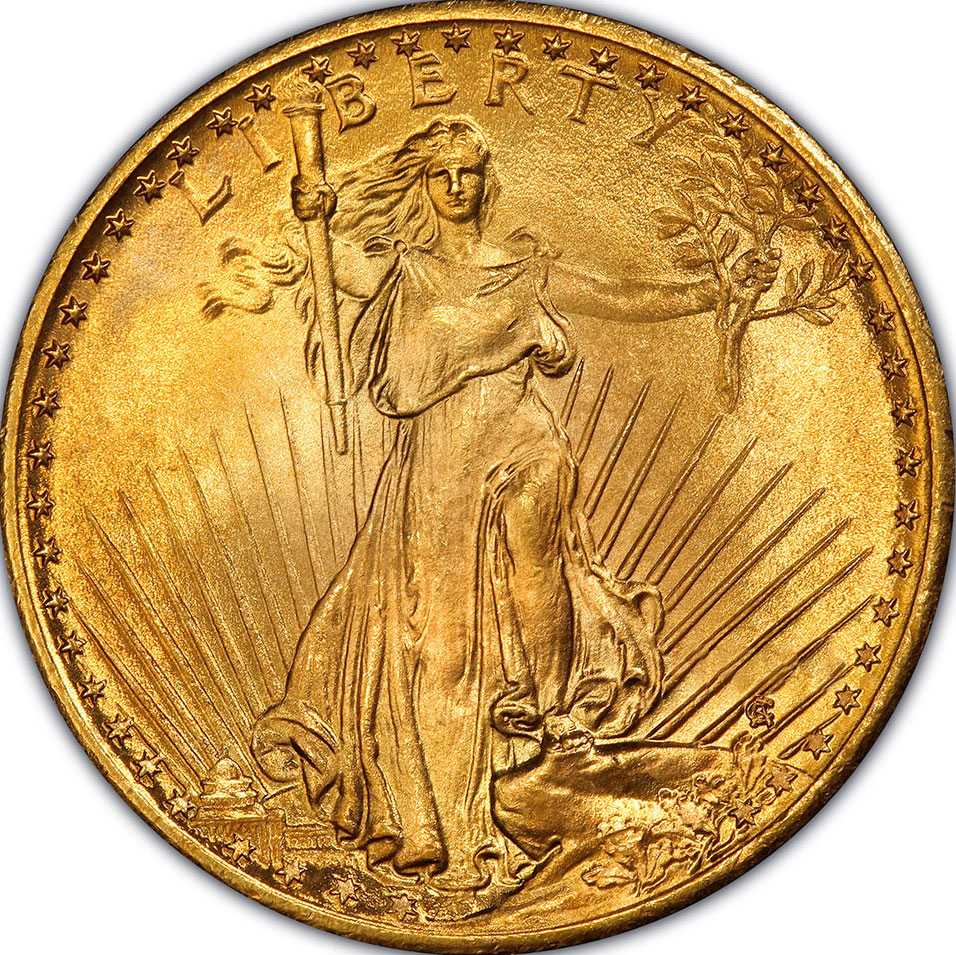
The Saint-Gaudens $20 Double Eagle is widely regarded as the most beautiful coin the United States Mint ever produced. Sculpted by Augustus Saint-Gaudens at Theodore Roosevelt's personal insistence, it replaced the static Liberty Head Double Eagle in 1907 and ran through 1933 — ending with the single most legally contested coin in numismatic history. Every example contains 0.9675 oz of pure gold, so even a worn common date is worth thousands. A top-grade 1907 High Relief is worth tens of thousands more than that, and the solitary legal 1933 sold at auction in 2021 for $18,872,250 — the highest price ever paid for a coin at public auction.
This guide covers the designer and the commission that produced the series, the production problems that shaped the 1907 High Relief, what every grade of a High Relief is worth today, the full story of the 1933 Double Eagle, and the authentication checks that matter when you are handling a coin worth this much.
Augustus Saint-Gaudens and the "most beautiful coin" commission
By the early 1900s, Theodore Roosevelt had grown impatient with what he called the "atrocious hideousness" of American coinage. He reached out directly to Augustus Saint-Gaudens, then considered the dean of American sculpture, and asked him to redesign the cent and the double eagle. Saint-Gaudens accepted, though he had been diagnosed with cancer years earlier and his health was already failing as serious work on the double eagle began in 1905–1906.
The design Saint-Gaudens produced for the double eagle drew on classical Greek and Roman high-relief coinage. The obverse shows a full-length Liberty striding forward, torch raised in her right hand and olive branch in her left, Capitol building visible in the background. The reverse shows a soaring eagle above the rising sun. The concept was striking on paper; executing it in struck metal proved far harder.
The 1907 High Relief: technical triumph and practical problem
Saint-Gaudens wanted the coin struck in ultra-high relief — the figures rising dramatically from the field, as on an ancient Greek stater. The Mint produced roughly two dozen ultra-high-relief patterns in 1907, each requiring as many as nine blows of the medal press to fully bring up the design. These patterns are extraordinary objects, but they were completely impractical for mass production.
The Mint worked with the design through the year, reducing the relief significantly so that coins could be struck in a single blow at production speed. The result was two distinct 1907 issues: the High Relief— a compromise version that still required multiple strikes and produced only a limited number of coins before the dies wore out — and the flat-relief "Roman numerals" and later Arabic numerals versions that carried the series forward through 1933. Saint-Gaudens died on August 3, 1907, and never saw the coins in full production.
The Philadelphia Mint struck 12,367 examples of the 1907 High Relief Double Eagle, making it genuinely scarce in any grade — though the novelty of the design encouraged a high survival rate, so most known examples are in the higher grades.
1907 High Relief values by grade
Values below are pulled from the LuckyCoin catalog. The full grade-by-grade chart lives on the Saint-Gaudens $20 coin page.
| Grade | Approximate Value | What this grade looks like |
|---|---|---|
| VF-20 | $11,000 | Moderate wear on Liberty's gown and eagle; all major details clear |
| XF-40 | $12,000 | Light wear on highest points; fields mostly lustrous |
| AU-45 | $13,000 | Trace wear; most original luster intact |
| AU-50 | $13,000 | Minimal wear; luster broken only at highest relief points |
| AU-55 | $15,000 | Faint wear; nearly full luster |
| AU-58 | $16,000 | Slightest rub; essentially full mint luster |
| MS-60 | $18,000 | No wear; noticeable contact marks or bag marks |
| MS-61 | $20,000 | No wear; several visible marks |
| MS-62 | $23,000 | No wear; moderate marks; some luster break |
| MS-63 | $32,000 | No wear; scattered light marks; above-average eye appeal |
| MS-64 | $40,000 | No wear; minor marks; strong luster |
| MS-65 | $70,000 | Gem; only minimal marks; full luster and sharp strike |
| MS-66 | $150,000 | Exceptional preservation; nearly mark-free surfaces |
Catalog snapshot. Gold coin markets move with both the spot price of gold and collector demand — for any transaction, check current dealer pricing and the live grade-by-grade chart.
The series: 1907–1933, common dates, and bullion value floor
After 1907 the Mint struck Saint-Gaudens Double Eagles every year through 1933, with a few gaps, at Philadelphia and at branch mints in Denver (D) and San Francisco (S). Every coin is 90% gold, 10% copper, 33.43 mm in diameter, and contains 0.9675 troy oz of pure gold. That gold content sets an absolute value floor: even a coin that has been heavily worn and handled is worth at minimum the current spot price of roughly 0.9675 oz of gold. The gold melt calculator applies that figure to any quantity at live spot.
High-mintage common dates from the 1920s — 1922, 1923, 1924, 1925, and 1926 Philadelphia issues among them — typically trade at a modest collector premium above melt in circulated grades. The premium grows in Mint State and climbs sharply for branch-mint issues, low-mintage dates, and pre-1910 examples still showing the original flat-relief design details clearly. Browse the full Saint-Gaudens $20 series page for year-by-year mintages and values across the entire run.
The 1933 Double Eagle: 445,500 struck, one legal to own
The United States Mint struck 445,500 Double Eagles dated 1933. None were officially released into circulation. In March 1933, President Franklin Roosevelt issued executive orders pulling gold coins from circulation as part of the response to the banking crisis, and the 1933 Double Eagles were ordered melted. Almost all of them were.
A small number escaped. The Secret Service spent decades pursuing specimens that appeared on the market, seizing them as government property. The legal theory: because the coins were never officially released, title never passed from the government to any private holder. Collectors who believed they had purchased 1933 Double Eagles legitimately had their coins confiscated as a result.
One coin eventually received a unique legal dispensation. A specimen that had passed through the collection of King Farouk of Egypt was returned to the United States, subjected to litigation, and ultimately monetized — officially issued as a $20 denomination and sold at a Sotheby's/Stack's Bowers auction in 2002 for $7,590,020. That sale made it, at the time, the most valuable coin ever sold at public auction. The same coin — known as the Weitzman specimen — was resold at Sotheby's in June 2021 for $18,872,250, breaking that record. A second group of ten 1933 Double Eagles surfaced in a legal dispute with the heirs of Philadelphia jeweler Israel Switt; the government prevailed and those coins remain government property.
The LuckyCoin catalog lists the 1933 Saint-Gaudens at $23,400,000 at MS-65 — a figure consistent with the 2021 auction record and the unique legal status of the coin. For all practical purposes, this coin exists outside the normal collector market. It appears in the catalog for completeness.
Authentication essentials
Saint-Gaudens Double Eagles are frequently counterfeited in base metal, and genuine examples are sometimes subjected to cleaning, altered dates, or added mintmarks. Before handling any transaction, run these checks. For a deeper treatment of spotting fakes across all series, see our guide to spotting counterfeit coins.
Weight and dimensions
A genuine Saint-Gaudens Double Eagle weighs 33.436 grams and measures 33.43 mm in diameter. A precision digital scale accurate to 0.01 g is the single most effective counterfeit screen for gold coins. Base-metal counterfeits — even gold-plated ones — almost always fail the weight test, and even high-end tungsten-core fakes (which approximate gold's density) tend to miss the mint specification by enough to detect on a scale calibrated to 0.01 g.
The magnetic test
Gold is not magnetic. Hold a strong rare-earth magnet near the coin: any attraction, even faint, indicates a ferrous core. This test catches the cheapest counterfeits immediately, though it will not detect non-magnetic base-metal fakes like copper or brass.
Third-party grading for significant purchases
For any Saint-Gaudens Double Eagle priced above melt value — which means essentially any collector purchase — a slab from PCGS or NGC is the only reliable authentication. Both services have graded large populations of Saint-Gaudens Double Eagles and maintain online population reports you can cross-reference. An unslabbed coin presented as a 1907 High Relief or any scarce date should be treated as unverified until graded.
Why the design never really went away
When the United States Mint launched the American Gold Eagle bullion program in 1986, it chose Saint-Gaudens' Liberty striding figure for the obverse — a direct tribute to his 1907 design. The modern Gold Eagle is not the same coin (it is 22-karat rather than 90% fine, and the reverse is a different design), but every American Gold Eagle minted since 1986 carries Saint-Gaudens' Liberty. The design is, in that sense, still in production more than a century after his death.
Collectors who want to explore the broader context of US gold coinage can browse the full US Gold Coins catalog on LuckyCoin, which covers everything from early eagles through the modern bullion series.
- What is a Saint-Gaudens Double Eagle worth?
- Every genuine Saint-Gaudens Double Eagle contains 0.9675 oz of pure gold, so the absolute floor is roughly that amount at current spot price. Common circulated dates from the 1920s typically trade at a modest premium above melt. A 1907 High Relief in VF-20 is worth around $11,000; in MS-65 it reaches $70,000. The sole legal 1933 example sold at auction in 2021 for $18,872,250 — a world record for any coin — and the catalog lists it at $23,400,000 at MS-65.
- How many 1907 High Relief Double Eagles were made?
- The Philadelphia Mint struck 12,367 examples of the 1907 High Relief, produced before the Mint shifted to a lower-relief design that could be struck at full production speed.
- Is the 1933 Double Eagle legal to own?
- Only one example is currently legal for private ownership — the coin that passed through King Farouk's collection, was officially monetized, and sold at auction in 2002. All other known 1933 Double Eagles have been seized by the United States government on the grounds that they were never officially released and title never passed to any private holder. Do not purchase any coin represented as a 1933 Double Eagle without extensive independent legal and numismatic counsel.
- How do I tell if a Saint-Gaudens Double Eagle is real?
- Start with weight: a genuine coin weighs 33.436 grams. Follow with the magnetic test — gold is non-magnetic, so any attraction to a rare-earth magnet is a red flag. For any purchase above melt value, require a PCGS or NGC slab. See our guide to spotting counterfeit coins for a full authentication walkthrough.
- What is the difference between the 1907 High Relief and later Saint-Gaudens issues?
- The 1907 High Relief was struck with deeper, more sculptural relief than the rest of the series — requiring multiple die strikes and limiting production. From late 1907 onward, the Mint reduced the relief so coins could be struck in a single blow at speed. The result is that standard-relief Saint-Gaudens Double Eagles, while beautiful, have noticeably flatter fields and less dramatic modeling than the High Relief. The design elements are the same; the three-dimensional presence is markedly different.
- Should I clean a Saint-Gaudens Double Eagle?
- No. Cleaning any gold coin — even with a soft cloth — can leave hairlines that are immediately visible under magnification and will result in a "details: cleaned" designation from PCGS or NGC, substantially reducing both collector value and resale liquidity. Store the coin as found, in a non-PVC holder, and let a professional grader assess it before any intervention.
- Why does the American Gold Eagle use Saint-Gaudens' design?
- When Congress authorized the American Gold Eagle bullion program in 1985, the Mint adopted Saint-Gaudens' striding Liberty figure for the obverse of the new bullion coin, launched in 1986. The choice was both aesthetic — Saint-Gaudens' Liberty is widely considered the finest figure ever to appear on a US coin — and historical, connecting the modern bullion series to the pre-1933 gold coinage tradition.