Lincoln Memorial Cent (1959–2008): The Postwar Penny
Catalog values, history, and authentication — lincoln memorial cent history.
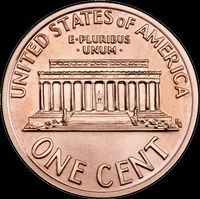
The Lincoln Memorial cent ran from 1959 to 2008 — fifty years on circulating American coinage. It is the middle chapter of the Lincoln cent story, sitting between the beloved Lincoln Wheat cent (1909–1958) and the modern Union Shield cent (2010–present). For most Americans alive today, it is simply what a penny looks like: Lincoln on the front, a small columned building on the back.
That familiarity obscures a surprisingly eventful history. The series spans a composition change that split 1982 into seven distinct collectible varieties, produced two major doubled-die errors that still command serious premiums, and quietly became one of the most counterfeited cent types in the hobby. This guide covers all of it — the design story, the metal change, the key errors with catalog values, and where the Memorial cent sits in a collection today.
1959: The Lincoln centennial reverse
The Wheat cent reverse had been in continuous production since 1909. By the late 1950s, the Mint was looking for a way to mark the 150th anniversary of Lincoln's birth, and the decision was made to replace the wheat-stalk reverse with a new design. Chief Engraver Frank Gasparro submitted a reverse depicting the Lincoln Memorial in Washington, D.C. — a building that had itself been dedicated in 1922. The design was chosen and placed into production beginning with the 1959 issue.
The choice was quietly significant: for the first time, a US coin depicted the same historical figure on both sides. If you look closely at the Memorial reverse under magnification, a tiny seated Lincoln statue is visible inside the colonnade — Lincoln on both faces of the same cent. Gasparro's initials "FG" appear on the reverse to the right of the Memorial.
The obverse remained Victor David Brenner's 1909 portrait of Lincoln, with the "VDB" initials — removed in 1909 after the original reverse placement drew controversy — quietly restored in 1918 in micro-typeface beneath the truncation of Lincoln's shoulder, the same portrait Lincoln cent collectors had known for fifty years.
Composition: 95% copper through mid-1982
From 1959 through the first half of 1982, Memorial cents were struck in a 95% copper alloy. From 1959 through 1962 the remaining 5% was a mix of tin and zinc; from 1962 onward the tin was eliminated, leaving 95% copper and 5% zinc (commonly called "bronze" or "brass" depending on the exact alloy). These coins weigh 3.11 grams, have a warm reddish-brown color when circulated, and turn a rich chocolate brown with age.
Rising copper prices in the late 1970s and early 1980s pushed the metal value of the cent uncomfortably close to — and at times above — its face value. Congress authorized a composition change, and beginning in mid-1982 the Mint switched to a core of 99.2% zinc plated with a thin copper coating, reducing the coin's weight to 2.5 grams. The copper-plated zinc cent looks nearly identical to its bronze predecessor in new condition but corrodes differently and sounds different when dropped on a hard surface.
The 1982 transition: seven varieties
The 1982 changeover happened mid-year without a formal announcement of exactly when each mint switched, which means 1982 cents were struck in both compositions at both the Philadelphia and Denver mints. Combine that with a simultaneous hub change that produced large-date and small-date varieties, and 1982 becomes one of the most variety-rich single years in Lincoln cent history.
Collectors recognize seven 1982 varieties:
- 1982 Large Date, bronze (Philadelphia, no mintmark)
- 1982 Small Date, bronze (Philadelphia, no mintmark)
- 1982 Large Date, copper-plated zinc (Philadelphia, no mintmark)
- 1982 Small Date, copper-plated zinc (Philadelphia, no mintmark)
- 1982-D Large Date, bronze (Denver)
- 1982-D Large Date, copper-plated zinc (Denver)
- 1982-D Small Date, copper-plated zinc (Denver)
The small-date vs. large-date distinction is visible in the size and style of the numerals in the date, most easily seen in the "2" at the end. Weight is the reliable test for composition: a bronze 1982 cent weighs 3.11 grams; a copper-plated zinc 1982 cent weighs 2.5 grams. A jeweler's scale accurate to 0.01 grams separates them definitively. The Lincoln Memorial cent page lists all seven varieties with their individual catalog data.
Famous errors: the doubled-die cents
The Memorial cent series produced several significant doubled-die errors, two of which have become widely collected. Both result from a hub-doubling process during die manufacture, where a working die receives two impressions from the hub at slightly different rotational angles, producing a ghost image on every coin struck from that die. This is a completely different process from machine doubling or strike doubling, which add no premium.
1969-S Doubled Die Obverse
The 1969-S Doubled Die Obverse is one of the most dramatic — and legally fraught — errors in the entire Lincoln cent series. The doubling on "IN GOD WE TRUST," "LIBERTY," and the date is so strong that when the variety first surfaced in 1970 the Secret Service — already pursuing a separate counterfeit 1969 (P) doubled-die scheme — declared examples to be fakes and ordered some destroyed before the error was confirmed as a genuine Mint product. Fewer confirmed examples are known compared to the 1955 or 1972 doubled dies, which keeps values exceptionally high even in circulated grades.
| Grade | Approximate Value | What this grade looks like |
|---|---|---|
| XF-40 | $11,000 | All details sharp; trace wear on hair and cheek |
| AU-50 | $16,000 | Slight wear on highest points; most luster present |
| AU-58 | $26,000 | Faintest wear; original mint luster mostly intact |
| MS-60 | $32,000 | No wear; noticeable contact marks or blemishes |
| MS-63 | $50,000 | No wear; minor contact marks; acceptable luster |
| MS-64 | $70,000 | No wear; few scattered marks; above-average strike |
Catalog snapshot. For any transaction involving the 1969-S DDO, insist on a PCGS or NGC slab — this is one of the most counterfeited Lincoln cent errors in existence.
For comparison, the earlier 1955 Doubled Die Obverse is the most famous Lincoln cent error; the 1969-S DDO runs a close second in notoriety and far ahead in per-coin auction results at equivalent grades.
1972 Doubled Die Obverse
The 1972 Philadelphia Doubled Die Obverse is far more available than the 1969-S DDO — enough examples exist that circulated specimens are regularly traded — but the doubling is still clearly visible to the naked eye on "IN GOD WE TRUST," "LIBERTY," and the date. It remains one of the more accessible major doubled-die errors a collector can acquire without a five-figure budget.
| Grade | Approximate Value | What this grade looks like |
|---|---|---|
| G-4 | $170 | Lincoln's outline clear; major details flat |
| VG-8 | $180 | Some hair detail visible; full rim |
| F-12 | $190 | Most hair detail visible; bowtie distinct |
| VF-20 | $210 | Most details sharp; light wear on highest points |
| XF-40 | $240 | All details sharp; trace wear on hair and cheek |
| AU-50 | $260 | Slight wear on highest points; most luster present |
| AU-58 | $320 | Faintest wear; original mint luster mostly intact |
| MS-60 | $340 | No wear; noticeable contact marks or blemishes |
| MS-63 | $370 | No wear; minor contact marks; acceptable luster |
| MS-64 | $400 | No wear; few scattered marks; above-average strike |
| MS-65 | $600 | Sharp strike, nearly mark-free, original color |
| MS-66 | $1,300 | Exceptional preservation; strong luster |
| MS-67 | $3,200 | Near-perfect; virtually no marks; full original color |
Catalog snapshot. Coin markets move — verify current pricing before any transaction and confirm doubling is hub-doubling, not mechanical doubling, before paying a premium.
1995 Doubled Die Obverse
A third notable doubled die, the 1995 DDO, shows clear doubling on "LIBERTY" and "IN GOD WE TRUST." It is the most available of the three Memorial cent doubled dies and is often found in circulation by attentive searchers. Catalog data for the 1995 DDO is not included in this snapshot; see the Lincoln Memorial cent page for current values.
The Memorial cent as a cultural object
By the 1980s and 1990s, the Lincoln Memorial cent was simply "the penny" to most Americans — a backdrop to everyday commerce so common it became invisible. Annual mintages in those decades regularly exceeded ten billion coins across both mints, making it one of the most heavily produced coin designs of the modern era. That ubiquity is precisely why the errors that survived into collector hands are remarkable: finding a 1972 DDO in a jar of change still happens occasionally because so many billions of ordinary 1972 cents were made that even a small error run could slip through broadly.
The Memorial cent also bridges the great composition divide in American coinage. Pre-1982 bronze cents and post-1982 copper-plated zinc cents look nearly identical but behave completely differently over time — the zinc core corrodes aggressively if the copper plating is breached, which is why so many post-1982 cents in circulation develop dark spots and pitting that bronze cents do not.
2009 and beyond: the end of the Memorial reverse
In 2009 — the bicentennial of Lincoln's birth and the centennial of the Lincoln cent — the Mint issued four special reverse designs representing stages of Lincoln's life: his Kentucky birthplace log cabin, his Indiana frontier youth, his Illinois professional life, and his presidency in Washington. These are collected as the Lincoln Bicentennial cents. The Memorial reverse was not used in 2009.
Beginning in 2010, the Union Shield reverse replaced both the Memorial and Bicentennial designs and remains in production today. The Memorial cent's fifty-year run officially ended with the last 2008-dated coins. For the broader context of where the penny itself stands today, see our guide to the US penny discontinuation debate.
Where the Memorial cent sits in collecting today
For most collectors, Memorial cents fall into three distinct categories. First, the error coins — the 1969-S DDO, the 1972 DDO, and the 1995 DDO — are serious numismatic items that belong in slabs and require the same authentication diligence as any high-value Lincoln cent variety. Second, the 1982 seven-variety set is a genuinely interesting puzzle that rewards patient roll-searching and a postal scale. Third, the common-date Memorial cent in high Mint State grades (MS-67 and above) can carry surprising premiums because even "common" coins were poorly handled at the mint and in distribution, making true gem examples scarcer than mintage figures suggest.
Collectors building a complete run of US cents by date and mintmark will find the Memorial series far more manageable than the Wheat cent series — no true key dates at the level of the 1909-S VDB or 1914-D — but the variety hunting in 1982 and the error hunting across the full run keep the series interesting well beyond face value. See our Wheat Penny Value Chart for how the earlier series compares.
- What years are Lincoln Memorial cents?
- Lincoln Memorial cents were produced from 1959 through 2008. The design was replaced in 2009 by four Lincoln Bicentennial reverse designs, and then by the Union Shield reverse beginning in 2010, which is still in use today.
- What is the composition of a Lincoln Memorial cent?
- Memorial cents made through mid-1982 are 95% copper (bronze), weigh 3.11 grams, and have a warm reddish-brown appearance. Those made from mid-1982 onward are copper-plated zinc — a zinc core with a thin copper outer layer — weigh 2.5 grams, and corrode differently over time. The easiest way to tell them apart is to weigh them: 3.11 g for bronze, 2.5 g for zinc.
- How many varieties does the 1982 Lincoln cent have?
- Seven recognized varieties: 1982 Large Date bronze, 1982 Small Date bronze, 1982 Large Date zinc, 1982 Small Date zinc, 1982-D Large Date bronze, 1982-D Large Date zinc, and 1982-D Small Date zinc. Collecting all seven from circulation requires patience and a scale accurate to 0.01 grams to separate bronze from zinc.
- What is the most valuable Lincoln Memorial cent error?
- The 1969-S Doubled Die Obverse is the highest-value Memorial cent error in the catalog. In XF-40 condition it catalogs at $11,000; in MS-63 it catalogs at $50,000; and in MS-64 it reaches $70,000. Because of these values, the 1969-S DDO is heavily counterfeited — only buy a PCGS- or NGC-slabbed example.
- What does the 1972 Doubled Die Obverse look like?
- The doubling is visible to the naked eye: "IN GOD WE TRUST," "LIBERTY," and the date all show a clear secondary offset image. It is distinct from machine doubling, which produces a shelf-like effect rather than a fully separated secondary impression. The 1972 DDO catalogs from $170 in G-4 to $3,200 in MS-67.
- Is a Lincoln Memorial cent worth keeping?
- Common-date Memorial cents in circulated condition are worth face value. However, the 1982 varieties, any doubled-die obverse, and high-grade Mint State examples of certain dates can carry meaningful premiums. Before discarding any Memorial cent lot, check 1969-S, 1972, and 1982 dates carefully, and weigh any 1982 cents to identify the bronze varieties.
- Where does the Lincoln Memorial cent fit in a complete Lincoln cent set?
- It is the second of four major Lincoln cent design phases: Wheat reverse (1909–1958), Memorial reverse (1959–2008), Bicentennial reverses (2009), and Union Shield reverse (2010– present). For the key dates and values in the earlier Wheat cent series, see the Wheat Penny Value Chart.