1951 Doubled Die Reverse Specimen King George VI 10 Cents · LuckyCoin
1951 Doubled Die Reverse Specimen King George VI 10 Cents
The 1951 Doubled Die Reverse Specimen King George VI 10 Cents is a specimen strike from Canada, struck at the Royal Canadian Mint. composed of silver (.800) (.800 silver .200 copper) (2.33 g).
Your Coins
Sign up to track your coins
Tap Add Coin to sign up and start tracking your collection.
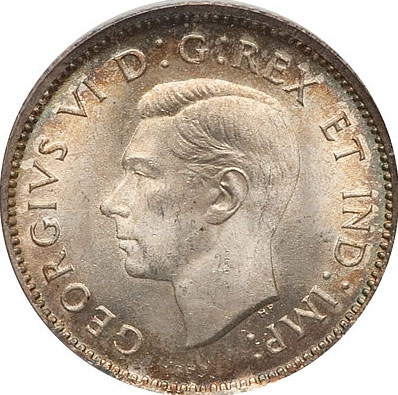
The 1951 Doubled Die Reverse Specimen King George VI 10 Cents coin, struck at the Royal Canadian Mint mint, engraved by (HP) Thomas Humphrey Paget, and made of silver (.800) (.800 silver .200 copper). Weighing 2.33 grams, with a diameter of 18.034 mm, and a thickness of 1.23 mm, and featuring a reeded edge.
The obverse is head of king george vi facing left. . It reads "GEORGIVS VI DEI GRATIA REX
HP". The reverse is the bluenose under sail, a canadian schooner from nova scotia, a celebrated racing ship and a symbol of the province, is surrounded with the face value and the inscription "canada". It reads "CANADA
1948
H
10 CENTS".
What is the 1951 Doubled Die Reverse Specimen King George VI 10 Cents made of?
The 1951 Doubled Die Reverse Specimen King George VI 10 Cents is made of silver (.800) (.800 silver .200 copper), weighs 2.33 grams, and measures 18.034 mm in diameter.
Where was the 1951 Doubled Die Reverse Specimen King George VI 10 Cents minted?
The 1951 Doubled Die Reverse Specimen King George VI 10 Cents was struck at the Royal Canadian Mint mint.