1910 Indian $10 Value
The 1910 Indian $10 is a business-strike issue from the United States, minted in Philadelphia, Pennsylvania. Mintage was 318,500, in line with typical production for the series. Among 1910-dated variants, this is the lowest-mintage strike. Current catalog values range from $1,600 in lower grades to $18,000 in top condition — toward the affordable end of the series; composed of gold (.900) (.100 copper) (16.718 g).
39 collectors own oneScarcer than 51% of the seriesfull ranking →
Your Coins
Sign up to track your coinsTap Add Coin to sign up and start tracking your collection.
About the Indian $10
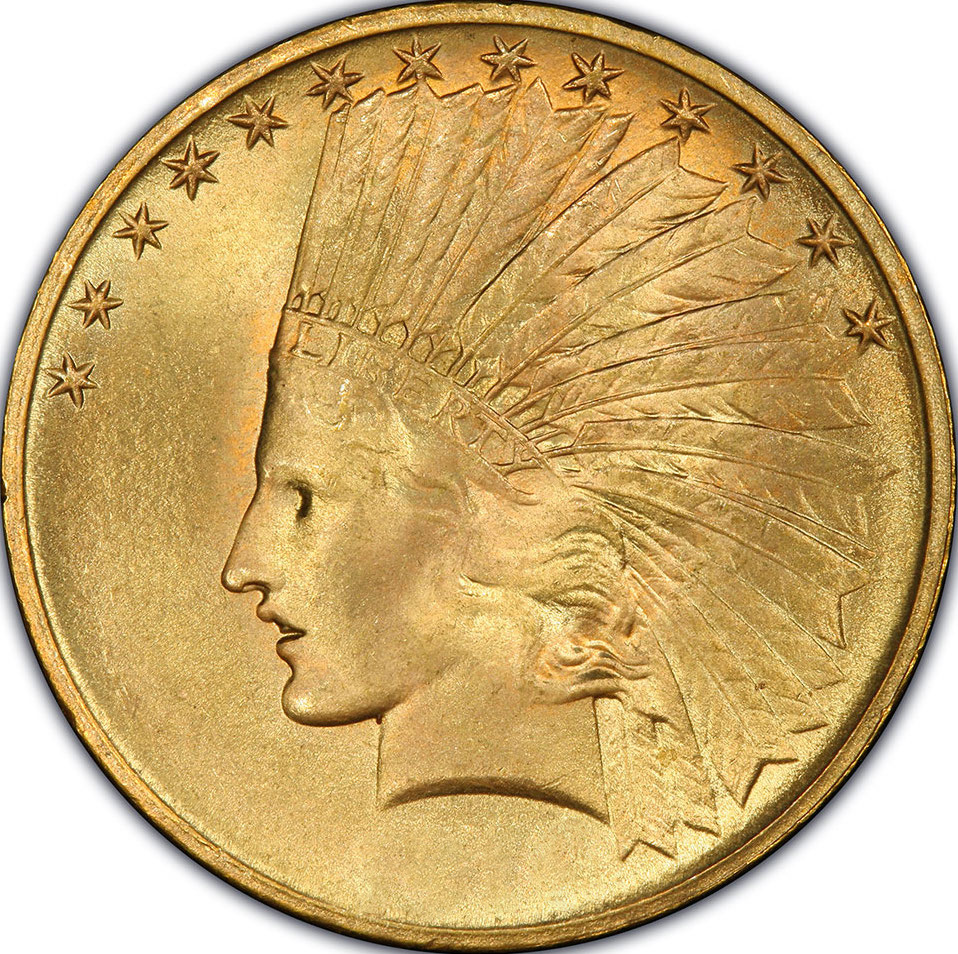
The Indian Head $10 gold coin, first minted in 1907, was designed by sculptor Bela Lyon Pratt and features an indigenous profile on the obverse, with a standing eagle on the reverse. The obverse features an intricate headdress composed of a feathered headdress and a crown of feathers atop a profile of a Native American man. The reverse features a perched eagle facing left, with its wings slightly spread. The coins were minted from 1907 until 1933, when the U.S. government recalled all gold coins.
The history of the Indian $10 coins starts with President Theodore Roosevelt’s vision of a unified U.S. coinage system. In 1906, he commissioned sculptor Bela Lyon Pratt to design a new gold coinage. Pratt was a disciple of renowned sculptor Augustus Saint-Gaudens, whose designs on the Saint-Gaudens $20 double eagle gold coin had given that denomination its iconic look. Pratt took inspiration from Saint-Gaudens’ Native American imagery and designed the Indian Head $10 gold coin for minting in 1907.
In addition to the design, the Indian Head $10 gold coin was also significant for its denomination. The $10 coin had not been widely circulated by the U.S. government since 1804, when the Mint ceased production. When it came back into circulation in 1907, it had a new look, with a unique and captivating design on the obverse.
The Indian Head $10 coin was minted from 1907 to 1933. During this time, there were five variations of the coin that were produced. The most common of these was the Type I, which was produced from 1907 to 1912. This version used Roman numerals “X” and “D” to denote denominations on the reverse. The Type II, which was minted between 1913 and 1915, used Arabic numbers instead of Roman numerals.
The other three versions of the Indian Head $10 coin were minted between 1929 and 1933. These included the Type III, the Type IV and the Type V. All three versions featured a reeded edge and a higher relief for the obverse and reverse design. The Type III used Arabic numbers, while the Type IV and Type V used Arabic numbers in a different format.
The Mint produced more than 17 million Indian Head $10 gold coins from 1907 to 1933. Today, the Indian Head $10 gold coin is highly sought after by collectors and investors, primarily due to its unique design and historical significance. The coin can typically be found in any grade of circulated condition, although uncirculated and proof coins are much scarcer. The PCGS CoinFacts website offers information on the coin’s current value, depending on the coin’s condition.
In conclusion, the Indian Head $10 gold coin, minted from 1907 to 1933, is an iconic numismatic piece with a unique and captivating design. The coin is highly sought after by collectors and investors, primarily due to its unique design and historical significance.
The 1910 Indian $10 coin, has a total mintage of 318,500, struck at the Philadelphia, Pennsylvania mint, and engraved by Augustus Saint-Gaudens. Made of gold (.900) (.100 copper), weighing 16.718 grams, with a diameter of 27 mm, and a thickness of 2.03 mm, and featuring a 1908-1911 46 raised stars 1912-1933 48 raised stars edge.
The obverse is indian head capped with feathered headdress, date below, 13 stars above. It reads "LIBERTY 1908". The reverse is an eagle facing left on a bundle of arrows with olive twigs, motto to left. It reads "UNITED·STATES·OF·AMERICA E PLURIBUS UNUM IN GOD WE TRUST TEN·DOLLARS".
Price by Grade
Unlock all 12 grades| Grade | Price (USD) |
|---|---|
| 20 | $1,600.00 |
| 40 | $1,600.00 |
| 45 | $1,600.00 |
| 50 | $1,600.00 |
| 55 | $1,700.00 |
| 58 | $1,800.00 |
| 60 | $1,800.00 |
| 62 | $1,900.00 |
| 63 | $2,200.00 |
| 64 | $2,500.00 |
| 65 | $9,000.00 |
| 66 | $18,000.00 |
What's it worth melted? See today's $10 Gold Eagle (Pre-1933) melt value →
eBay Listings
No eBay listings found for “Indian $10 1910”.
As an eBay Partner, we may be compensated if you make a purchase.
Specifications
- Type
- Standard circulation coin
- Composition
- Gold (.900) (.100 copper)
- Weight
- 16.718 g
- Diameter
- 27 mm
- Thickness
- 2.03 mm
- Edge
- 1908-1911 46 raised stars 1912-1933 48 raised stars
- Designer
- Augustus Saint-Gaudens
- Currency
- Dollar (1785-date)
Frequently Asked Questions
- What is the mintage of the 1910 Indian $10?
- The 1910 Indian $10 has a total mintage of 318,500.
- What is the 1910 Indian $10 made of?
- The 1910 Indian $10 is made of gold (.900) (.100 copper), weighs 16.718 grams, and measures 27 mm in diameter.
- Where was the 1910 Indian $10 minted?
- The 1910 Indian $10 was struck at the Philadelphia, Pennsylvania mint.
- How many people collect the 1910 Indian $10?
- 39 LuckyCoin collectors currently track the 1910 Indian $10 in their collection.
- How much is a 1910 Indian $10 worth?
- A 1910 Indian $10 is valued between $1600 and $18000, depending on grade and condition.